
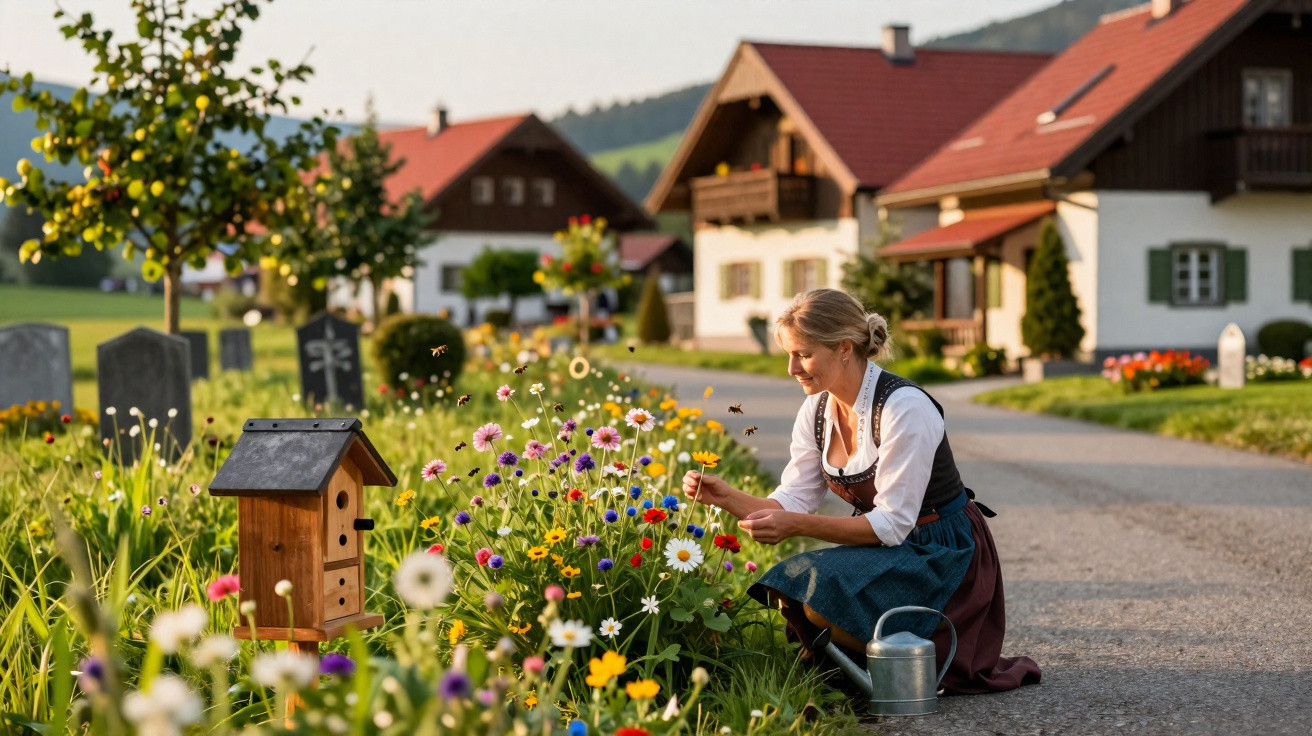
Bees can be seen buzzing around flowers in countless settings, yet an important question is rarely considered: can everyday villages contribute to protecting pollinators? Scientists now think they can.
Small rural communities may sustain considerably more insect life than previously assumed. Gardens, parks and even neglected plots within villages can offer secure habitats for pollinating insects.
The Buzzing Villages research project was created to investigate this possibility. Scientists at Julius Maximilians Universität Würzburg examined pollinating insects in villages across Bavaria, Germany.
Their aim was to discover how village settings support pollinators and how people could make these places more suitable for insects.
Villages can host many pollinators
Pollinating insects, including bees and hoverflies, enable plants to reproduce. A wide range of fruit, vegetables and wild plants rely on them to carry pollen between flowers. Ecosystems and food supplies would find it difficult to survive without pollinators.
Research into pollinators has largely concentrated on farmland, woodland and major cities. Small villages have seldom been studied. Yet villages include a variety of green spaces that are absent from intensively managed agricultural land.
Gardens, cemeteries, small parks and unused land provide a mosaic of habitats where insects can find food and shelter.
The researchers chose to examine this theory in detail, studying 40 villages in northern Bavaria.
Within every village, scientists selected five habitat types: cemeteries, fallow land, public green spaces, farmhouse gardens and gardens at residential homes.
What was found in village habitats
Researchers observed plants and insects in these locations for several months. Fieldwork was carried out from April until August.
Over this period, the scientists walked through the survey plots and logged pollinating insects visiting flowers.
The totals soon proved striking. The team recorded more than 20,000 solitary bees, over 10,000 bumble bees, more than 12,000 hoverflies and more than 10,000 honey bees. These records demonstrated remarkable biodiversity within small villages.
The variety of species also took the researchers by surprise. They documented 208 wild bee species and 56 hoverfly species. Many are rare or threatened, and more than one fifth of the wild bee species found in the study are classified as endangered.
Plants in villages were exceptionally diverse too. Across the study sites, scientists recorded 1,258 species of flowering plants. This range gives insects access to nectar and pollen throughout the growing season.
The role of bright flowers
Colourful flower beds may initially appear to be ideal for pollinators. The team expected the places with the greatest number of flowers to draw the most insects, but the findings suggested otherwise.
“What is particularly surprising is the remarkable diversity of wild bees that could be recorded in village habitats. First impressions can be misleading; the areas with the most colourful blooms are not necessarily those with the greatest species diversity,” said project coordinator Dr. Fabienne Maihoff.
Closer observation offers an explanation. Pollinators seek more than nectar and pollen: they also require places to nest and take shelter.
A garden filled with attractive flowers but lacking nesting opportunities can attract fewer insects than a more modest landscape.
Cemeteries attract fewer pollinators
Cemeteries may seem to offer ideal habitats for insects. Flower beds are common and numerous plants bloom over the season. Nevertheless, the study found that cemeteries supported fewer pollinators than anticipated.
This pattern is largely explained by human management. Lawns are often mown regularly and natural vegetation is cleared away. Plants are also commonly chosen for their decorative appearance, rather than their ecological usefulness.
“Cultivated roses of the genus Rosa with double blossoms, as well as lilac (Syringa) and heather (Erica), may look attractive but are not appealing to bees and hoverflies,” noted Dr. Maihoff.
Many ornamental flowers offer very little nectar or pollen. In some cultivated varieties, dense layers of petals conceal the pollen, making it difficult for pollinators to obtain food.
Nesting opportunities present another problem. Pollinating insects depend on natural features such as exposed soil, plant stems and small openings in the ground. Intensively managed cemeteries rarely retain these features.
Wild areas support insects better
While examining the various village habitats, the team made an interesting observation. Some of the places that were most welcoming to insects looked rather unremarkable. Fallow land and straightforward green spaces frequently supported substantial numbers of pollinators.
Such areas generally contain naturally occurring vegetation. Native plants can grow when mowing is less frequent, allowing wildflowers including thistles and scabious to emerge without deliberate planting.
“Native wildflowers such as species of Knautia (scabious) or Cirsium (thistles) can thrive here. These are particularly valuable for pollinators,” said Dr. Maihoff.
These natural settings help pollinators in several ways. Wild plants supply nectar and pollen, while bare soil creates nesting places for bees that make nests underground. Reduced disturbance also enables insect populations to increase.
Surrounding landscapes also matter
Village habitats are not separate from their surroundings. The landscape around a village has a strong effect on the pollinator communities found within it.
Semi-natural environments, including woodland, grassland and hedgerows, supply further sources of food and nesting sites. They function as source areas, where pollinator populations develop before spreading to nearby villages.
The researchers found that solitary bee diversity rose when villages were surrounded by a greater amount of semi-natural habitat. Landscapes with more natural areas enabled numerous bee species to prosper.
Bumble bees responded somewhat differently. Where landscapes contained abundant natural habitats, bumble bees often favoured those areas rather than village environments. When natural habitat was limited, villages became important places for feeding.
Gardens can make a real difference
People living in villages can help pollinators through straightforward measures. Even a small garden can become a valuable habitat when suitable plants and management approaches are chosen.
The study recorded more than 38,000 pollinator visits to flowers. Certain plants were particularly popular with insects, with lavender, clover and borage serving as favoured nectar sources for bees.
Other plants were visually attractive but had limited ecological value. Double-petalled roses, lilac and heather received very few visits from pollinators.
Letting some wild plants grow can benefit insects as well. Plants often described as weeds can provide bees and hoverflies with excellent nectar and pollen.
Hidden potential for biodiversity
The Buzzing Villages project demonstrates that small rural settlements can sustain diverse pollinator communities.
Gardens, parks, fallow land and other spaces within villages can serve as important insect habitats.
Straightforward changes in management can enhance these environments. Mowing less frequently gives wildflowers time to bloom.
Exposed patches of soil offer nesting locations for many bees, while a varied selection of flowering plants provides nectar and pollen across the growing season.

Comments
No comments yet. Be the first to comment!
Leave a Comment