
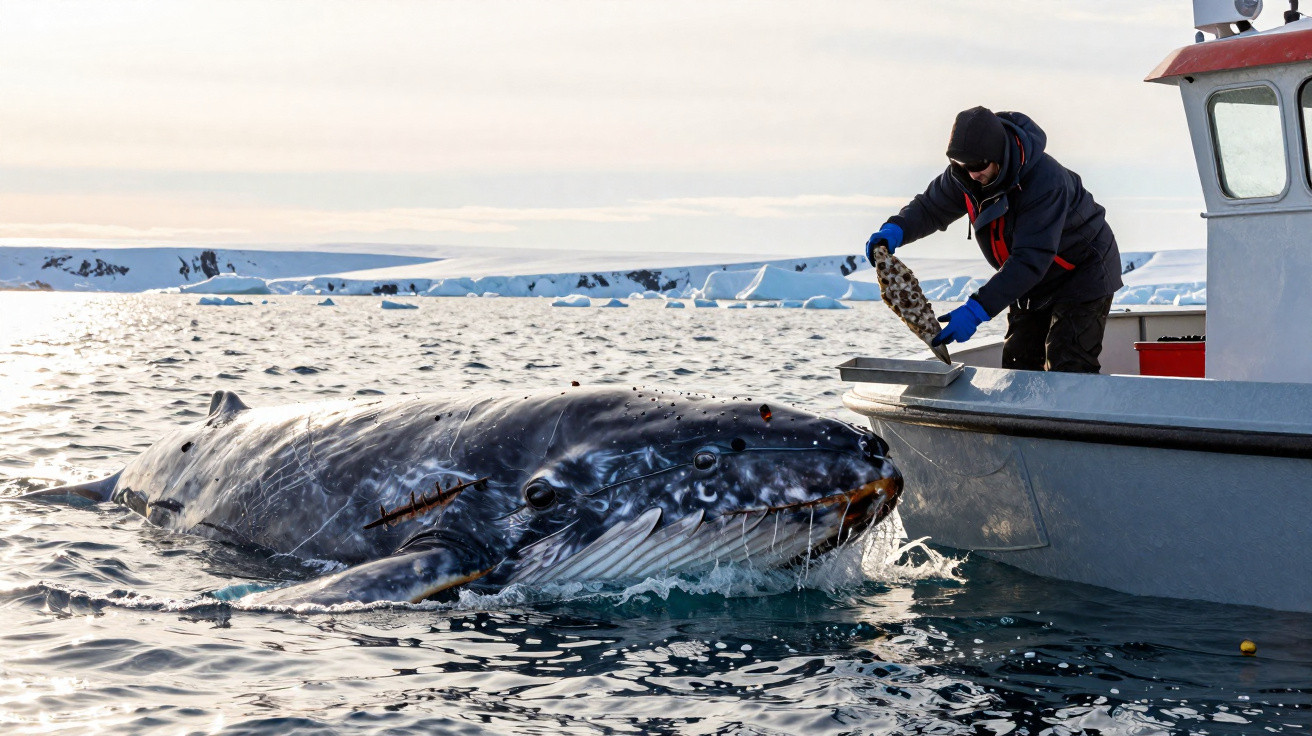
A bowhead whale swimming through the Arctic today could, in theory, have been born before the start of the American Civil War in 1861. The species Balaena mysticetus has an exceptional lifespan among mammals: chemical analyses of its eyes indicate that some individuals are more than 200 years old, while 19th-century hunting weapons found embedded in whales provide striking physical evidence of this ability.
How did scientists discover that bowhead whales live beyond 200 years?
Establishing the age of these cetaceans is challenging because they lack some of the structures used to count annual layers in other species. In a study of eye lenses, researchers used aspartic acid racemisation, a chemical process that takes place gradually throughout life. Several of the animals examined were more than a century old, and later estimates placed one male at around 211 years old.
What did 19th-century harpoon fragments reveal?
The most intriguing evidence did not come from the laboratory alone. Hunters found objects inside captured animals that had remained in their bodies for decades. Documented discoveries include several artefacts linked to historic Arctic whaling:
- stone and ivory points recovered from animals killed in Alaska;
- metal fragments from old whaling weapons;
- an explosive lance found in a whale captured in 2007;
- another similar fragment recovered from a female in 1980.
The 2007 discovery was particularly informative. The object matched a model patented by Ebenezer Pierce in 1879 and replaced by a different version in 1885. Researchers considered it likely that the weapon had been used during the 19th century, suggesting that the animal survived the injury for more than a century before being caught.
Could a living bowhead whale really predate the American Civil War?
Yes, this is biologically possible, although it does not mean that an individual alive today has had its age definitively verified from that period. The American Civil War began in 1861; a whale born before that year would now be more than 165 years old, an age that falls within estimates already established for the species. The evidence supports the possibility, rather than identifying a particular animal with that history.
What allows such a large mammal to age for two centuries?
The species' longevity has also become the subject of cellular research. A study published in 2025 found that these animals' cells have especially effective mechanisms for repairing DNA damage, which is important for a huge organism that accumulates cell divisions over two centuries. Notable findings included:
- a greater capacity to repair DNA double-strand breaks;
- a lower frequency of certain mutations after repair;
- greater accuracy in mechanisms responsible for reconnecting broken sections of the genome;
- high expression of the CIRBP protein, which researchers associated with maintaining genetic stability.
These mechanisms do not, by themselves, prove why the animal lives for so long, but they help explain how a mammal that can exceed 80 tonnes keeps its tissues functioning over such extended periods. The combination of age studies, genetics and historical artefacts has made this whale an unusual model for investigating ageing and resistance to illnesses linked to the passage of time.
Ancient harpoons made longevity a visible story
The strength of these findings lies in their temporal contrast. A metal point made when whaling ships still travelled across the Arctic remained lodged in the body of an animal that continued to grow and swim through generations of humans. The fragment recovered in 2007 belonged to a technology patented in 1879 and already regarded as outdated only a few years later.
The bowhead whale therefore brings together chemical, biological and historical evidence of a life that may span more than two centuries. Some individuals may have shared the ocean with 19th-century vessels, survived historic commercial hunting and reached an era of satellites, genetic sequencing and aerial monitoring of the Arctic - a timescale with virtually no parallel among known mammals.





Comments
No comments yet. Be the first to comment!
Leave a Comment