
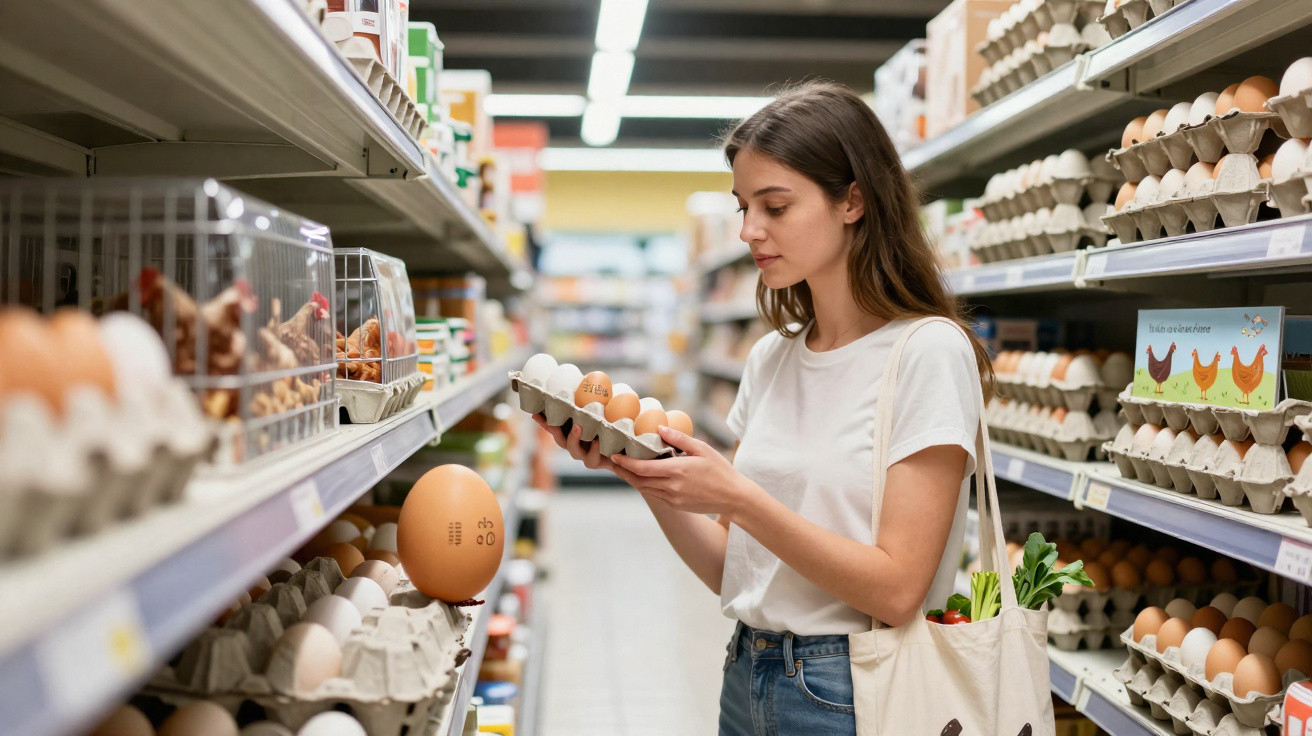
Behind the egg cartons, however, lies a far more complex reality.
While many supermarkets have promoted animal welfare and responsible shopping for years, a fresh look at their shelves reveals a different picture. Despite high-profile pledges to end cage farming, large numbers of eggs still come from hens that spend their lives confined in cramped cages.
Broken promises? What the new investigation reveals
In January 2026, animal-protection organisation Anima and the Data for Good data collective visited 386 French supermarkets and hypermarkets. Their aim was to establish whether major retail chains were honouring their commitment to stop selling cage eggs.
The result: at least one pack of eggs from caged hens was on sale in 73% of the stores surveyed.
This means the proportion of supermarkets selling cage eggs remains unexpectedly high. On paper, almost all major chains had pledged years ago to phase out cage farming completely from the start of 2026, including for their own-label products.
The reality appears more complicated. The findings show substantial differences between individual chains:
- Only around 3.6% of Monoprix branches still sold cage eggs.
- At Carrefour and E.Leclerc, more than 80% of stores stocked cage eggs.
- At Système U, Auchan and Lidl, the figure exceeded 90%.
For shoppers, this creates a contradictory impression: anyone familiar with the advertising campaigns would expect very different figures. The investigation demonstrates how wide the gap remains between announcements and what is actually sold.
From 51 to 14%: the long move away from cages
Despite the criticism, the market has shifted noticeably in recent years. France's Itavi research institute puts the share of cage eggs in grocery retail at:
| Year | Share of cage eggs in retail |
|---|---|
| 2016 | 51% |
| 2025 | 14% |
The 14% figure is considered historically low, but it also shows that cage farming has not disappeared. Looking at hen places in production systems, in particular, underlines how slowly farming is changing. Industry data indicates that the proportion of hens kept in cages fell from roughly 67% of the flock in 2016 to around a quarter today.
The sector is targeting approximately 90% cage-free production from 2030. Until then, there is a transition period in which retailers, farmers and policymakers often have to make decisions under time pressure.
Supermarkets under pressure: animal welfare versus price
Why do cage eggs remain on shelves when most chains have announced their exit? In response to questions, several retailers point to supply-chain bottlenecks. Demand for barn, free-range and organic eggs has grown faster than production capacity.
Cage-free production is not progressing at the same pace in every region, while egg consumption remains consistently high.
According to industry figures, per-capita consumption in France reached around 237 eggs a year in 2025. This number includes both fresh shell eggs and eggs processed into food products.
Supermarkets are therefore caught between two pressures. On one hand, public demand for better animal welfare is increasing. On the other, many customers expect low prices, particularly at a time when food costs have generally risen. Cage eggs usually remain the cheapest choice on the shelf.
France, Poland, no Ukrainian eggs: where cage eggs come from
One notable finding from the investigation concerns the origin of cage eggs. In 95% of cases, the cage eggs identified were produced in France. Just one major chain stands out: Lidl regularly offered imported cage eggs, mainly from Poland.
The debate about cheap imports from Eastern Europe therefore also applies to eggs. At the same time, the investigation's authors stress that they found no eggs from Ukraine, an issue made sensitive by the war in Ukraine and discussion surrounding agricultural imports.
How to identify cage eggs reliably in the supermarket
Anyone wishing to avoid cage farming does not need to rely on marketing claims. The most reliable clue is printed directly on the egg, rather than appearing only on the packaging. Every egg bears a stamp with a number from 0 to 3.
The code on the shell and what it means
- 0 – Organic: hens are kept in line with organic standards, have outdoor access and receive organic feed.
- 1 – Free range: hens can go outdoors, while the hen-house space allowance is tighter than in organic systems.
- 2 – Barn: birds move freely inside the hen house but have no outdoor access.
- 3 – Cage farming: hens spend their lives in cages or enriched colony systems.
Avoiding code 3 means avoiding cage farming, regardless of the marketing on the pack.
This code is standardised across the EU. It can therefore be used when shopping on holiday or living near a border. In practice, it is simple: open the pack, take out an egg, read the stamp and, if necessary, choose another pack.
The blind spot: processed eggs in cakes, pasta and ready meals
One aspect easily overlooked in daily life is that around 35% of eggs consumed in France are not bought as shell eggs. Instead, they are used as so-called ‘egg products’ in other foods, including:
- industrially produced cakes and biscuits
- fresh and dried pasta
- ready meals and frozen food
- mayonnaise and some sauces
In these products, the production system is often not immediately apparent. The ingredients list may simply state ‘egg’, ‘whole egg’ or ‘egg powder’. Many cage eggs still end up in this category because they are cheaper for manufacturers.
Those wishing to make their own consumption more animal-friendly can act here: buy fewer highly processed foods, bake more often at home, or choose brands that explicitly avoid cage eggs and label this transparently.
Dispute over the figures: retailers versus animal-protection groups
The dispute does not end at the shelf. Some retail chains openly challenge the investigation's methodology. Carrefour, for example, firmly rejects the findings and criticises Anima's analysis.
Retail chains and animal-protection organisations are locked in a dispute over counting methods, samples and definitions, while customers face fully stocked shelves.
Other checks are also taking place in the background. France's consumer-protection authority, the DGCCRF, is examining whether labelling is accurate and whether product claims match reality. National legislation surrounding the so-called EGAlim law, which seeks greater fairness in the agricultural sector, also applies.
Europe joins in: End the Cage Age and new laws
The debate over cage eggs is no longer confined to France. At EU level, the ‘End the Cage Age’ citizens' initiative is increasing political pressure. It calls for an end to cage farming for a wide range of farmed animal species across Europe.
The European Commission is working on legislative proposals that include rules affecting laying hens. Depending on how strict those rules become, supermarkets and producers will have to make major changes to their systems in the years ahead. Many farms face investment decisions that will bind them for decades.
What cage farming means in practice
The term ‘cage farming’ may sound abstract, but it describes a highly physical everyday existence for millions of animals. Hens live in tight metal enclosures, often with only a few square decimetres of space each. Modernised ‘enriched colony cages’ may include perches and nesting areas, but freedom of movement remains restricted.
Moving to barn or free-range systems does not resolve every animal-welfare issue, but it significantly reduces certain pressures: more movement, more opportunities to retreat and, in some cases, outdoor access. At the same time, disease risks and production costs rise, making hen-house planning more complex.
Practical strategies for shoppers
Anyone who wants to avoid cage eggs consistently in everyday life can take three steps:
- Always check the code on the shell in the supermarket and leave packs marked ‘3’ on the shelf.
- For processed foods, favour brands that clearly state ‘cage-free eggs’ or ‘free-range/organic eggs’.
- Question overall egg consumption: does it need to be an egg every day, or could it be less frequent but of better quality?
A realistic example is someone who mainly buys cheap cakes, frozen pizza and discount pasta. In many cases, they will be consuming cage eggs indirectly, even if only code 0 or 1 eggs go into their basket from the egg aisle. Even small changes to a shopping basket can therefore alter demand within the supply chain.
Risks and opportunities for retail and farming
For supermarkets, the issue remains sensitive. Leaving cage eggs behind too early risks empty shelves or sharp price rises. Acting too late can damage a retailer's reputation among a growing group of customers who shop consciously.
For farmers, conversion brings substantial costs. New hen houses, different feeding practices and stricter inspections are viable only if farms receive a fair price over many years. If imported products from countries with lower standards enter the market too cheaply, this model becomes unstable.
At the same time, opportunities are opening up. Higher-value eggs, regional brands and transparent farming systems can be marketed more effectively. Producers that move early into free-range or organic farming and can supply reliably may secure long-term contracts with retail chains and become less dependent on short-term price fluctuations.


Comments
No comments yet. Be the first to comment!
Leave a Comment