
If you spend every summer day rushing around the garden with a watering can yet still harvest limp tomatoes and lettuce leaves chewed by slugs, you will know the frustration. Water is becoming more expensive, time is in shorter supply, and the soil still never seems to retain enough moisture. Meanwhile, countless small parts from drinks bottles are casually thrown away, even though they can become discreet helpers for a more relaxed gardening routine.
How small bottle leftovers became a secret vegetable garden trick
The principle is straightforward: every drinks bottle has a cap, and that cap usually ends up in the bin. Plastic and cork caps are made from materials that largely withstand moisture and sunshine, making them ideal for reuse in the vegetable garden. Anyone who regularly drinks wine, juice or water from bottles will accumulate dozens of these small cylinders over the course of a year without giving them a second thought.
These inconspicuous items can be turned into a minimal watering system that delivers water to the roots one drop at a time. They can also help keep an army of hungry slugs at a distance while protecting sensitive plant bases.
“A disposable item becomes a useful aid: bottle leftovers can save water, protect plants and keep slugs away – without any high-tech equipment.”
Why plastic bottle caps make ideal mini irrigators
Plastic is durable, does not rot in the soil, and copes well with both damp conditions and sun. These qualities make a bottle cap an effective water regulator.
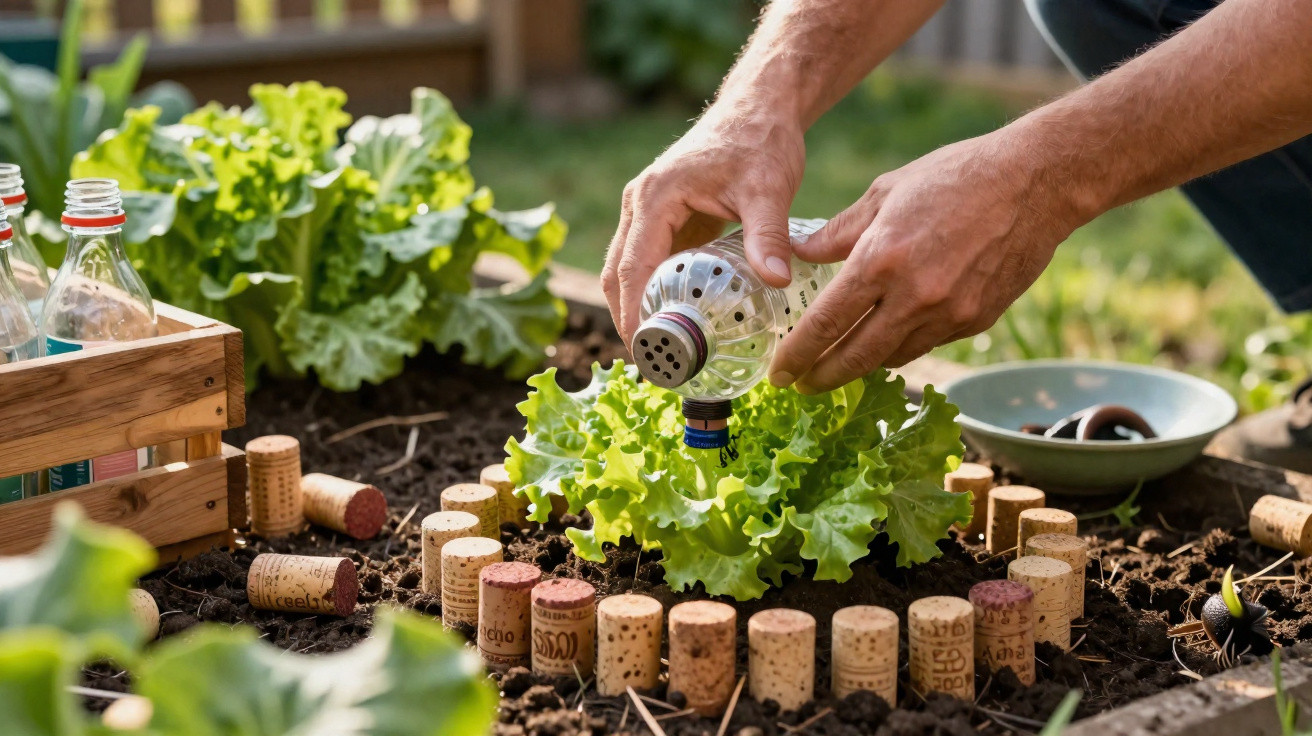
The result is simple: if a small hole is made carefully in the cap and it is screwed back onto a filled bottle, the setup becomes a drip-irrigation system. Rather than running away across the surface of the soil, the water slowly seeps into the root zone.
- The soil surface stays comparatively dry, reducing evaporation.
- The leaves remain dry, which lowers the risk of fungal diseases.
- Roots receive small, steady amounts of water, encouraging deeper root growth.
This is particularly suitable for thirsty crops such as tomatoes, courgettes and aubergines. They do not cope well with alternating extremes of waterlogging and drought stress; instead, they need consistent soil moisture.
How to make a simple drip system from a bottle
A small homemade drip-irrigation system requires very little equipment. Most of what is needed is likely to be in the kitchen or toolbox already.
Materials needed
- 1 plastic bottle (500 ml for young plants, 1–1.5 litres for large vegetable plants)
- a matching cap
- a thin nail or needle
- a lighter for heating the tip
- a craft knife or sharp knife
Step-by-step instructions
- Briefly heat the tip of the nail with the lighter so that it pierces the plastic cleanly.
- Make a small hole in the centre of the cap. Do not twist; press gently instead, so the hole remains as round as possible.
- Fill the bottle with water and screw on the cap.
- Test it over the sink: ideally, one drop should fall every two to three seconds. If the water runs too quickly, use a new cap with a smaller hole.
- Cut off the bottom of the bottle with the craft knife. This makes it easy to refill from the top later.
In the bed, place the bottle in the soil with its neck pointing downwards. Dig a hole around 10 to 15 centimetres from the plant, bury the bottle neck 5 to 10 centimetres deep, then firm the soil back around it. This keeps the arrangement stable and directs the water into the root area.
“One refill a week in spring, and every two to three days at the height of summer – this system generally requires no more work than that.”
How cork leftovers retain water and disrupt pests
While plastic is especially useful for precisely controlling water delivery, cork offers different benefits. It is light, porous and absorbs moisture like a small sponge. When the surroundings become dry, it gradually releases that moisture back into the soil.
Cork also contains natural substances whose scent some insects dislike. Ants, certain types of midge and aphids can be partly disrupted by it. In the vegetable garden, a thin ring of cork around vulnerable plants is often enough to make the area slightly less appealing.
Cork has another advantage: it is a poor conductor of heat. When pieces are used as a mulch layer on the soil, the ground does not heat up as intensely and temperatures around the roots remain more stable. This can noticeably reduce stress on plants during summer, when the sun can scorch the soil.
More than irrigation: creative uses in the vegetable garden
Once you start using bottle leftovers, you will quickly find other ways to put them to work in the bed.
Lure slugs away instead of poisoning them
A classic organic-garden approach is to use small traps containing beer or sweet syrup, which attract slugs. Rather than setting out large bowls, cut plastic pieces can also be used as miniature dishes. Set into the soil and positioned around vulnerable crops such as lettuce, they act as an attraction point for these hungry molluscs away from the young leaves.
Visible, safer support canes
Pointed bamboo canes and metal rods in a growing bed can be hazardous, especially amid knee-high dense foliage. Fitting small plastic pieces over their tops makes the ends easy to see and considerably less dangerous. It is a quick step that can prevent bruises, scratches and painful knocks to the eye.
Cork as a barrier and drainage aid
Broken-up cork can be scattered around delicate young plants. Its rough surface is unpleasant for slugs and some species of slug, so they are more likely to avoid the area. Container gardeners can use it in another way too: placing several pieces as a drainage layer at the base of a pot helps water drain away while stopping compost from washing through the hole.
- large pieces: a barrier against slugs and protection for the soil surface
- medium-sized pieces: a mulch layer that retains moisture
- small crumbs: mixed into growing medium for better aeration
How much water use can really be reduced
Anyone switching from conventional watering with a watering can or hose to drip irrigation will generally notice a difference after only a few weeks. The soil around the roots stays moist for longer, while the surface dries more quickly. This cuts evaporation and makes conditions more difficult for many weeds.
There is a practical benefit too: the daily round with the watering can is no longer necessary. This can be crucial for people in work or during short holidays, preventing the vegetable garden from drying out within a few days. Installing several bottles in each bed distributes the water evenly rather than flooding isolated spots.
In sandy soils, a slightly faster flow is advisable so that a cone of moisture forms around the root zone. Heavy clay soils need only a very small hole because water spreads more slowly. At first, it is worth checking more often to see how far the moisture is penetrating downwards.
What to watch for – and where the trick reaches its limits
Despite all its advantages, this approach is no substitute for basic garden care. During very wet periods, the soil does not need extra drip irrigation or waterlogging may result. In such conditions, simply leave the bottles empty or remove them temporarily.
The system also has limits in very large areas. Anyone watering dozens of square metres is better off using professional drip hoses. For a typical family garden, several raised beds or a balcony with containers, however, the bottle solution is often entirely sufficient.
It is important to inspect the bottles regularly: algae, soil and small insects can block the hole. A quick rinse under running water solves the issue. If the same parts are used over several seasons, a more thorough clean in autumn is worthwhile.
Why it can be worth viewing “rubbish” differently in the garden
Using bottle leftovers in the vegetable garden is more than simply a money-saving trick. It changes the way everyday items are viewed. Something that would automatically have gone into the bin yesterday can now save water, protect plants and reduce work.
Many small aids from daily life can be repurposed in similar ways: old wooden sticks as plant markers, broken buckets as planters, or worn-out kitchen towels as frost protection over vulnerable young plants. Once you begin, you will soon find your own variations to suit your gardening style.
At a time of rising water prices, every method that conserves resources while improving harvests is worthwhile. Just a few unassuming bottle leftovers can be enough to make the hottest weeks of the year far more manageable in the vegetable garden, with stronger plants and considerably less slug damage.
Comments
No comments yet. Be the first to comment!
Leave a Comment