
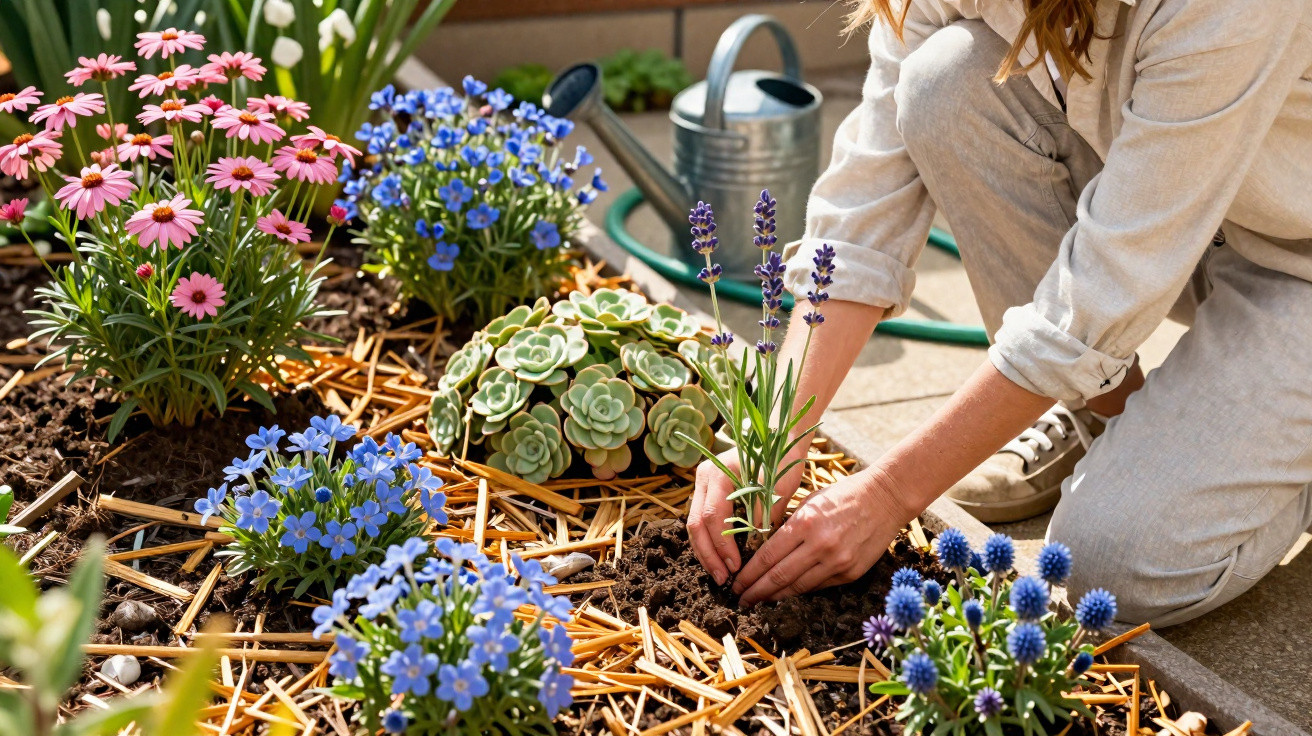
Increasingly hot summers and local water restrictions are changing the rules of gardening. Rather than thirsty displays of flowers, resilient plants and a well-chosen planting date now matter most. Those who act by the end of March and choose particular perennials can prepare a border that will need little more than rainfall.
Why the end of March is the decisive deadline for your perennial border
Spring determines whether a garden can cope through July and August without constant watering. The period up to around 31 March represents a biological turning point: most perennials emerge from winter dormancy, sap begins to flow and soils are still well supplied with moisture.
Planting now takes full advantage of these conditions. The ground is cool and damp, giving young roots time to establish themselves deeply before the first hot spell arrives. Once temperatures later rise above 25 degrees, newly planted specimens face two challenges at once: recovering from transplanting stress while also coping with dry conditions.
The secret to a summer with minimal watering lies less in “dry” varieties than in getting the planting timing exactly right.
Perennials planted early develop fine root hairs before conditions become demanding. This leaves them far better able to cope when rain fails to arrive. It is therefore not simply a matter of decoration, but of sound plant biology.
Five long-flowering perennials that thrive in heat and withstand drought
For a genuinely low-maintenance, drought-tolerant border, choose so-called “camel” perennials now: plants that either store water or root especially deeply. Five species have proved particularly dependable in the Central European climate.
Perovskia – an airy cloud of mist for a sunny border
Perovskia, often called Russian sage, combines delicate silvery-grey foliage with fine blue-violet flower spikes. Its grey leaves limit evaporation, while the plant copes exceptionally well with poor, stony ground.
- Position: full sun, including very hot spots
- Soil: relatively poor, free-draining and ideally mineral-rich
- Care: cut back hard in early spring, after which it will regrow strongly
Planting Perovskia in groups creates a light, almost Mediterranean look, without the need for daily watering.
Sedum ‘Autumn Joy’ – water storage in every leaf
The familiar stonecrop cultivar ‘Autumn Joy’ stands out for its thick, succulent leaves. These retain water like a sponge, making it a reliable choice for hot positions. Later in the year, it delivers another striking display with dense, rusty-red flower heads.
This autumn favourite attracts bees and butterflies while many other perennials are already looking tired. Once established, Sedum needs very little water, provided the soil does not become waterlogged.
Gaura lindheimeri – dancing butterfly flowers
Gaura appears as though a swarm of delicate butterflies is hovering over the border. Its countless fine flowers are carried on flexible stems that sway in even the gentlest breeze. Beneath the soil, a powerful taproot draws on moisture held deeper down.
That root is precisely what makes it so robust. If Gaura has enough time to root before the first high summer, it will later need hardly any help from the watering can.
Echinops ritro – the bold blue globe thistle
Echinops, the globe thistle with metallic-blue spheres, favours dry soils, including those rich in lime. Once established, it endures heat and dry spells with almost stoic resilience. Its distinctive shape gives the border structure even when other plants temporarily struggle.
Globe thistle is particularly suited to the back of a border, where its firm stems and striking globes provide a strong framework.
Lavender – a classic with exacting soil requirements
Everyone knows lavender, yet many gardeners make the same mistakes: soil that is too wet and winter waterlogging. With excellent drainage and a sunny position, however, it becomes one of the easiest plants to maintain in the garden.
Well-rooted lavender requires almost no additional water in a typical summer. It only needs occasional help during its planting year; afterwards, pruning and good air circulation are the main priorities.
Gardening tip: Geranium as the quiet problem-solver
Alongside these five key plants, it is worth considering robust perennial cranesbill varieties. Many Geranium types need no frost protection, grow in both sun and partial shade, and will tolerate most soils.
Geranium can often fill awkward garden spaces with little fuss, particularly beneath lightly branched trees, beside walls or around border edges. In most cases, cutting back or removing dry material towards the end of winter is all the care required.
How to plant in March so the watering can stays in the shed
The planting date is only half the battle. Anyone planting by 31 March should take a deliberate approach so that perennials do not wilt at the first peak of summer heat.
- Water the rootball: immerse the pot-grown rootball in water for around 15 minutes, until no more air bubbles rise.
- Make generous planting holes: dig each hole at least three times as wide as the pot and loosen the surrounding soil.
- Improve heavy soils: mix around 20 per cent coarse sand or grit into loam or clay soils.
- Initial watering: give each perennial around 10 litres of water immediately after planting, even if it is raining.
- Roughen up the roots: lightly score the rootball so fresh roots can grow more readily into the surrounding soil.
- Use mineral mulch: apply a mulch layer of around 7 centimetres of gravel or lava rather than bark mulch.
Anyone who waters thoroughly once at planting time saves hundreds of litres of watering later on – especially during the first summer.
A practical comparison makes this clear: a Gaura planted into dry soil in mid-May can quickly require water every two days during hot July weather. Over the year, that can amount to well over 200 litres more than a properly planted March specimen needs.
Too late? How to save an April planting
Many amateur gardeners only really get going around Easter. Missing March does not mean abandoning the idea of a summer without watering altogether, but it does call for more realistic planning. From April onwards, evaporation rises in many regions and soils dry out more quickly.
Planting in April, or even early May, can still work if you expect emergency watering in the first year and optimise the site consistently:
- favour bright, fully sunny positions
- loosen heavy soils with mineral material and sand
- always apply a mineral mulch layer
- monitor especially carefully during the first hot spells
A clear, simple layout is worthwhile: place tall perennials such as Echinops and Perovskia at the back, Gaura and Sedum through the middle, and lavender around the edge. Individual Geranium cushions can fill the gaps between them. The result is a calm but lively border, which can be reshaped with one maintenance cut in late winter.
Why drainage, mulch and plant choice matter more than daily watering
Anyone wishing to conserve water over the long term should view the soil as a storage system. A well-drained, slightly mineral growing medium prevents winter waterlogging while still allowing deeper layers to retain moisture. Perennials then “learn” to send roots downwards instead of becoming reliant on surface watering.
Mineral mulches made from gravel or lava reflect heat, reduce severe drying at the surface and create a microclimate directly around the root zone. Unlike bark mulch, they do not draw nitrogen from the soil and are much better suited to plants that enjoy drought.
Gardeners who consciously choose these structures will notice the difference as early as the next hot summer: while neighbours are juggling hoses, their own border will generally need only a few carefully targeted waterings – and many perennials will manage without any at all.

Comments
No comments yet. Be the first to comment!
Leave a Comment