
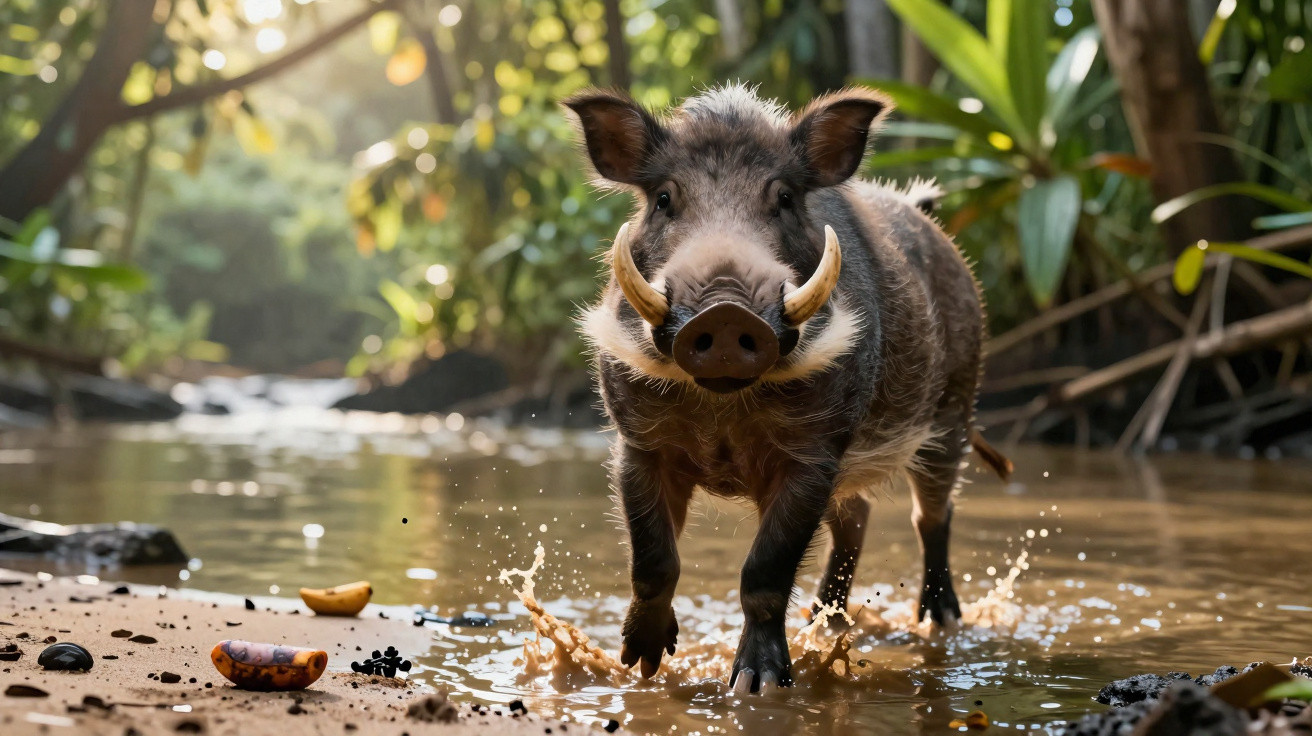
Among the world’s most unusual wild pigs, the babirusa stands out even before it opens its mouth. In males, two upper canines grow so extraordinarily that they pierce the skin of the snout, point upwards and then curve backwards, sometimes progressing towards the animal’s own head.
What animal is the babirusa?
The babirusa is a wild pig found on Indonesian islands, best known for a feature that is almost impossible to overlook. Its body resembles that of other pigs, yet adult males develop long canines that appear to emerge from the upper part of the snout.
These teeth give the animal such a distinctive look that they are often likened to horns. That appearance is misleading, however: they are genuine canines, continuing to grow along an extraordinary path that is entirely unlike the tusks of most wild pigs.
How do babirusa teeth pierce the snout?
In males, the upper canines begin growing in an unusual direction until they break through the skin on top of the snout. Once visible on the outside, they keep lengthening and curve backwards, creating arcs that may extend ever closer to the forehead.
This growth does not mean every individual ends up with enormous tusks. They can wear down or break during the animal’s lifetime. If that does not happen, though, the curve may continue to develop, producing the striking impression of teeth growing back towards the animal itself.
Are these huge tusks used for fighting?
It would be reasonable to assume that such conspicuous structures are the males’ main weapons. Behavioural observations, however, make that explanation less straightforward. The upper tusks are comparatively delicate and do not seem well suited to withstand heavy impacts in confrontations.
Questions remain over all the roles played by these canines, and several possibilities are still considered. What makes the babirusa particularly intriguing is the contrast between the threatening appearance of its tusks and the way males have been observed competing with one another:
- The upper canines pass through the skin of the snout and keep growing outside it.
- The tusks curve backwards and may progress towards the forehead when they are not worn down.
- The upper teeth do not appear to be especially robust structures for violent fights.
- Males have been seen standing on their hind legs and striking rivals with their forelegs.
Watch the video shared by the YouTube channel ANIMAL TV, showing the animal with teeth that grow until they pierce its own skull.
Why do babirusas appear to be boxing?
During some disputes, males may rise onto their hind legs and use their forelegs against an opponent. The movement creates a scene resembling two animals “boxing”, quite unlike the clash of interlocked tusks that the babirusa’s anatomy might initially suggest.
This does not mean the teeth never play a part in interactions between the animals, but it indicates that the large upper tusks are not necessarily their main weapon. Their precise purpose may involve display, competition or other factors that continue to interest researchers.
Why is this wild pig so surprising?
The babirusa combines two seemingly contradictory traits. On one hand, it has canines capable of breaking through its own skin and forming vast curves over its head. On the other, its confrontational behaviour can see males rely on their forelegs rather than turn these remarkable tusks into their primary weapons.
The next time an animal’s appearance seems to reveal precisely how it survives or fights, it is worth looking again. The babirusa shows how evolution can create spectacular structures whose role is not as obvious as it appears, while still leaving unanswered questions behind one of nature’s strangest sets of teeth.



Comments
No comments yet. Be the first to comment!
Leave a Comment