
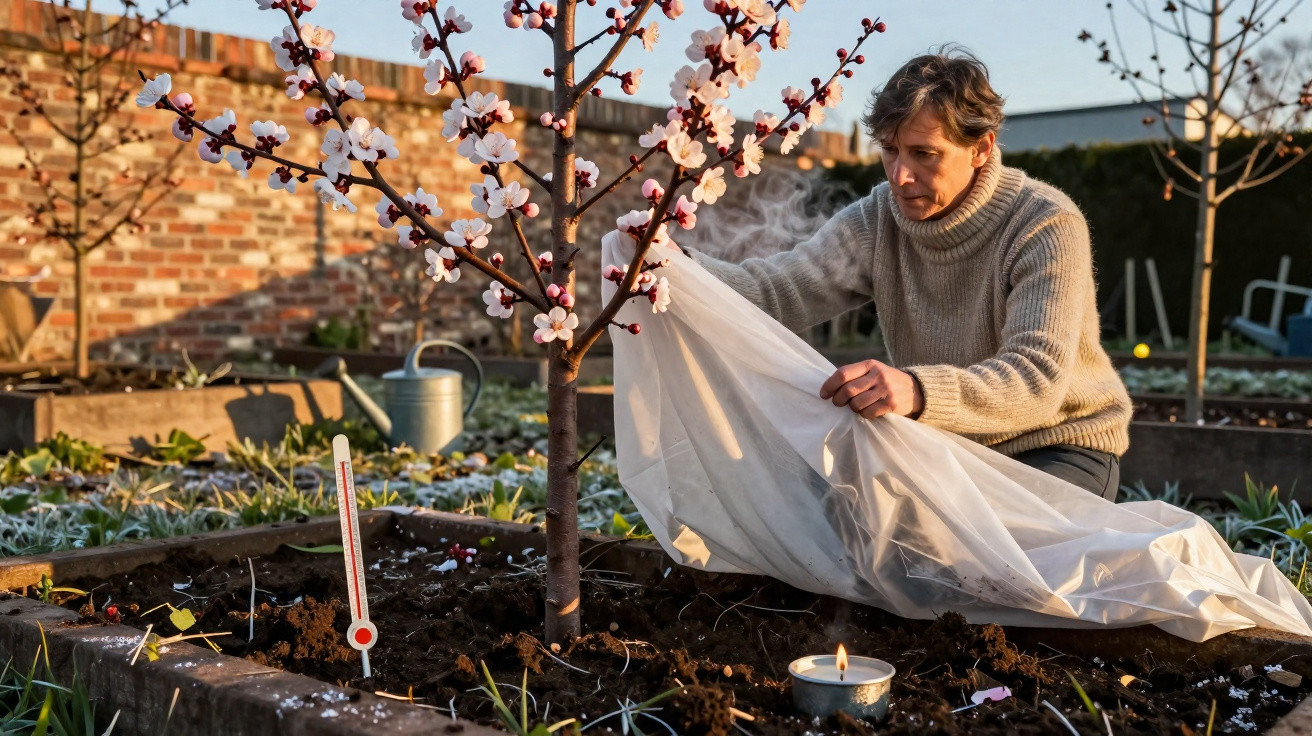
A very brief overnight temperature drop can wipe out an entire crop, just when the trees appear to be growing strongly again.
Mild days at the end of winter often create a misleading sense of safety. Buds swell, the first blossoms draw pollinating insects, and new shoots emerge. Then, during the night, a cold air mass moves in. By morning, petals have turned brown and no fruit will develop. A few straightforward measures can reduce the damage, provided they are taken before the early hours of the morning.
Why a cold night becomes risky in spring
An apple or pear tree can withstand severe cold during winter. At that time, it is dormant: sap movement is limited and its tissues cope better with sub-zero temperatures. That changes once growth resumes.
At bud burst, when the scales begin to part and the first green parts of the bud become visible, damage may occur between -2 °C and -4 °C, depending on the species. Once a flower has opened, it becomes substantially more vulnerable. Temperatures from -1.5 °C to -3 °C may already destroy its reproductive organs.
“The temperature shown by a weather app is not always enough: close to the ground, the air may be noticeably colder than at the height where the reading is taken.”
Newly set fruit is vulnerable too, and can be damaged from -0.5 °C. Apricot, peach, cherry and almond trees are often affected first because they flower early. Late-flowering apple and pear trees sometimes have a little more leeway, but they are not immune.
Fleece: protection to put in place before sunset
For small trees, wall-trained specimens and plants grown in containers, horticultural fleece remains the most accessible option. It does not generate heat; instead, it slows the loss of warmth stored in the soil and around the tree during the day.
The right approach is to fit the fleece in late afternoon, once a frost risk has been confirmed. Cover the branches without crushing the flowers. Canes, hoops or a few stakes can be used to make a small frame around the tree. The material should reach as low as possible, since cold air readily enters through any gaps.
- Choose lightweight, breathable fleece rather than an airtight plastic sheet.
- Secure the edges to the ground with stones or clips, without constricting the trunk.
- Prevent the fabric from resting directly on the most exposed clusters of flowers.
- Remove the cover as soon as daytime temperatures rise again.
- Check humidity beneath the fleece after several consecutive nights.
A waterproof sheet can trap condensation, encourage certain diseases and weigh down branches. It may provide a very short-term solution if it is held above the foliage on a frame, with no direct contact with the flowers.
A wall can provide a few valuable degrees
A tree trained against a south- or south-east-facing wall benefits from more favourable conditions. Stone, brick and dark-rendered surfaces absorb some of the day’s warmth, then release it gradually after sunset.
In suitable conditions, this position can produce a local gain of 2 to 3 °C. It does not guarantee a crop during a severe cold spell, but the difference can sometimes save flowers closest to the wall. Container-grown fruit trees also benefit from being moved nearer a sheltered wall, away from draughts.
Warming the soil without disturbing the roots
Soil has a quiet but useful role to play. Ground that is slightly damp retains daytime heat better than very dry soil. Moderate watering in late afternoon before a forecast cold night can therefore improve thermal inertia around the tree. Do not saturate the root zone or water the flowers when cold weather is approaching.
A thick mulch mainly protects the roots and the graft union. Straw, thoroughly dry fallen leaves, wood chips or ramial chipped wood can all be suitable. Keep several centimetres clear around the trunk to prevent permanent dampness against the bark.
“Mulch does not directly protect flowers in the canopy. It safeguards the lower parts of the tree and reduces sudden temperature changes close to the ground.”
For a tree in a container, insulate the pot as well. Wrapping it in cardboard, horticultural felt or a purpose-made cover protects the root ball, which cools far faster than one planted in open ground.
Actions to avoid during a frost warning
Late pruning can sometimes slightly delay development in certain species, but pruning immediately before a cold night is not advisable. Cutting stimulates the tree and creates unnecessary wounds. It is better to follow the schedule appropriate for each variety.
Also avoid improvised fires beneath the branches. They pose a fire risk, release harmful smoke and are of very limited effectiveness in a domestic garden. Heating candles, continuous overhead watering and air-mixing machines are methods used in some commercial orchards. They require specialist equipment, large volumes of water or constant supervision.
Preparing the garden for future springs
The most effective protection is often decided at planting time. Cold air flows downhill and gathers in low points. A hollow, the bottom of a plot or an area enclosed by very dense hedges can form a frost pocket. By contrast, a gentle slope allows it to drain away.
Standard trees carry their first branches above the coldest layer of air. Trained forms offer another benefit: they are easier to cover when a cold spell is forecast. In areas where frost can still occur in May, a local late-flowering variety is often a sensible choice.
Monitoring temperature in the right place
A small thermometer positioned near the branches helps with making the right decisions. Place it at flower height, away from a wall that could distort the reading. The most critical period is often between 4 am and 6 am, shortly before sunrise.
After a difficult night, do not remove flowers too quickly. Carefully open a few buds: a brown or black centre often signals frost damage, while a green or pale centre offers hope of fruit set. Even when losses are obvious, some trees retain enough undamaged flowers to yield a satisfactory crop.



Comments
No comments yet. Be the first to comment!
Leave a Comment