
The gloomy suspicion usually points to drought, the wrong fertiliser or “poor-quality grass seed”. Yet, in practice, the cause is surprisingly often far more straightforward: an incorrect lawnmower cutting height. Get this wrong and even the most expensive lawn mixture will suffer; get it right and a tired lawn can become a remarkably resilient green carpet.
Why the correct cutting height determines the health of your lawn
Every blade needs sufficient leaf area to generate energy through photosynthesis and nourish its roots. Mow it too short and this natural “solar panel” is lost.
A lawn cut too low may resemble a golf course for a day or two – but it often collapses afterwards.
The effects are consistently the same: roots remain shallow, the soil warms up more, weeds gain an easy advantage, the grass scorches more quickly in hot weather and the lawn becomes patchy overall. Moss and clover ruthlessly exploit this weakness.
The simple one-third rule
Garden professionals follow one straightforward rule of thumb: never remove more than one third of the grass blade’s current length in a single cut. If the lawn has grown to 9 cm, the mower should therefore be set to roughly 6 cm. This keeps the growing point – located approximately halfway up the blade – intact.
Following this rule prevents the dreaded “scalping”, where sections of lawn are shaved almost down to the soil. Such patches recover much more poorly and are vulnerable to scorching and disease.
Mow more often and higher, rather than rarely and drastically
The same principle applies to mowing frequency: mow a little higher and more regularly instead of infrequently and extremely short. During the main growing season, an interval of four to seven days is generally sufficient. In spring, favourable conditions may even require mowing twice a week if the lawn grows by more than 2.5 cm per week.
Wet grass creates further difficulties: clumps stick together in the collection box, blades are torn rather than cut, and the finish is uneven. If mowing damp grass cannot be avoided, raise the cutting height slightly, use the collection system, avoid mulching and make sure the blades are genuinely sharp.
Which cutting height suits each type of lawn
The ideal height depends greatly on how you use your garden. An ornamental strip outside the patio needs a different setting from a children’s football area.
Useful settings for everyday lawns, ornamental gardens and shade
- Family lawn / play lawn: 3 to 5 cm – hard-wearing, resilient under foot and suitable for everyday use.
- Ornamental or carpet lawn: 2 to 3 cm – only with good maintenance and light use.
- In hot or dry conditions: preferably 5 cm or more – helps prevent the soil from drying out.
- Shade lawn: 5 to 6 cm – greater leaf area captures more light.
- Large areas used infrequently: 5 to 8 cm – low-maintenance and less stressful for the lawn.
Many amateur gardeners cut their lawn considerably shorter out of habit than these figures suggest. The result is a seemingly “tidy” lawn that is under continual stress and reacts sensitively to every dry spell.
Different grasses thrive at different heights
A lawn is usually a blend of several grass species. Each has its own preferred range in which it grows densely and is less prone to disease:
| Grass species / type | Recommended cutting height |
|---|---|
| Cool-season lawn grasses (e.g. Kentucky bluegrass) | 6–9 cm, preferably towards the upper end in summer |
| Fescues (tall-growing, fine-leaved) | 7.5–10 cm |
| Perennial ryegrass / ryegrass | 5–7.5 cm |
| Bermuda grass | 2.5–5 cm, with hybrids preferably 2.5–3.8 cm |
| Zoysia | approx. 1.3–2.5 cm |
| Buffalo grass and centipede grass | 2.5–5 cm |
| St Augustine grass | 6–7.5 cm |
| Creeping bentgrass (golf greens) | 1–1.5 cm, only practical with professional equipment |
If you do not know the precise composition of your lawn mixture, 3 to 5 cm is usually a safe range – particularly for a typical British family garden.
How to adapt cutting height to the season
One fixed setting rarely works well throughout the year. Lawns respond to temperature, rainfall and light levels, so the mowing routine should respond too.
Spring: encourage density
In spring, it is worth mowing slightly lower within the recommended range, while of course keeping to the one-third rule. This encourages new side shoots, making the lawn denser and helping bare areas fill in. Cutting too high at this stage can lead to softer, less stable blades.
Summer: give the soil shade
During hot spells, every centimetre helps. A cutting height of 5 to 6 cm shields the soil from direct sun, so the ground dries out more slowly. The mowing interval can also be extended slightly because growth naturally slows.
One common mistake in dry summers is cutting the lawn “neatly” short for appearance’s sake. This removes the lawn’s only effective sun protection – its own leaves.
Autumn and winter: make the transition gradually
During autumn, the cutting height can be reduced gently in stages. Shorter grass blades are less susceptible to fungal problems caused by wet leaves left lying on the lawn. In winter, only a few, relatively high cuts are needed, and only when the ground is neither frozen nor completely waterlogged.
Restoring young, damaged and neglected lawns
The first cuts for a newly seeded lawn
Freshly seeded grass requires particular care. Make the first cut once the blades reach around 8 to 10 cm. Reduce them to roughly 5 to 6 cm at that point. Once the turf is well rooted, the height can gradually be brought down towards 3 to 4 cm – always over several stages, never with one drastic cut.
Catching up after a long holiday
After a three-week holiday, grass can easily be 15 to 20 cm tall or even longer. Cutting it straight down to the preferred height will cause significant damage.
Several mowing sessions a few days apart are better – remove only one third of the grass blade length with each cut.
If growth is exceptionally high, it may be sensible to make an initial pass with a brushcutter or scythe before using the lawnmower. This prevents the collection box from clogging and avoids putting unnecessary strain on the blade.
Set up and maintain your lawnmower correctly
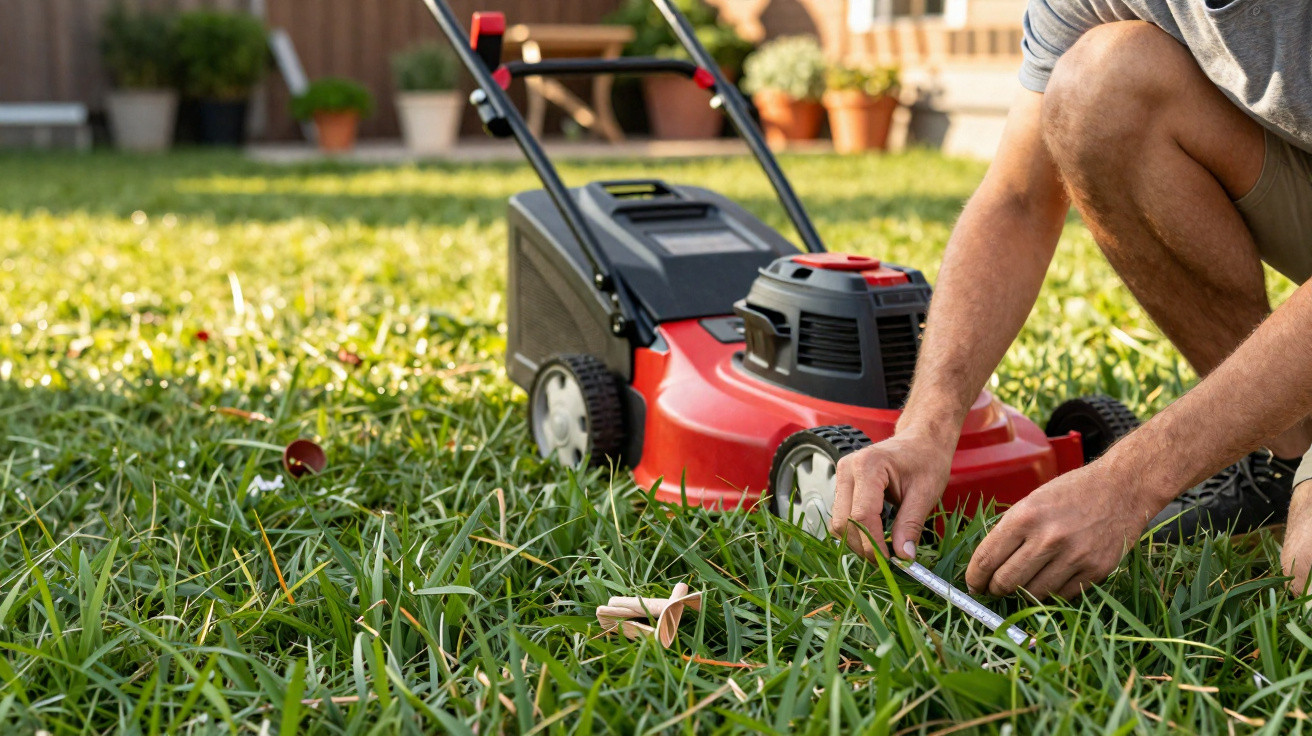
The numbers on a mower’s height adjustment are broad guides rather than dependable centimetre measurements. For precise results, use a tape measure briefly.
A practical calibration method
Place a piece of cardboard or wood on the lawn, run the mower over it, cut a narrow strip and measure the remaining grass length. Then adjust the setting on the machine until the desired height is reached. This quick test can prevent many unsuccessful mowing sessions.
Blade sharpness – the overlooked factor
Blunt blades tend to rip grass rather than cut it. The leaf tips become frayed, turn brown and look scorched. As a result, many lawns appear unhealthy when they simply need their blades sharpening.
A good guideline is to have the blades sharpened, or sharpen them yourself if you have the necessary skills, every 20 to 25 operating hours. Before adjusting or cleaning a mower, disconnect its power supply or remove the spark plug lead – a safety measure many people ignore for convenience.
What else affects the ideal cutting height
Choosing a cutting height can be combined with other lawn-care measures. If you mow higher in summer, moderate mulching can complement it: a thin layer of clippings offers extra protection against evaporation and returns nutrients to the soil. In wet periods, however, heavy mulching is risky because grass clippings rot less effectively and can form thatch.
Soil type also matters. Sandy soils that dry quickly benefit from a somewhat higher cut than heavy, damp clay soils. In heavily used spots – such as beneath a trampoline, beside a football goal or along garden paths – a lawn set slightly higher copes better with wear because the roots grow deeper and stronger.
Anyone combining these adjustments – cutting height, mowing frequency, blade maintenance and suitable watering – will often notice a clear difference within just a few weeks. The lawn responds with denser growth, less weed pressure and far greater tolerance of hot spells. This resilience is what turns a vulnerable patch of green into the sought-after “summer carpet”, one that looks good not only the day after mowing but for months at a time.




Comments
No comments yet. Be the first to comment!
Leave a Comment