
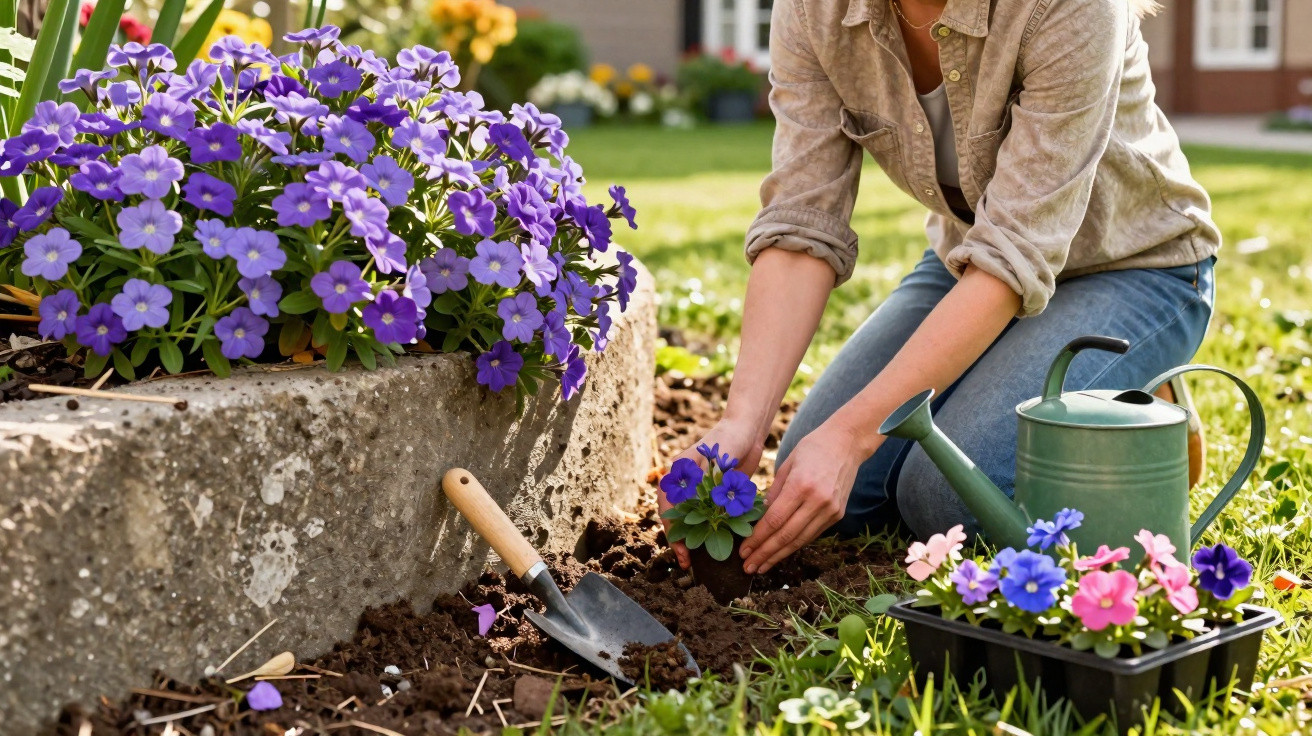
Many homeowners know the issue: the slope has been secured and the wall is structurally sound, yet it looks more like a motorway embankment than a garden feature. This is where an unassuming perennial comes in. On sparse wall tops, it develops into a vivid carpet of flowers, turning bare concrete into a genuine focal point.
The unassuming star: why choose Aubrieta?
The plant in question is Aubrieta, commonly known as rock cress. Its botanical name is Aubrieta deltoidea. It originates from rocky, stony landscapes where many other garden plants would already have given up. That is precisely why it thrives on retaining walls.
Aubrieta turns a bare wall into a dense carpet of purple flowers – without being delicate or demanding intensive care.
Rock cress forms low, cushion-like clumps around 10 to 15 centimetres high, although it quickly spreads sideways. From roughly mid-April into early summer, it produces hundreds and sometimes thousands of small blooms. Depending on the variety, colours range from pale violet and purple to pinkish shades.
Most strikingly, during its peak flowering period the grey-green foliage almost disappears beneath the blooms. This “carpet effect” makes even the dreariest wall look like a deliberately designed garden scene.
Why a retaining wall is a favourite spot for Aubrieta
The conditions on a retaining wall are challenging for many plants: there is little humus, soil dries quickly, sunshine creates heat, and heavy rain can cause waterlogging in joints and crevices. For Aubrieta, however, these conditions are close to ideal.
- Plenty of sun: South- or west-facing walls warm up the stones, which this perennial loves.
- Good drainage: Water runs away quickly, so the roots do not sit in wet soil.
- Little competition: Few other plants can cope with such exposed conditions.
Aubrieta is considered hardy and generally comes through cold spells without difficulty across much of central Europe. Its flexible shoots cascade over edges and fill gaps and cracks without damaging the wall structure. Over time, it creates the impression of a purple wave flowing down the stones.
How to plant Aubrieta on your wall properly
For the flowering cascade to make the right impact, the initial planting is particularly important. Follow a few straightforward rules at this stage and there will be very little work later on.
The best position for maximum floral display
The top edge of a south- or west-facing wall is ideal. Here, the plant will receive several hours of sunshine each day. It is important to provide a small pocket of growing medium – in other words, a space containing soil:
- Clear a gap between two stones or behind the final row of stones.
- Fill it with a loose mix of garden soil, plenty of grit or gravel, and a little compost.
- Slope the growing medium slightly outwards so that the shoots can later trail over the edge effectively.
Sowing seeds directly into a wall often leads to disappointment because the seedlings dry out. Small young plants in pots are considerably easier to establish.
The right time to plant
Two times of year are especially suitable:
- Spring: After the last frosts, once the soil has warmed slightly.
- Autumn: During a mild spell, allowing the roots enough time to establish.
Carefully remove the potted plant from its container and place it in the prepared soil so that the top of the root ball sits roughly level with the surface of the growing medium. Water thoroughly once afterwards to remove air pockets. From then on, water less frequently but deeply until the plant has established.
Water it well once – then, with a little patience, the purple cloud will grow by itself.
Easy care: keeping rock cress in shape
Aubrieta is one of the classic “plants for lazy gardeners” – in the best possible sense. Anyone who follows a few basic principles is unlikely to encounter problems.
Watering, feeding and pruning: less is more
- Watering: Only needed during prolonged dry spells, particularly in the first year.
- Feeding: A light application of organic fertiliser in spring is entirely sufficient; too many nutrients are more likely to be harmful.
- Pruning: Cut the cushions back by around half immediately after flowering.
Trimming encourages denser growth, produces fresh foliage and prevents the rock cress from becoming thin or woody. Frost damage after severe winters can also quickly be removed from view with a decisive cut.
There is another benefit: the flowers attract wild bees and butterflies, while deer and other browsing animals usually show little interest in the plant.
Combinations, colours and varieties for added interest
Anyone who does not want a single uninterrupted colour can combine different varieties. Garden centres offer Aubrieta types in slightly varying shades of lilac, with some tending towards pink and others displaying a deeper purple. Double-flowered varieties are also available, along with types that flower for slightly longer.
A retaining wall area looks particularly lively when Aubrieta is combined with other drought-tolerant plants:
- houseleeks along the wall top for sculptural rosettes
- different Sedum species to provide structure in summer and autumn
- trailing thyme varieties, which add fragrance as well
This means that the wall remains appealing beyond its spring flowering period, offering changing structures and colours throughout the year.
How long does it take to create a flowering wall?
The question many people ask is: when will the effect become clearly visible? Rock cress is among the faster-growing cushion-forming perennials. Even in its first year, the clumps spread noticeably, leaving gaps only in isolated spots. After two to three seasons, the plant will usually hang well over the edge and conceal large sections of the stone surface.
This can act as a visual turbo boost, especially on initially bleak retaining walls at newly built homes. Where there was previously only concrete and grey stone, a band of colour runs through the garden, visually connecting the patio with the higher part of the plot.
Practical advice and potential pitfalls
Despite its toughness, there are a few areas where many gardeners struggle. It helps to be aware of them in advance:
- Waterlogging: Water that remains permanently behind the wall will cause plants to rot. Drainage is essential.
- Too much shade: On a north-facing wall, flowering will be considerably less impressive.
- Overly nutrient-rich soil: Plants become soft and lush, and produce fewer flowers.
If the wall has only recently been built, make sure that the mortar has fully cured and that strongly alkaline deposits are no longer appearing. Virtually nothing will establish in joints made entirely of concrete; small areas of loose soil are much better.
Benefits for the garden, insects and homeowners
Beyond its appearance, Aubrieta offers further advantages. The plant partly shields the wall top from intense sunshine, its foliage reduces how quickly the soil dries out, and it stops unwanted wild growth from taking hold in every crack. Many insects use its flowers as an early food source during the year.
For gardeners with limited time or who travel frequently, rock cress is a “set-and-forget” solution: once planted, the perennial needs only occasional pruning and some water during droughts. In return, it creates a genuine “wow” moment on the slope every spring, year after year – and may leave you wondering why you put up with a grey wall for so long.
Comments
No comments yet. Be the first to comment!
Leave a Comment