
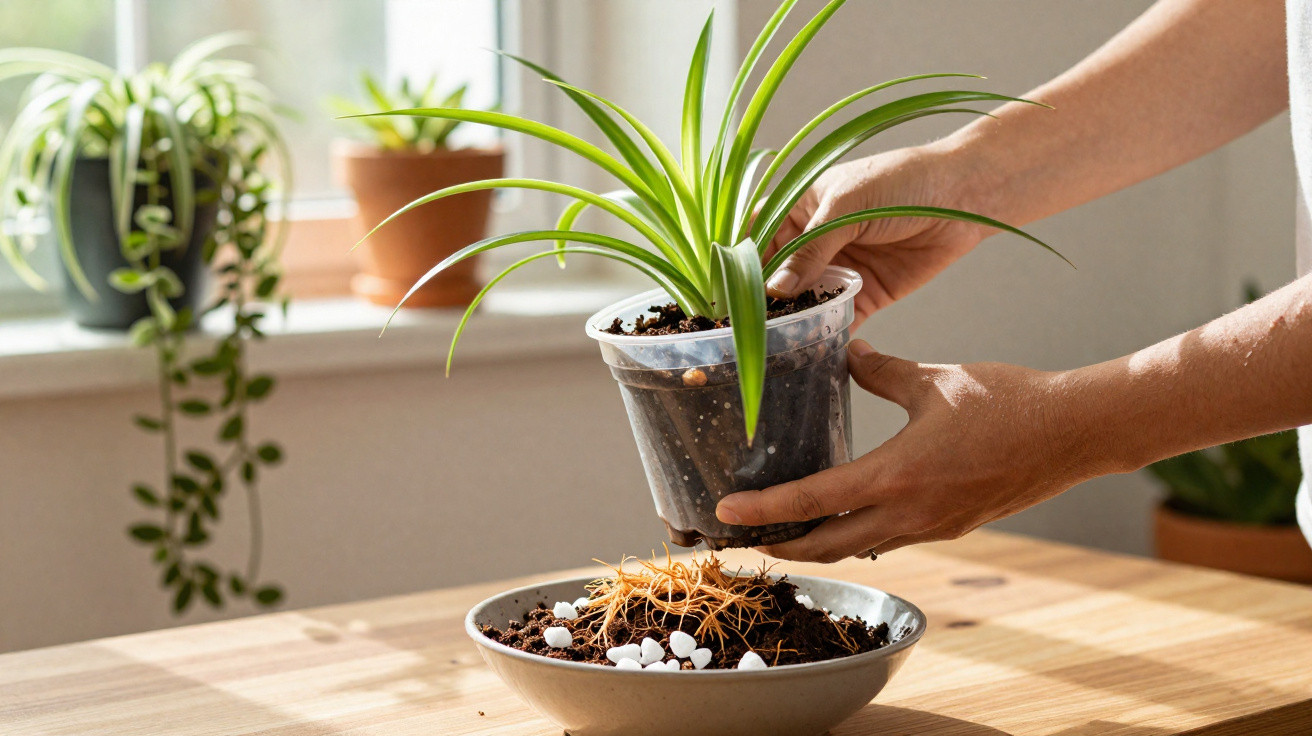
The cause is often sitting quietly inside the pot.
Many owners take great care with watering cans, spray bottles and the best possible windowsill. Yet their spider plant can suddenly look distinctly unhappy. The real issue is usually neither light nor watering, but the inconspicuous growing medium. A simple three-component soil mix can often turn things around completely – transforming tired foliage into a real cascade of plantlets.
Why spider plants react so quickly when unhappy
The classic spider plant (Chlorophytum comosum) is considered a tough houseplant. It copes with missed watering sessions, can tolerate its pot drying out almost completely now and then, and will even manage in a less-than-perfect position. However, when conditions around its roots are unsuitable, its condition can deteriorate rapidly.
Typical warning signs include:
- Leaves becoming soft and limp
- Tips turning brown and dry
- Hardly any new plantlets forming on the long, trailing stems
It is easy to blame too little water, excessive sunshine or dry central-heating air. In reality, the cause is often much closer at hand: in the pot. A growing medium that is too dense, permanently wet or poorly aerated can soon make this otherwise hardy houseplant temperamental.
“Healthy spider plants begin in the pot, not with the watering can – the right growing medium determines whether you get brown tips or a dense waterfall of plantlets.”
How a spider plant behaves in its pot
Chlorophytum develops thick, fleshy roots that store moisture. These tuber-like roots build up water reserves and can fill a pot surprisingly quickly. But this very strength becomes problematic if the soil mix has the wrong composition.
Heavy, clay-rich garden soil stays wet for a long time, compacts easily and forces air out of the pot. The roots then suffocate, fungi can spread and rot becomes a risk. In response, the plant slows its growth and produces fewer plantlets – a protective measure that can seem puzzling to its owner.
A spider plant therefore needs a mix that can do two things at once:
- Hold water temporarily, so the roots do not dry out immediately after watering
- Drain surplus water quickly while retaining enough air around the roots
The 3-ingredient mix to tackle brown tips
The good news is that an ideal growing medium requires neither specialist chemicals nor expensive branded products. In most cases, three ingredients are enough to stop brown tips and revive the plant.
The base: a loose houseplant compost mix
Use a standard compost mix for foliage plants or houseplants as the main ingredient. These blends are generally much more open than straight garden soil and are already formulated to absorb water well without staying wet indefinitely.
Put it into a large bowl or bucket first; it will form the base for the other two ingredients.
Ingredient 1: perlite for air around the roots
Perlite consists of small white granules made from expanded volcanic rock. It keeps the growing medium open and airy, allowing water to drain more freely while giving roots enough oxygen.
A useful mixing guide is:
- Around 2 parts houseplant compost
- Around 1 part perlite
If perlite is unavailable, coarse sand or fine expanded-clay grit can be used instead. The result is similar, although not quite as effective.
Ingredient 2: coconut fibre or peat for moisture retention
To stop the mix from drying out too rapidly, add a moisture-retaining ingredient: coconut fibre (coco coir) or, if it is already available, peat. Both materials retain water, release it gradually and remain relatively loose in structure.
Mix a generous handful into the compost and perlite until the texture feels light and crumbly. When the damp mixture is squeezed in your hand, it should not form a solid lump; once released, it should crumble apart again.
“The perfect spider plant compost feels airy and remains slightly moist, but it should never turn into a sticky, wet clump.”
Repotting correctly: the right pot is essential
Even the best mix offers little benefit if the pot is unsuitable. Spider plants prefer to be slightly pot-bound; an oversized container full of wet compost can quickly lead to rotting areas.
When it is time to repot
Repotting is advisable when:
- Roots are growing out through the drainage holes
- The compost barely absorbs water when watered
- The entire root mass looks like a dense tangle when lifted out
Usually, a pot only one or two sizes larger is sufficient. Moving straight into a much larger pot is more harmful than helpful, because a large amount of compost without roots remains wet for too long.
Repotting a spider plant step by step
- Select a new pot with drainage holes and have a saucer ready.
- Add a thin layer of the 3-ingredient mix to the base of the pot.
- Carefully remove the plant from its old pot and take away any old, soft root sections.
- Position the root ball in the centre and fill the gaps with the new mix.
- Firm the growing medium only lightly so air pockets remain.
- Water thoroughly once, then allow the surface to dry before watering again.
Watering and feeding: keeping the cascade of plantlets going
After repotting, a spider plant needs a little time to send fresh roots into its new mix. During this period, avoid overdoing either watering or fertiliser.
Everyday guidelines:
- Water when the top layer of compost looks dry and feels slightly dusty
- Never leave the pot standing in water; empty the saucer after a few minutes
- From spring until late summer, use a liquid foliage-plant fertiliser every two to four weeks at half the strength stated on the bottle
Too much fertiliser can quickly cause brown leaf tips. Salt levels build up in the compost, causing the tips to dry out – a problem that looks much the same as a simple watering mistake.
Common growing-medium mistakes – and how to avoid them
| Mistake | Result | Better approach |
|---|---|---|
| Straight garden soil that is heavy and clay-rich | Waterlogging, rot and few plantlets | A light houseplant mix with perlite and coconut fibre |
| Pot without drainage holes | Permanently damp roots and fungal infection | A pot with several drainage holes and a saucer |
| Straight cactus or succulent compost | The growing medium dries too quickly | Use cactus mix only as an addition, mixed with standard compost |
| An oversized pot filled with lots of fresh compost | Wet areas without roots remain for a long time | Choose only a slightly larger pot |
Why brown tips are not always a death sentence
Slightly brown leaf tips may look unattractive, but they indicate stress rather than a final decline. Adjusting the growing medium, watering more carefully and reducing fertiliser often results in the spider plant producing fresh, strong green leaves again over the following weeks.
Trimmed brown tips do not grow back, so the leaves retain the cut edge. Many owners carefully cut along the natural shape of the leaf without removing too much of the green section. At the same time, once the plant is comfortable in its new growing medium, it begins producing flawless new leaves – and usually fresh plantlets on its long stems as well.
Extra tips for especially plentiful, healthy plantlets
Anyone wanting to encourage baby spider plants can use a few simple methods:
- Keep the plant slightly pot-bound – mild “pot stress” often encourages plantlet production.
- Give it a bright position without harsh midday sun, such as a light east- or west-facing window.
- Water only moderately in spring after repotting, so the roots are encouraged to grow actively.
Plantlets that already show small roots can be placed straight into the same 3-ingredient mix without difficulty. Keep the mix lightly moist at first, allowing the young plants to establish their own root systems quickly. A well-maintained mother plant can therefore soon become an entire spider plant collection throughout the home.
Once the principle of a loose, airy mix is understood, it can also be applied to other houseplants with moisture-storing roots, including some ferns and easy-care plants related to spider plants. The principle remains the same: less heavy soil, more structure, sufficient moisture, but never a waterlogged swamp in the pot.
Comments
No comments yet. Be the first to comment!
Leave a Comment