
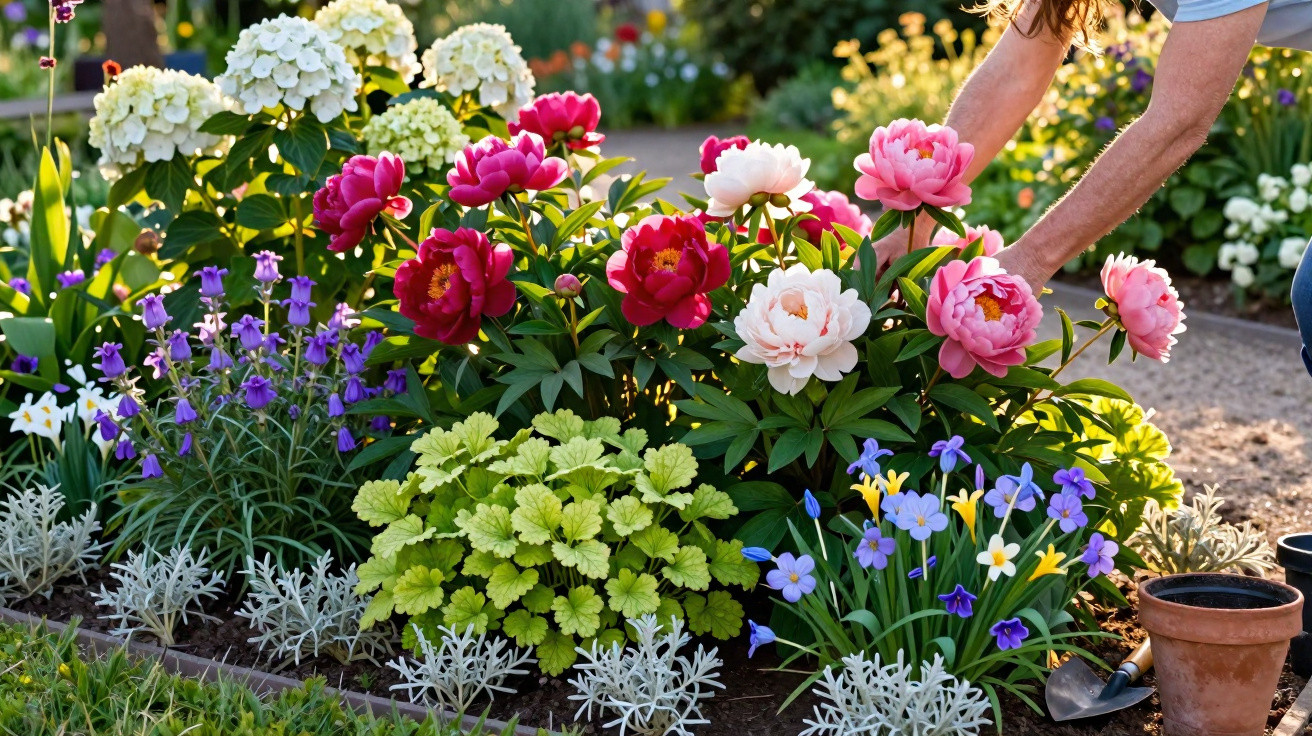
Peonies – commonly known as Paeonia in everyday gardening – bring lavish flowers to the garden from late April well into summer. Many amateur gardeners simply plant them as single specimens in a border, then wonder why the overall effect looks pleasant rather than spectacular. The difference between “beautiful” and “wow” lies in the neighbouring plants: they determine whether a few stems become a true floral picture or disappear into the greenery.
What peonies need before companions are added
To combine peonies successfully, it is important to understand what they prefer. These perennials are long-lived, resilient and can flower for decades in the same position when the conditions are right. They favour a sunny site or light partial shade, along with deep, nutrient-rich yet well-drained soil. Waterlogging in winter is disastrous for them.
Dense planting raises the risk of fungal diseases such as grey mould. Wet foliage and poor air circulation can cause buds to rot before they have a chance to open. Vigorous roots from plants growing too close by also deprive peonies of water and nutrients.
Peonies make their greatest impact when they have air, light and enough distance from vigorous competitors on every side.
Three straightforward principles help with every border plan involving peonies:
- Choose companion plants that also enjoy sun and freely draining soil.
- Avoid planting tall specimens directly in front of them, so their flowers are not lost in shade.
- Leave a “clear-space ring” around each clump, allowing the area to dry quickly.
Lady’s mantle and bellflowers: a stage for large peony flowers
Once the framework is in place, it is time to think about the display. The best choices are plants that highlight the rounded blooms of peonies without stealing attention from them. Lady’s mantle (Alchemilla) is a classic option: it creates a soft, dense carpet of rounded foliage, topped in early summer by countless lime-green flowers.
These delicate clouds sit visually like a veil beneath pink, white or cream peony heads. The same combination works beautifully in a bouquet as it does in a border: lady’s mantle makes the large flowers more prominent because its colour remains understated.
Bellflower species also work well as companions. Most stay compact, flower in summer in white, blue or violet, and do not compete heavily for water or nutrients. Their slim flower spikes resemble vertical brushstrokes beside the rounded globes of peony blooms.
One detail needs a little care: some bellflowers attract pests more readily. When adding them to a border, it is best to plan a “protective line” of fragrant herbs or Allium bulbs, so that the peonies do not suffer as a result.
Hydrangeas and bulbs: a succession of flowers rather than a brief display
Mophead hydrangeas are particularly suitable for the back of large borders. Their large, rounded flower heads echo the shape of peony blooms, but appear higher up and later in the year. Planted with sufficient space, they frame a peony border without crowding it.
The result is that the display remains lively for months. Peonies take centre stage in late spring, followed by the blooms of hydrangeas. During the hottest weeks, their light shade also helps protect the soil from drying out without compromising the peonies’ need for light.
A staggered flowering sequence using bulbs and other perennials is especially effective:
- Bearded irises flower shortly before peonies and introduce the run of colour.
- Allium produces spherical blooms at the same time or immediately afterwards, adding graphic accents.
- Daylilies take over in high summer, once the peony display has ended, and keep the border colourful.
This prevents a gap from appearing in the border as soon as the peonies have finished flowering. Instead of a brief burst of colour, the planting tells a continuous colour story from spring through to high summer.
Lavender as a bodyguard: scented protection for elegant flowers
Lavender is an especially valuable companion for peonies. Like peonies, it thrives in sunshine and well-drained soils. Its main benefit, beyond its flowers, is its fragrance: the essential oils deter a range of unwelcome visitors. Mosquitoes, flies, fleas and moths avoid the area, while even deer often leave strips of lavender alone.
A lavender border acts like a natural protective band around a peony bed – decorative and practical at the same time.
Lavender complements many peony varieties in colour, whether they are pale pink, vivid pink or pure white. The important point is to place it as edging or at a little distance from the peony clumps, so its roots do not crowd the perennials.
Allium species are similarly useful because of their slightly sulphurous scent. Many insects dislike it greatly. Planting them between and behind peonies combines ornamental appeal with a protective effect.
Which neighbours can harm peonies
Not every popular garden plant makes a suitable neighbour. Particularly troublesome are very vigorous ornamental grasses, which develop substantial clumps over the years. They block light, draw heavily on water and allow very little air to reach the base of the peonies.
Perennials that require constantly wet, heavy soil are equally unsuitable. They encourage exactly the conditions that promote fungal disease on peonies. Where the ground is already prone to becoming waterlogged, drainage and raised beds should be addressed before planting is considered at all.
More delicate bellflower species can certainly be used nearby, but should then be surrounded by “guards” such as lavender or Allium. This makes it more likely that pest insects remain around the outer edges, while the peonies stay protected at the centre.
Practical example: what an ideal peony border looks like
| Area of the border | Plant selection | Purpose |
|---|---|---|
| Centre | Peonies spaced 60–80 cm apart | Main feature, large rounded blooms |
| Foreground | Lady’s mantle, low bellflowers | Soft edge, carpet of colour, emphasis for the main flowers |
| Edge | Lavender, interplanting with Allium | Scented protection, clear lines |
| Background | Hydrangeas, daylilies | Height, later flowers, summer structure |
Common mistakes – and how to avoid them
Many peonies appear disappointing even when the variety and position are correct. The reason almost always lies in their surroundings. An overcrowded border stays damp for too long, foliage dries poorly after rain, and fungi can spread easily. Simply leaving a patch of visible soil around the perennials already creates noticeably healthier plants.
Another mistake is placing peonies behind taller-growing perennials or shrubs, leaving them in partial shade. They will then flower sparsely or may stop flowering altogether. In this situation, relocation is the only answer – but not before autumn, and with patience, as it often takes two years for full flowering to return.
Why these peony combinations work so well
All of the companion plants mentioned fulfil several roles: they bring out the best in flower shapes and colours, extend the season, provide protection from pests and stabilise the border’s microclimate. Lady’s mantle conceals spent stems, bellflowers fill gaps, hydrangeas bring structure to the composition, while lavender and Allium reduce pest pressure.
Anyone planning a new border can follow one simple principle: decide on the location for the peonies first, then think in rings around them – beginning with low, protective planting at the front, moving through filling companions, and ending with framing shrubs. This creates a long-lasting, low-maintenance arrangement.
This approach is especially worthwhile in smaller gardens. When correctly combined, just a few peony clumps, flanked by carefully selected companions, can produce a scene year after year that resembles a professionally designed perennial border – without maintenance becoming excessive.


Comments
No comments yet. Be the first to comment!
Leave a Comment