
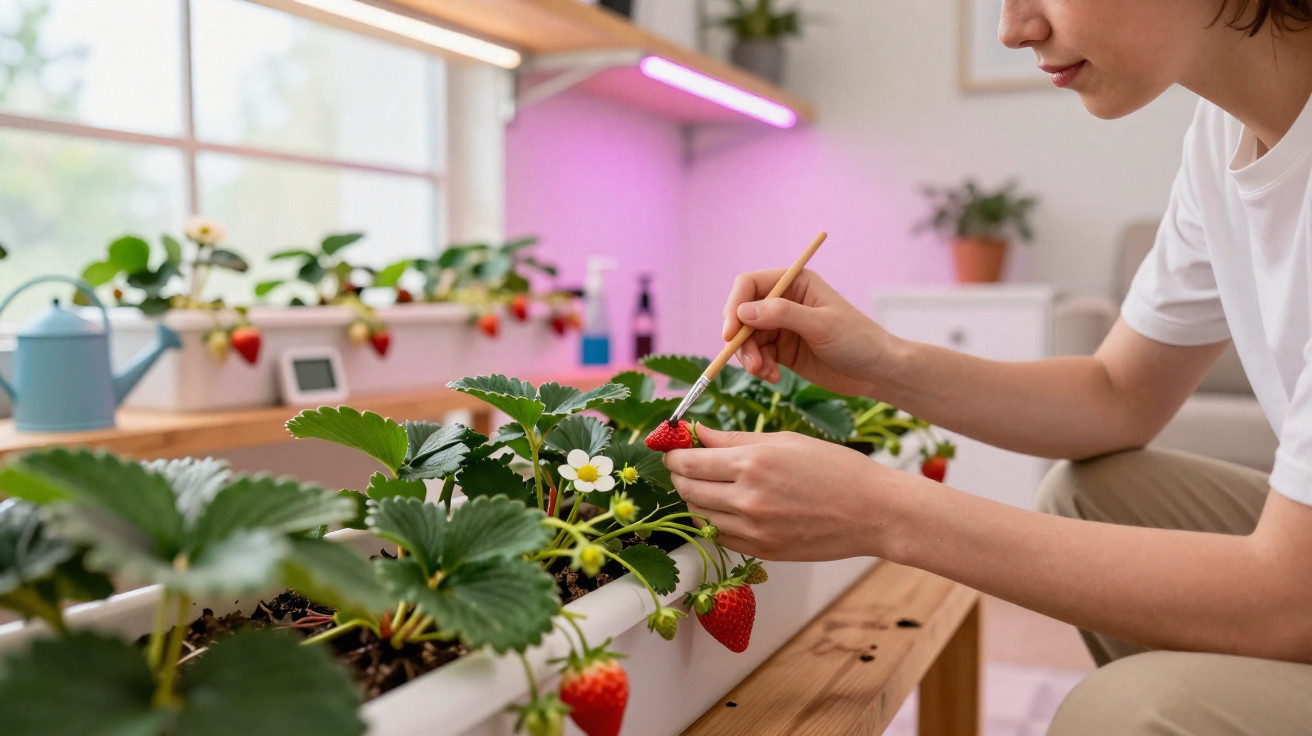
With a little-known professional technique, this can even work right in the middle of your living room.
More and more people live in cities, often with no more than a narrow windowsill available. Yet the desire to pick fresh fruit yourself remains. What many people do not realise is that strawberries can grow remarkably well indoors – provided you follow a few gardeners’ professional tricks. The method is straightforward but carefully considered: it combines the right variety, suitable lighting, a stable indoor climate and one small task that bees would normally handle outdoors.
Why growing strawberries indoors works at all
Strawberries are usually thought of as traditional garden plants, complete with beds, slugs and straw mulch. In reality, however, many cultivated varieties perform extremely well in pots. What matters is meeting the plants’ real needs: light, steady warmth, enough water and help with pollination. All of these factors can be controlled much more precisely indoors than in open ground.
“Anyone who treats their strawberries like houseplants, but follows the professionals’ system, can snack on them for almost the whole year – even from a third-floor flat with no balcony.”
Home growers who apply this approach consistently report regular, modest harvests. You will not pick field-sized baskets weighing kilos, but there will be enough for muesli, a cake topping or a handful of sweet berries while relaxing on the sofa in the evening.
Choosing the right strawberry variety: no crop without selection
Gardeners do not recommend conventional once-fruiting varieties for a living room. Ever-bearing strawberries, which flower repeatedly throughout the year, are far more suitable, as are small-fruited types such as wild strawberries or alpine strawberries. These varieties cope well with pot growing and changing light levels.
- Ever-bearing varieties: produce fresh fruit repeatedly over many months.
- Alpine and wild types: smaller berries, but an intensely flavoured crop and strong performance in pots.
- Seeds or young plants: for a quicker harvest, begin with young plants rather than seeds.
Many professionals favour aromatic alpine varieties. Their berries tend to stay small, but they offer a particularly clean, almost wild strawberry flavour. Some strains will even fruit in their first year after sowing, making them appealing for impatient growers. Modern varieties bred specifically for window boxes, hanging baskets and indoor systems are among the well-known options.
Pots, compost and position: getting the foundations right
The right container prevents many issues before they begin. Pots or planters should ideally be at least 20 centimetres deep and have drainage holes. Waterlogging is the enemy of healthy strawberry roots. A bottom layer of expanded clay pebbles or gravel provides drainage. For the growing medium, choose a loose, slightly humus-rich blend of potting compost or vegetable compost.
The following work especially well:
- large terracotta pots or containers with saucers
- multi-level “strawberry towers” with several planting openings
- ready-made indoor growing units with built-in lighting
Choose a bright spot, preferably close to a south- or south-west-facing window. If you only have north-facing windows, supplementary artificial light is essential; otherwise, flowering and fruit set will be sparse.
Light, temperature and humidity: the small indoor world for strawberries
Sweet fruit is impossible without sufficient light. Gardeners use a clear guideline: for dependable flowering and fruiting indoors, strawberries need around 12 to 14 hours of light each day.
| Factor | Recommendation for indoor strawberries |
|---|---|
| Light duration | 12–14 hours a day; supplement with LEDs in winter |
| Temperature | around 21 °C; 20–25 °C is tolerated |
| Humidity | approximately 50–70% relative humidity |
When the pot sits directly on a windowsill, check its proximity to radiators and draughts. Dry central-heating air draws moisture from the leaves, while blasts of cold air from tilted windows put the plants under stress. Keeping them away from radiators and in a permanent position without constant gusts from ventilation can make a remarkable difference.
LED grow lights: the quiet secret weapon
If you do not have an ideal south-facing window, an LED grow light can provide the boost needed. These lights use little electricity but deliver the targeted spectrum plants use for growth and fruit production. Ideally, position the lamp 20 to 30 centimetres above the plants and run it for 10 to 12 hours daily during the darker months.
“With a simple LED grow light, you can practically cancel out the changing seasons in the living room – strawberries get the impression it is high summer, even when sleet is falling outside.”
Complete indoor garden systems automate much of the process: timers control the lights, while sensors monitor water levels. Those who prefer a simpler arrangement can use a timer from a DIY shop and one LED strip above the pot.
Watering, feeding and drainage: keeping strawberry plants healthy
Strawberries prefer consistently moist compost, but never sodden conditions. One thorough watering a week is often enough, depending on pot size, room temperature and available light. Professionals rely on a simple check: push a finger into the compost. Water if the top centimetre is dry; wait if it still feels damp.
- Water: water less frequently but thoroughly, instead of offering constant small sips.
- Drainage: never allow water to remain in the saucer permanently.
- Fertiliser: apply a balanced all-purpose fertiliser every two to four weeks.
Balanced NPK fertilisers with evenly distributed nutrients, such as 10-10-10 or 14-14-14, have proved effective. Used regularly but moderately, they supply what plants need for fresh leaves, flowers and fruit. Too much fertiliser encourages leafy growth, while flowers may fail to appear or the fruit may become watery.
Common watering mistakes
Many people fail because they water too generously “out of love”. The most frequent issues are:
- a constantly wet root ball → roots rot and the plant wilts
- watering from above into the leaf crown → encourages fungal diseases
- icy tap water straight from the tap → causes a growth shock
Settled, room-temperature water applied directly to the compost is ideal. If you already use water butts on a balcony or in a courtyard, you can combine the two: one part rainwater and one part tap water gives better results with lime-sensitive varieties.
The key indoor trick: hand-pollinating strawberries
Outdoors, bees, bumblebees and the wind take care of pollination. These helpers are absent indoors. Without pollination, flowers remain unproductive, and the white stars never turn into red fruit. Gardeners solve this with one simple tool: a soft brush.
Manual pollination works as follows:
- Have a soft brush or cotton bud ready.
- Sweep its tip over the yellow stamens of the first flower.
- Use circular movements to transfer the collected pollen to the centre of the same flower or the next one.
- Spend 5 to 10 seconds on each open flower.
- Repeat the process every two days while flowers are open.
“In the living room, the brush replaces the bee – a few minutes every two days are enough to turn a handful of flowers into a small shower of strawberries.”
Look closely and you will later see whether it has worked. After a few days, the white petals fall away, while the base of the flower begins to thicken slightly and turn green. This is the young strawberry, which will gradually colour red over the following weeks.
Practical ways to get more strawberries from a small space
A single pot is a good way to experiment, but many growers want to increase their yield without turning the room into a greenhouse. A few straightforward strategies can help:
- Several small pots instead of one huge container: diseases and problems stay contained, and moving the plants is easier.
- Turn plants regularly: rotate the pot by a quarter every few days so that leaves do not grow only towards the window.
- Remove old leaves: cut away yellowing or spotted foliage so the plant can direct its energy into fresh shoots and fruit.
- Use hanging baskets: ever-bearing varieties with long runners are particularly decorative and produce fruit at easy picking height.
It is also useful to watch the plant’s rhythm. If it produces very few flowers, the cause is usually insufficient light or nutrients. If it sets plenty of flowers but no fruit, it is missing pollination help or the air is extremely dry.
Risks and minor pitfalls
Indoor strawberries are not a high-risk project, but a few details need attention. Excessively high humidity encourages mould, particularly in poorly ventilated corners and very dense growing systems. Ventilate briefly and fully from time to time, without directing cold draughts straight onto the leaves.
Fungus gnats or aphids may appear occasionally. Yellow sticky traps, slightly drier conditions and, if necessary, a biological plant-protection product will usually be enough. Chemical products with long waiting periods are not a good choice in a living room, especially when the fruit is edible.
Combining strawberries with other indoor growing projects
Many people who begin with strawberries in the living room soon expand their mini garden. Herbs such as basil, mint and thyme pair well with them, have similar light requirements and bring extra freshness to the kitchen. Indoor growing units often allow several levels to be used: strawberries on top, with salads or radishes below.
It becomes particularly interesting when you compare varieties over time: vigorous, large-fruited plants alongside compact, richly flavoured wild strawberries. This lets you see the diversity within the species and discover which types thrive in your own indoor climate. Anyone who keeps a few notes – for example, on light duration and watering quantities – will quickly find their own formula for success.
The gardeners’ method ultimately shows that you do not need an allotment or a raised bed to harvest your own strawberries. All that is required is a bright spot, a little technology, regular attention and a brush. The rest follows step by step – culminating in perhaps the most surprising snack you can offer guests in a city living room.
Comments
No comments yet. Be the first to comment!
Leave a Comment