
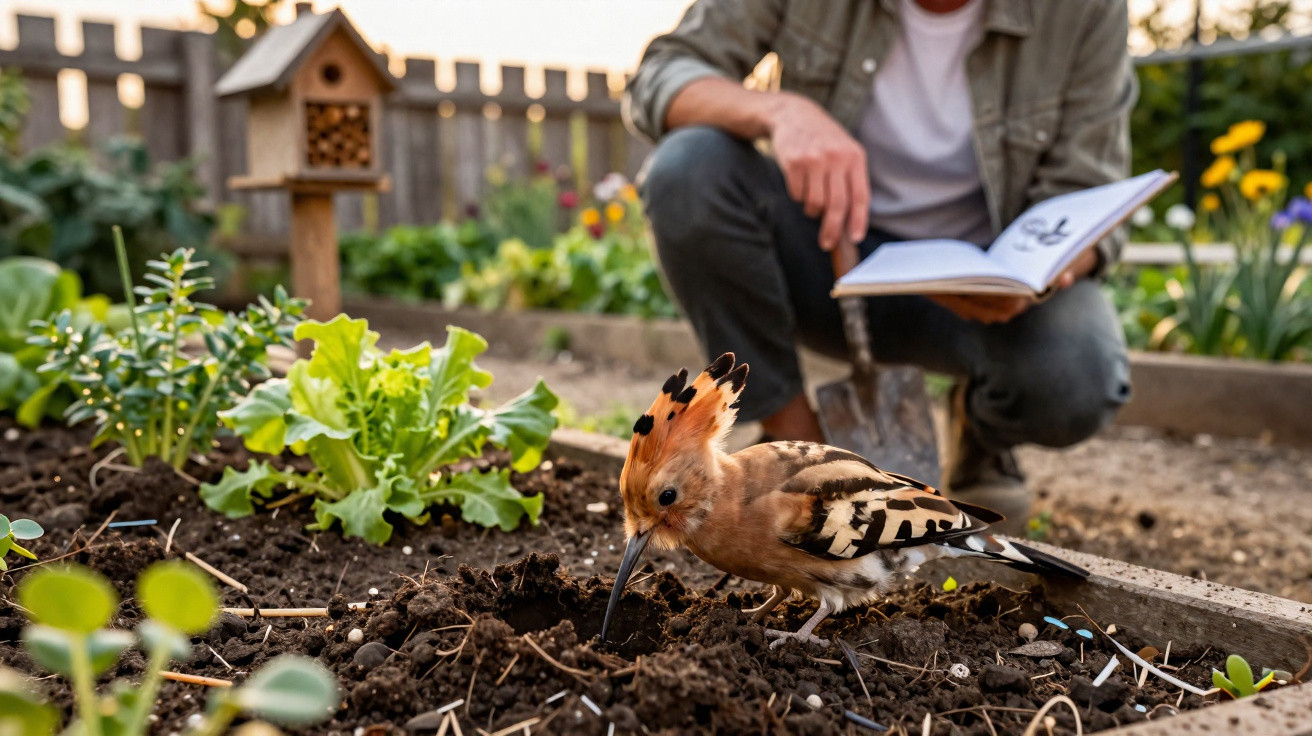
If you think you have spotted a crested lark, you would be mistaken: this striking visitor with its fold-up feather crest is the hoopoe. When this bird does more than pass overhead and deliberately visits your garden, it is not simply chance – its presence reveals a great deal about your soil, surroundings and even the future of your plot.
How the hoopoe assesses your soil
The hoopoe feeds solely on animals living in or directly on the ground. Using its long, gently curved bill, it probes loose soil and deliberately picks out:
- white grubs and cockchafer larvae
- crickets and house crickets
- mole crickets
- beetles and their larvae
- caterpillars, including processionary moth caterpillars
- various other insects living in the soil
Its presence therefore reveals several things at once:
Where a hoopoe hunts regularly, the soil is alive, loose and rich in insects – and is generally not saturated with toxic chemicals.
A garden treated extensively with chemical products offers the bird very little to eat. If it stays for several days or returns repeatedly, it regards your land as a well-stocked table. That is a strong sign of a healthy soil ecosystem.
Why your garden is not a chance discovery
The European hoopoe generally spends the winter south of the Sahara. In spring, it travels towards central and southern Europe, remaining here roughly from April to September. Within Europe, it is more commonly found in warmer, drier and sunnier areas.
Before settling in an area, however, it examines the site closely. Its preferred landscapes typically include:
- open, sunlit meadows with short grass
- traditional orchards, vineyards and old fruit gardens
- parks with sparse vegetation
- domestic gardens combining lawn with bare ground
If it remains visible in your garden for longer, the site meets several of its requirements: sufficient peace, few disturbances, unobstructed feeding areas and soil that is easy to work with its bill. In northern Germany in particular, seeing one is considered a small accolade, as the species is still concentrated mainly in mild regions.
Anyone watching a hoopoe in a garden in the northern part of the German-speaking world has, in a sense, an ecologically exemplary plot.
A rare visitor with protected status
In many European countries, the species came under severe pressure during the 1990s. More intensive farming, the disappearance of hedgerows and orchards, and widespread pesticide use caused numbers to fall sharply. Since the 2000s, populations have gradually stabilised or even increased slightly.
The hoopoe is regarded as a strictly protected bird species. Its breeding sites and nesting trees receive particular protection. Only a small number of pairs occur in densely built-up areas and conurbations. In some large urban regions, only a few dozen breeding pairs were counted a few years ago.
So if this bird chooses your garden of all places, your plot belongs to a minority of sites that still meet its needs for quiet, food and suitable structure.
The message a hoopoe brings to your garden
Stories have surrounded the hoopoe for centuries. In ancient Near Eastern traditions, it is seen as a guide and messenger, while Persian poetry portrays it leading other birds on a kind of search for meaning. In parts of Africa and the Mediterranean, its crest is interpreted as a small royal crown, which is why it is sometimes called the “king of birds”.
Even without being superstitious, this bird does in a way send a signal about the future of your garden. It shows that there is still room on your plot for wilderness and natural processes – a real advantage at a time when many areas are heavily sealed or excessively manicured.
The hoopoe symbolises a garden in transition: away from the sterile ornamental lawn and towards a living, resilient ecosystem.
Many amateur gardeners say that their first sightings make them reconsider how they manage lawns, flowerbeds and “weeds”. Anyone hoping not to lose such a rare visitor often adjusts their behaviour instinctively – and, in the long term, that also benefits plants, soil organisms and other bird species.
What you can do to encourage the hoopoe to return
Anyone wishing to roll out the red carpet for a hoopoe does not need to create a luxury garden; they simply need to relinquish a little control. The key measures are:
- Avoid pesticides: insecticides, weedkillers and chemical lawn “boosters” remove the bird’s food supply. Organic gardening is the key here.
- Do not keep every part of the lawn short: some areas can be mown so the bird can search for prey. Leave other sections longer to provide habitat for insects.
- Allow patches of open soil: small areas of bare, loose earth make it easier for the bird to probe for larvae.
- Retain old trees and natural structures: it likes to nest in cavities, crevices and niches, such as those in old fruit trees, walls or wood piles.
- Keep things peaceful: less noise, no constant bustle and no free-roaming cats in its feeding area all increase the likelihood that it will stay.
Completely tidying away garden waste removes potential hiding places for the bird. Deadwood piles, old tree stumps and untended corners may look untidy, but they provide precisely the structures it values for finding food and potentially nesting.
When the rare visitor smells – and why there is no need to worry
In some regions, the hoopoe has an unflattering nickname relating to its smell. Nests and young birds can have a strong odour, especially during the breeding season. There is good reason for this: adult birds and their chicks release secretions intended to deter predators.
For garden owners, this means that a nearby nest may produce an unfamiliar smell, particularly in warm weather. The effect is temporary and disappears once the breeding season ends.
A brief, unfamiliar smell in the garden can be the price of free biological pest control.
What regular hoopoe sightings mean for your plot in the long term
Biologists describe species such as the hoopoe as bioindicators. These animals react sensitively to environmental change. Whether they are present or disappear can say a great deal about the health of a landscape. Anyone who regularly sees this bird in their garden can assume that their plot stands out positively in the regional comparison.
As temperatures rise, the ranges of many species are slowly shifting northwards. In future, the hoopoe may also appear more often in regions where it has so far been extremely rare – provided enough structurally diverse, chemical-free land remains available there.
For property owners, this creates an opportunity. Those who design their gardens naturally today will not only benefit earlier from this shift, but will also create a more robust microclimate overall. Living soils, varied planting and fewer chemicals make plots more resilient to heat, heavy rainfall and pests.
Anyone who watches a hoopoe quietly soon notices how closely bird, soil and garden structure interact. Its long bill, constant probing and short dashes across the lawn resemble a small soil health inspection. In a sense, the bird acts as a free assessor, showing you that there is more in good order here than simply the appearance of the flowerbeds.

Comments
No comments yet. Be the first to comment!
Leave a Comment