
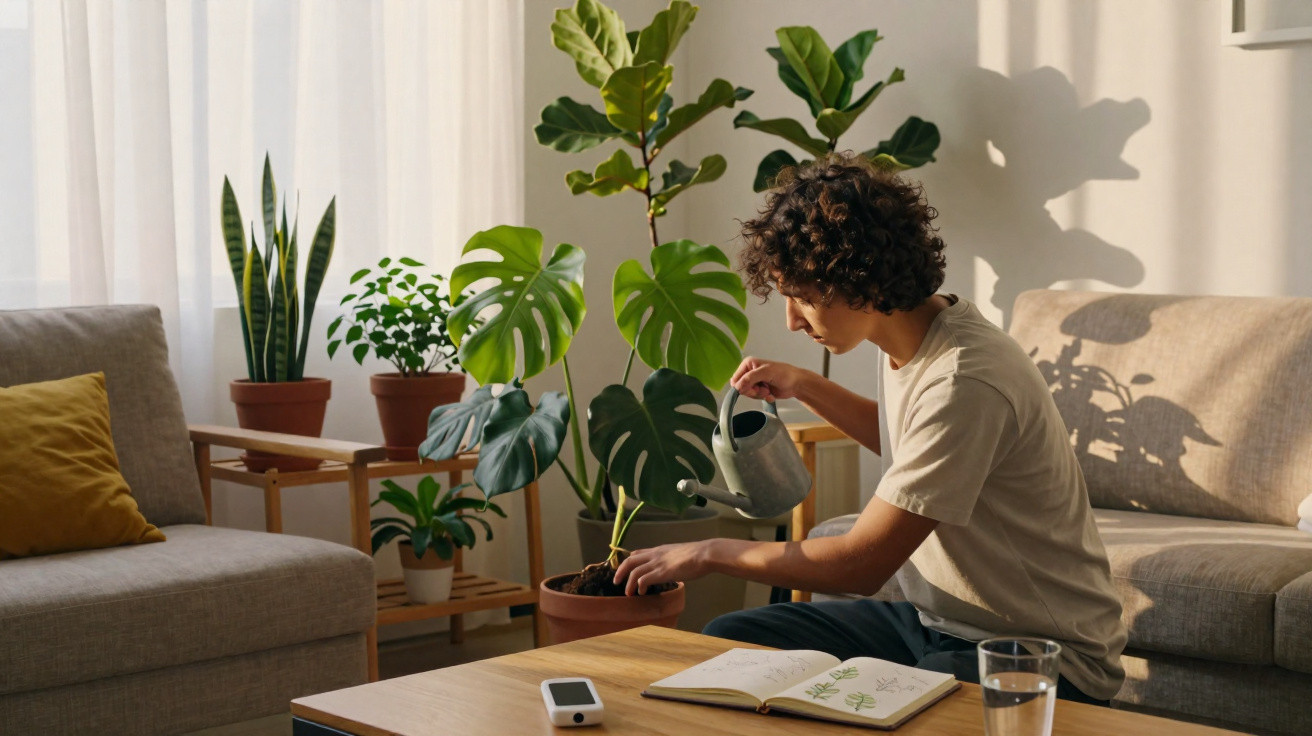
Sunday morning, grey light, and the city is still half asleep. Somewhere on the third floor of an old apartment building, Lisa stands in her pyjamas in front of her Monstera, watering can in hand. “You look a little sad,” she murmurs, pouring a generous amount of water into the pot. She recently read on Instagram: lots of water, lots of love. Her fingers brush across the large leaves, while she barely registers the brown patches at the edges. It will be fine.
One floor below, Mr Müller bends over his tiny windowsill and dutifully waters the succulent his granddaughter gave him. Every Tuesday at exactly 8 am. Because plants need water. Always.
What neither of them realises is that they are slowly loving their plants to death.
Why we so quickly “drown” houseplants
Anyone who walks through friends’ flats with their eyes open will spot it straight away: watering cans sit beside ficus plants, Monsteras and little pots of herbs like loyal pets. Water is our instinctive response to every yellow leaf and every drooping shoot. We grew up with the idea that anything alive must be fed regularly. So we water, often by instinct and sometimes out of guilt.
At first glance, many plants even appear healthier when the compost looks dark and damp. A pot feels heavy, creating a strangely reassuring sense of security. Yet hardly anyone talks about how quietly and unremarkably roots can rot out of sight.
An acquaintance recently told me about her own living-room tragedy. She had a magnificent yucca, nearly two metres tall, and it was her pride and joy. Every Sunday, it received its “spa treatment”: leaves wiped down, fertiliser sticks added and a large helping of water. At first the plant looked strong, until the lower leaves suddenly turned yellow and hung down limply. Believing the yucca was “dying of thirst”, she watered it even more.
Four weeks later, she pulled it out of the pot - or what remained of it. The compost smelled musty, while the roots were grey and mushy, almost like cooked pasta. It was a textbook case of root rot. The irony is that the visible part of a plant dies much later than its roots do. For a long time, it can look as though it is still salvageable, while the hidden disaster has already taken hold.
Once you understand the logic behind it, it is slightly painful. In nature, there is rarely a constant, even supply of water. Rain falls in bursts, the soil dries out again, and air circulates around the roots. Inside a pot, conditions are different: there is only a small amount of compost, limited air and often poor drainage. Each extra watering fills invisible gaps until oxygen can no longer reach the roots. Plants do not only “drink”; they also “breathe” below the surface of the pot. When water remains there for too long, an entire system of microorganisms, fungi and fine root hairs becomes unbalanced.
A well-intentioned watering then turns into a silent swamp.
How to stop overwatering houseplants out of love
To water less, you do not need a degree in botany - you need a change of ritual. The most important step is to stop watering by the calendar and start judging by the compost. Literally. Before any water is poured, use your finger. Push it one to two centimetres into the compost rather than simply touching the surface. If it feels cool and fairly moist, do not water. If it is dry, crumbly and almost dusty, it is time.
If you are unsure, try a simple method: lift and weigh the plant pot in your hand. The difference between a dry and a wet pot is surprisingly obvious once you pay attention to it. After a few weeks of practice, your body instinctively learns what an “all right” weight feels like. It is a straightforward, very human sensor - no app required.
Let us be honest: nobody carefully measures soil moisture every day or records watering volumes as if preparing a laboratory report. We make our way through work, screens and daily life, reaching for the watering can whenever we notice a plant. That is exactly where mistakes happen. Instead of giving it “a small sip every time I walk past”, adopt a clearer routine: water less frequently but thoroughly. Let water run through until it emerges from the drainage hole, then pour away any excess from the decorative outer pot after around 10–15 minutes.
Many plants cope with dry spells far better than they do with constant wetness. A slightly drooping leaf can perk up again after a thorough watering. A rotten root, on the other hand, does not recover. Anyone who has rescued a half-dried-out plant understands this very clearly. And anyone who has pulled a “drowned” one from its pot will not quickly forget the sight.
“The most common cause of death among houseplants is not neglect, but too much care,” a gardener at a city garden once told me. “People think that if their plant is unwell, it needs more of whatever they can give it. And that is often water.”
To ensure this sentence becomes more than a warning, it helps to create a small personal plant code, for example:
- Only water when both the finger test and the weight of the pot indicate “dry”
- Give every plant a brief label showing its watering type: dry, moderate or moist
- Do not water plants merely because other plants are being watered
- Check decorative outer pots regularly for standing water and empty any leftovers
- It is better to consciously underwater once and respond than to water constantly “just in case”
What changes when we see plants as independent housemates
Anyone who has lived with the same plants for a long time notices that each has its own character. The ficus that sulks when it is moved. The Calathea that closes its leaves in the evening like a book. The little succulent that survives for months without attention and quietly keeps growing. The moment we stop treating them all according to the same watering schedule, something unusual happens: we begin to look more closely. Rather than simply watering and moving on, we pause, compare and observe.
That closer attention creates a different kind of relationship. Whoever notices that their plant prefers to dry out almost completely before it produces new growth learns patience. Whoever does not immediately panic at brown leaf tips, but instead reads them as a “record” of the previous few weeks, changes their entire approach. Rather than automatically reaching for the watering can, the first question becomes: what has changed since last time? Its position, the light, the temperature or the dry air from central heating?
We are used to linking achievement with activity. The more we do, the better the result - at work, in sport and at school. Plants disrupt that pattern. Their greatest progress often happens when we do nothing at all. No extra water, no fresh compost, no constant moving about. For many people, that is difficult to tolerate, particularly when their plants are a small emotional anchor in everyday life. A splash of water can then feel like a tiny gesture of care.
Perhaps that is where the greatest opportunity to learn lies. Anyone able to let a plant dry out thoughtfully learns that care does not always mean taking action. Sometimes love means stepping back, allowing the compost to dry and trusting that the roots can cope. Plants are not indoor decorations that we can “top up” whenever we like; they are quiet housemates with their own sense of timing. It may sound sentimental, but viewed plainly, it is quite a comforting thought.
| Key point | Detail | Benefit for the reader |
|---|---|---|
| Overwatering is more common than “dying of thirst” | Roots need oxygen, and standing water causes unnoticed rot | Understand why yellow leaves are often caused by too much water rather than too little |
| Use the finger test instead of calendar watering | Feel one to two centimetres deep: dry = water, moist = wait | An easy routine that keeps plants stable over the long term |
| Every plant has its own rhythm | Succulents, tropical plants and herbs respond differently | Water more precisely and avoid poor purchases or “sudden” plant deaths |
FAQ:
- How can I tell whether I have watered my plant too often already? Warning signs include limp, yellowing leaves, a musty smell from the compost and a pot that remains heavy. If the compost looks dry at the top but is still wet and clammy underneath, there is often too much water in the pot.
- Can I still save a “drowned” plant? Sometimes. Take the plant out of its pot, carefully remove mushy roots, repot it in fresh, fairly loose compost and water only very sparingly for a few weeks. If enough firm, pale roots remain, it has a chance.
- How often should I water in winter? Most houseplants grow more slowly in winter, and many enter a resting phase. They need less water then. Depending on the plant and the dry air from central heating, watering only every two to three weeks may be enough. The finger test remains the best guide.
- Are moisture meters in plant pots useful? They can help you develop a feel for moisture, but they do not replace looking at the plant itself. Cheaper models in particular are inaccurate. They are fine as an addition, but rather risky as the sole basis for watering.
- What should I do if there is always water in the decorative outer pot? Always pour away leftover water, lift the inner pot briefly and allow it to drain properly. In the long term, a better drainage system is worthwhile: a hole in the pot, with pot shards or expanded clay at the bottom, so water can drain away and the roots receive more air.
Comments
No comments yet. Be the first to comment!
Leave a Comment