
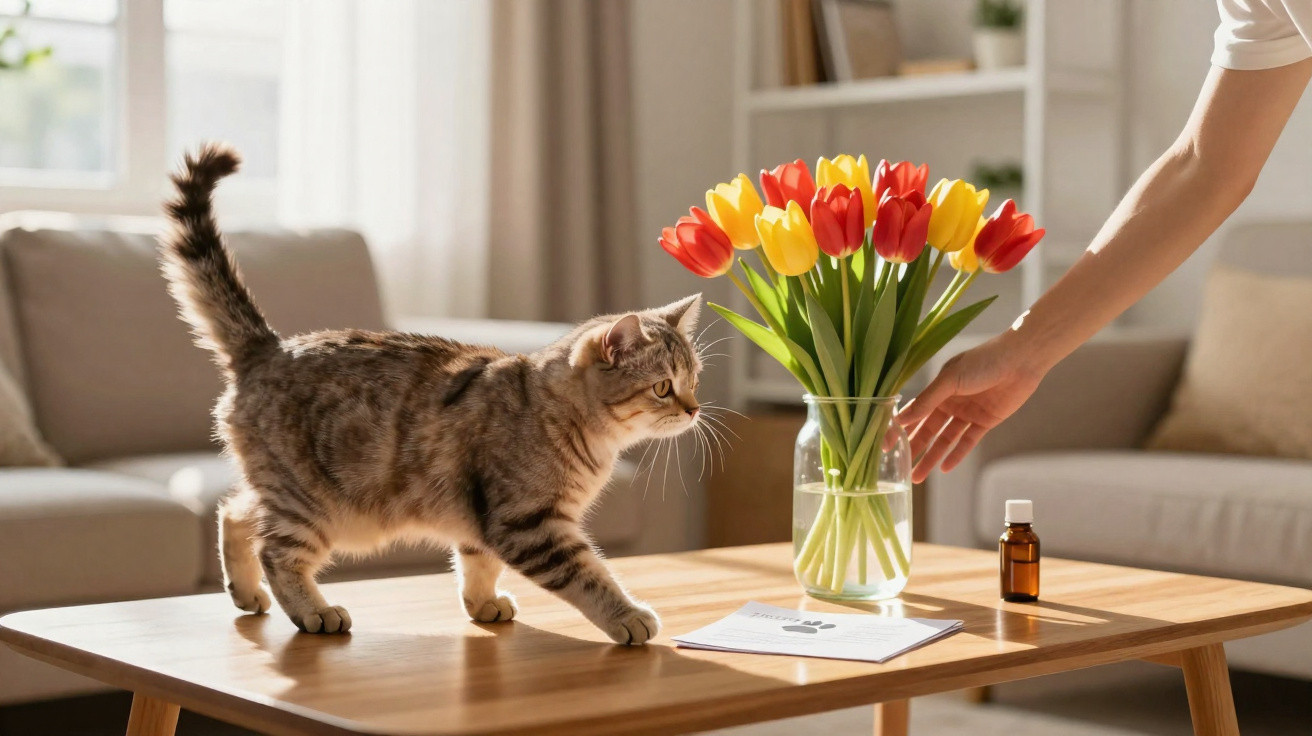
Many owners immediately think of oleander or poinsettias when poisonous plants are mentioned. Tulips, by contrast, seem harmless: they appear in countless front gardens and flower bouquets. That is precisely why the question arises: can cats safely sniff tulips, or do they pose a serious health risk?
How poisonous tulips really are for cats
Tulips are not among the most toxic plants, but they are certainly not harmless. They are considered moderately poisonous to cats. Even small quantities can cause symptoms; severe poisoning is uncommon but cannot be ruled out entirely, particularly if a cat chews on the bulbs.
Several tulip species are affected, including:
- Tulipa gesneriana – the familiar garden tulip commonly found in flowerbeds and bouquets
- Tulipa clusiana – more often seen in the warmer parts of Europe
- Tulipa agenensis – a wild species occurring in parts of Europe and the Middle East
All of them contain compounds known as tulipalins. These substances protect the plant from fungi and bacteria, but in a cat’s body they irritate the mucous membranes and digestive system.
Tulips are poisonous to cats, especially the bulbs. Poisoning is usually mild, but it should always be assessed by a vet.
Where tulips pose the greatest danger to cats
Although the toxins occur throughout the plant, they are not evenly distributed. The most concerning parts are:
- Bulbs – these contain the highest concentration of tulipalins
- Stems and leaves – moderately toxic and capable of causing symptoms
- Flowers – often the part kept in a vase indoors that attracts an inquisitive cat
Cats do not usually eat large amounts of tulip because the taste is unpleasant and the plant is irritating. Often, they chew it a few times and then leave it alone. Even so, this kind of “taste test” can be enough to trigger noticeable symptoms.
Typical signs of tulip poisoning in cats after contact
If a cat has eaten part of a tulip, symptoms generally develop fairly quickly, often within a few hours. Commonly observed signs include:
- Digestive problems: nausea, vomiting, soft stools or diarrhoea
- Excessive salivation: strings of saliva around the mouth, repeated swallowing or lip-smacking
- Irritated mouth lining: refusing food, chewing cautiously or licking the lips
- General discomfort: withdrawing, reduced activity and, occasionally, mild trembling caused by stress and discomfort
In most cases, these relatively mild to moderate symptoms are all that occur. This is because cats rarely consume large quantities: they are selective and highly sensitive to unfamiliar tastes.
Anyone who suspects that their cat has eaten tulips should always call a veterinary practice or emergency vet straight away, even if the animal still appears “relatively normal”.
When tulip poisoning can become dangerous
The situation becomes more serious if a cat gets hold of bulbs in the garden or in a plant pot. The concentration of toxins is much greater there. Small, young or already unwell animals are also more sensitive.
Warning signs that mean owners must not wait include:
- persistent or very frequent vomiting
- severe diarrhoea, possibly containing blood
- marked weakness, an unsteady gait or apathy
- pain when the abdomen is touched or loud meowing
If any of these signs develop, the cat needs veterinary treatment promptly. The sooner treatment begins, the better the situation can be managed.
How a vet treats tulip poisoning
There is no specific antidote for tulipalins. Treatment is based on the symptoms and aims to support the body. A veterinary practice will often use the following measures:
- Fluid therapy: intravenous fluids to replace fluid lost through vomiting and diarrhoea
- Anti-sickness medication: known as antiemetics, which calm the vomiting centre
- Anti-diarrhoea preparations: to help stabilise the bowel
- Stomach protection: medicines that soothe the stomach and intestinal lining
In many cases, symptoms improve considerably within 24 hours when the cat receives timely treatment. Without veterinary support, however, the condition may worsen unnecessarily.
What owners may do – and what they must not do
If you see your cat chewing a tulip, stay calm first and then act methodically.
| Action | Recommendation |
|---|---|
| Secure plant remains | Collect any bitten-off pieces, remove the tulip, and keep it for the vet or take a photograph. |
| Contact a vet | Call your veterinary practice or emergency vet and explain the amount eaten and when it happened. |
| Do not induce vomiting | Never give home remedies or try to “make the cat vomit”. |
| Monitor the cat | Keep a close eye on behaviour, food intake, stools and vomiting. |
Home remedies such as milk, oil or salt have no place in cases of acute poisoning in cats. In the worst case, they can make the situation considerably worse.
Making tulips safe around cats: practical tips for home and garden
Anyone who loves tulips does not necessarily have to stop having them altogether, but should make a few adjustments to everyday life. A few simple measures can greatly reduce the risk.
Indoors: place cut flowers wisely
- Put vases out of climbing reach, rather than on a coffee table or windowsill
- Do not leave trailing foliage that the cat may chew out of curiosity
- Do not pour vase water into bowls; dispose of it directly instead
- Ideally, display cut-flower bouquets in rooms that can be closed off
In the garden: protect beds and offer alternatives
- Plant tulips in beds shielded by low fences or mesh
- Cover bulbs in the ground with wire mesh so that the cat cannot dig or scratch at them
- Place planters on plinths or walls that are less appealing to cats
- Create a much more attractive “permitted area”, such as a bed containing cat grass and catmint
An appealing alternative will particularly help to distract many animals from the tulip bed. Cat grass also helps them get rid of hair from the stomach, which is a welcome additional benefit.
Why cats chew plants at all
For many owners, it seems illogical: the cat receives high-quality food yet still goes for the flower bouquet. There are several reasons behind this behaviour:
- Instinctive behaviour: free-roaming cats also consume some plant matter through their prey.
- Getting rid of hairballs: plant fibres often encourage vomiting, helping to expel swallowed hair.
- Curiosity and boredom: a new object that moves and has a scent invites investigation and tasting.
Providing enough safe plants for your cat to chew reduces the risk that it will choose tulips instead.
Other risky plants for cats to keep in mind
Besides tulips, a number of other popular ornamental plants can cause problems. Cats can be particularly sensitive to:
- lily species such as tiger lilies or daylilies
- dumb cane and other arum-family plants
- ivy, oleander and poinsettias
- certain orchid species
Before buying a new plant, it is worth taking a quick look at current lists of poisonous plants for pets. Many veterinary practices and poison information centres provide suitable guides.
By positioning tulips sensibly at home, monitoring the cat and responding in good time, you can enjoy spring’s colourful flowers without putting your four-legged companion’s health at risk.




Comments
No comments yet. Be the first to comment!
Leave a Comment