
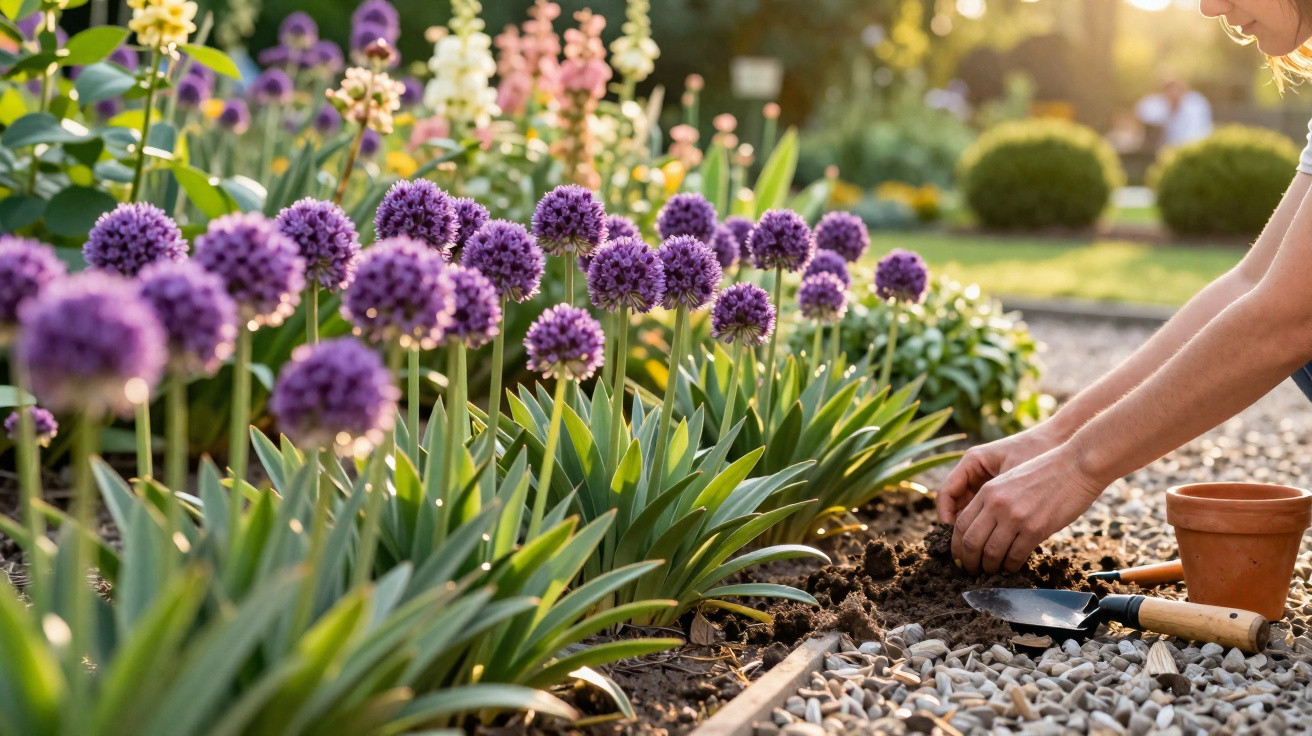
Anyone looking to give a garden path or flower bed a neat border often turns to the familiar boxwood – despite disease, watering demands and repeated clipping. A compact ornamental onion from North America shows there is another option: Allium ‘Millenium’ creates a tidy, colourful band throughout summer while needing little water and virtually no pruning.
Why so many flower-bed borders disappoint in summer
The plan sounds simple: an attractive green line beside a path, complemented by flowers that last into late summer. In reality, the result rarely meets expectations. Many perennials flop after heavy rain, while others scorch in full sun or disappear altogether after one or two winters.
Boxwood was long considered a dependable choice, but it is now under pressure from box tree caterpillars, fungal diseases and high maintenance costs. Many gardeners have removed their shrubs, leaving empty borders and uncertainty about what to plant instead. This is precisely where Allium ‘Millenium’ shows its strengths.
“Allium ‘Millenium’ provides the neat framework of boxwood, but with considerably less effort and more colour.”
Allium ‘Millenium’: a compact perennial with a defined edge
Botanically, Allium ‘Millenium’ belongs to the onion family, yet in a border it has the appearance of an elegant summer perennial. It forms dense clumps of narrow, glossy dark-green leaves. Growing upright to around 30 to 40 centimetres tall, it is ideally suited to path edges and low flower-bed borders.
Its leaves do not sprawl across the path; instead, they remain fairly firm and create the visual effect of an unbroken strip. Above them sit spherical flower heads measuring about five centimetres across. Looking like small violet-pink balls, they hover over the foliage for several weeks from mid-July onwards.
Flowering time, colour and garden impact
Its main flowering period runs from mid-July to the end of August, and may last a little longer depending on the region. At this point, many gardens lack clear structure: early perennials have finished flowering, roses are taking a break, and yews and similar evergreens offer little variation. The purple Allium spheres provide purposeful highlights during this period.
The way the flowers interact with sunlight is particularly striking. Their flower heads seem to glow in the evening sun. Yet the plants never look overpowering; instead, they bring order by edging paths, separating lawns from perennial beds or framing seating areas.
“Anyone seeking a clear line in the garden without reaching for the shears every four weeks will find this ornamental onion a good choice.”
Robust in frost, heat and drought
Allium ‘Millenium’ descends from ornamental onion species accustomed to drier, well-drained soils. The cultivar readily tolerates frost down to around minus 20 degrees Celsius and copes with sunny positions where other perennials have long since wilted.
A free-draining soil that does not remain waterlogged is ideal. Once established, the plant handles brief dry spells without difficulty. It remains remarkably sturdy even in light, sandy soils, making it well suited to front gardens or marginal areas alongside driveways.
Limited spread and no troublesome self-seeding
Many ornamental perennials either lose their shape or suddenly reappear throughout the bed. Allium ‘Millenium’ is notably well behaved: even at full growth, it generally reaches no more than 50 centimetres in height, does not invade neighbouring beds and rarely self-seeds.
This makes it especially suitable for narrow strips beside paths or walls, where only a fixed width is available. The plant fills the allotted space without overwhelming it.
How to plant Allium ‘Millenium’ for a perfect border
For a clean “band” along a path or patio, plant several specimens in a row. Leave approximately 30 to 40 centimetres between plants. This gives them room to form compact clumps without collapsing into one another.
- Position: Full sun to light partial shade, preferably sunny
- Soil: Loose and well drained; slightly calcareous soil is also suitable
- Planting time: Autumn is ideal; spring planting is also possible in mild regions
- Planting depth: About twice the bulb’s height, with the tip facing upwards
- Spacing: 30–40 centimetres between plants
Before planting, loosen the soil and remove any root remnants. In heavy clay soils, coarse sand or fine grit helps to prevent waterlogging. When creating a longer row, make a shallow planting trench and distribute the bulbs evenly within it.
Easy everyday care: how little this perennial requires
During the first year, a few targeted waterings are worthwhile to help the plants establish strong roots. After that, watering is only needed during extended dry periods. The regular watering required by summer bedding plants is unnecessary.
Once flowering has finished, the spent stems can be cut just above the foliage for an immediately tidier appearance. The leaves generally remain attractive into autumn, after which they can be removed completely at ground level if required as they die back.
“With just a few tasks each year, the border stays neat without the need for formal clipping shears.”
Practical benefits of Allium ‘Millenium’ in everyday gardening
The ornamental onion releases a light onion scent when its leaves are rubbed or cut. This fragrance brings a useful side benefit: deer, rabbits and hares generally avoid the plants. Even voles appear to be less comfortable in the immediate vicinity of the bulbs.
The flowers are highly attractive to bees, bumblebees and butterflies. For anyone planning a wildlife-friendly garden, an Allium border can create a genuine “runway” for pollinators. Along vegetable beds, it can even improve the pollination of tomatoes, cucumbers and similar crops, provided other flowering plants are nearby.
How to combine Allium ‘Millenium’
Planted on its own, this ornamental onion forms a calm, clearly defined band. Pairing it with other perennials creates more movement and variety. Reliable combinations include:
- Low grasses, such as fountain grass or blue fescue, for soft, mobile texture
- Coneflowers (Echinacea) behind the Allium row, using their larger flower heads to enhance high summer
- Gaura, creating an airy white or pink “cloud” in the background
- Compact roses, for gardeners who want a blend of structural planting and abundant flowers
Allium ‘Millenium’ is equally effective in containers. Several pots placed along steps or a patio establish a repeating line and look considerably more modern than traditional boxwood containers, with a much lower risk of disease.
When replacing boxwood makes sense
Gardeners with already unhealthy boxwood hedges often face a choice: replant them once more or switch to something different altogether? In sunny locations, moving to Allium ‘Millenium’ is particularly worthwhile for those who:
- do not have time for regular formal pruning;
- prefer a natural, insect-friendly garden;
- are dealing with box tree caterpillars and fungal problems;
- have light, dry soils where boxwood barely grows any longer.
In shaded areas, boxwood or another shade-tolerant hedge often remains the better solution. However, this decorative ornamental onion is well worth considering for every sunny strip alongside paths, driveways and patios.
Tips for beginners and small gardens
Anyone who feels unsure does not need to replace an entire border immediately. A good starting point is a two- to three-metre section beside a path or around a single bed. This makes it possible to observe how the plants perform in your own soil and climate.
Allium ‘Millenium’ is especially valuable in small urban or terraced-house gardens, where every square metre matters, because of its disciplined habit: it stays compact, does not fall apart and will not grow into the seating area. That also makes it suitable for people who regard themselves as “low-effort gardeners” but still value a clearly designed space.
Anyone already growing onion-family plants such as spring onions or garlic in the vegetable garden will immediately recognise the relationship with Allium ‘Millenium’ – except that this variety is purely decorative. Although it is not intended as a culinary onion, it shares the toughness of its edible relatives, and that is exactly what makes it such an advantage for flower-bed borders.
Comments
No comments yet. Be the first to comment!
Leave a Comment