
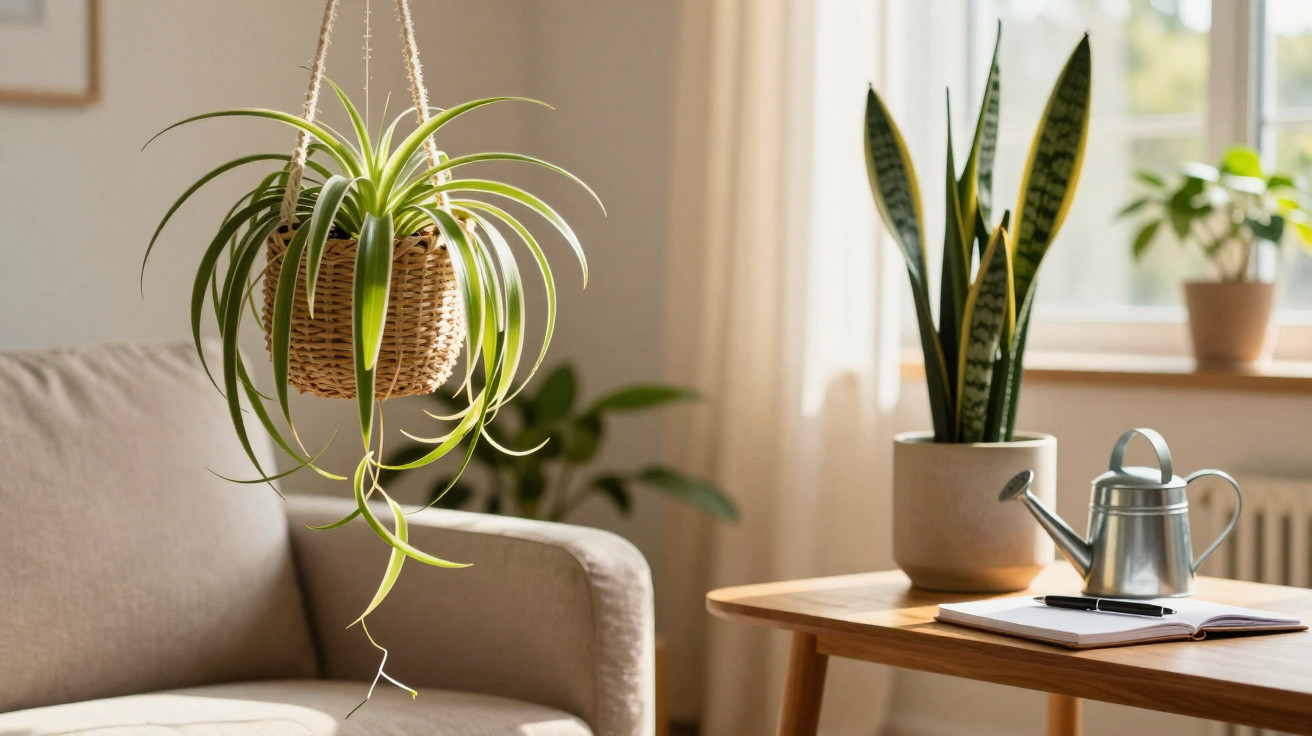
Many amateur gardeners lump the spider plant and snake plant together - quite literally, in the same pot. Both are considered easy to care for, and both are said to improve air quality. That apparent similarity often causes confusion: aren’t they simply two forms of the same houseplant? A closer look quickly reveals that these green classics use two entirely different strategies to survive indoors.
Related, but evolved along very different paths
From a botanical perspective, the spider plant (Chlorophytum comosum) and snake plant (Dracaena trifasciata, formerly Sansevieria) do belong to the same family, Asparagaceae. That may sound like a close relationship, but in practical terms the two species have been separated by millions of years of evolution.
The spider plant originates from tropical and southern parts of Africa. It grows there in relatively humid places, often in partial shade and with a regular supply of water. The plant produces a dense leaf rosette before sending out long runners bearing small young plants.
The snake plant, meanwhile, is chiefly native to West Africa, including Nigeria and the Congo. Its natural habitat is considerably drier. To cope with these conditions, the species developed thick leaves that store water - a clear benefit in areas with extended dry periods.
Spider plants and snake plants come from the same plant family, yet they follow completely different survival strategies.
This contrasting origin explains why they respond so differently in a living room: what benefits one can make the other unwell.
Appearance: cascading foliage versus upright green swords
Their most obvious difference is visible immediately: their growth habits and leaves could hardly be more contrasting.
Spider plant: a soft, homely green fountain
The spider plant forms long, narrow leaves that hang softly downwards. Growing from a central point, they spill over the edge of the pot like a green fountain. Depending on the variety, its leaves are rich green or striped lengthways, often with a pale centre or light-coloured edges.
Its runners are especially characteristic, with small ready-made plantlets hanging from them. These “babies” can be rooted in water or planted straight into compost. This makes it easy to raise a whole new generation of plants for a windowsill, office or as a gift for friends.
Snake plant: an architectural upright form
The snake plant relies on clean lines. Its rigid, upright leaves emerge directly from an underground rhizome. Many varieties look almost sculptural, which is one reason interior designers favour them.
Its colours range from dark green foliage with lighter horizontal bands to silvery leaves or varieties edged in gold. Depending on the cultivar, a snake plant may remain compact or develop tall “swords” reaching 1 metre or more.
| Feature | Spider plant | Snake plant |
|---|---|---|
| Leaf shape | Long, soft, hanging, grass-like leaves | Rigid, vertical, sword-shaped leaves |
| Growth habit | A rosette that cascades outwards | Upright clusters of leaves growing from rhizomes |
| Leaf texture | Soft and flexible | Thick, almost succulent-like |
| Propagation | Plantlets on long runners | Division of the rhizome or leaf cuttings |
| Flowers | Small white flowers on long stems | Rare greenish-white flowers, usually on older plants |
Their propagation methods make the distinction particularly clear. While the spider plant practically supplies its young plants ready to go, the snake plant must be divided or grown from leaf sections. With variegated varieties, leaf cuttings often lose the attractive pattern - a detail that frustrates many collectors.
Everyday care: what each plant needs
Both species are regarded as hardy, but their care requirements differ so greatly that they should never be treated in the same way.
Watering: a moisture lover meets a desert survivor
- Spider plant: prefers compost that stays evenly and lightly moist, but waterlogging must be avoided.
- Snake plant: needs watering much less often and copes extremely well with dry spells.
A spider plant is sensitive when its root ball dries out completely. Its leaves may become limp and their tips can turn dry. Watering once a week is a useful guide, perhaps slightly more often in summer and less in winter.
With a snake plant, too much water quickly leads to root rot. Anyone watering it as often as a spider plant risks killing it. Depending on its position, watering every two to six weeks is enough, and the pot can be allowed to dry out fully between waterings.
Light and humidity for spider plants and snake plants
Spider plants thrive in bright, indirect light, such as at east- or west-facing windows. They can manage with lower light levels, but will grow more slowly and produce fewer runners. They also benefit from slightly increased humidity, for example through regular misting.
The snake plant is much more adaptable. It remains reasonably healthy even in darker corners, although bright indirect light noticeably speeds up its growth. It does not need extra humidity and copes easily with dry air from central heating.
If you enjoy watering often, a spider plant is the better choice. If you tend to forget watering, a snake plant is a far safer option.
Temperature and nutrients
Spider plants prefer typical indoor warmth, ideally around 18 to 24 °C. Below approximately 10 °C, they show visible signs of stress. During the growing season, they appreciate a monthly feed.
Snake plants tolerate a much wider temperature range. Around 13 to 30 °C causes no problems, and they take short-term fluctuations in their stride. Feeding every three months is sufficient, while some specimens continue growing acceptably for years without additional nutrients.
For both species, high fluoride levels in tap water can often cause brown leaf tips. If this becomes a problem, use water that has been left to stand or filtered water.
Which plant suits which home?
Choosing between a spider plant and a snake plant depends greatly on your lifestyle, interior and watering habits.
Spider plant: ideal for hanging baskets and plant lovers with a routine
Thanks to its trailing growth, the spider plant is perfect for hanging baskets, shelves or plant stands. It is especially decorative where it has room to hang down. Anyone who enjoys propagating plants and giving them away will soon be pleased with it, as the “babies” appear almost in series along its runners.
It is well suited to homes where people air rooms and water plants regularly, and to households where someone pays conscious attention to plant care. If its care remains consistent, it rewards this with vigorous growth.
Snake plant: the perfect housemate for busy people
The snake plant performs best where time and light are limited: in offices, holiday homes, hallways or bedrooms. It does not mind if watering is occasionally forgotten and will tolerate even relatively dark room corners where many other species would die.
Its disciplined upright shape also suits modern, minimalist interiors. In narrow corners or beside a sofa, it uses little floor space and has more of the presence of a design object.
Health, air quality and pets: what to know
Both plants are frequently promoted using the term “air purification”. In laboratory tests, including research by NASA, the snake plant proved particularly efficient at breaking down pollutants such as formaldehyde and benzene. The real effect in an ordinary home is considerably smaller than marketing claims suggest, but it should not be dismissed entirely.
One point that many people underestimate is that both spider plants and snake plants contain substances that may cause discomfort if eaten by pets or small children. Reactions are generally mild, but can range from nausea to gastrointestinal upset. In homes with curious cats, dogs or toddlers, pots should therefore be kept out of direct reach.
Additional tips for beginners
If you are still unsure, use a simple rule of thumb: if the interval since the last watering was clearly too long and the compost is bone dry, the snake plant will usually cope better. If a plant has been kept too wet, the spider plant is more forgiving - provided waterlogging does not become permanent.
It is also worth combining both species in one room. The spider plant adds movement and softness, while the snake plant brings structure and calm. By using different positions - a hanging basket by the window and a snake plant in a room corner, for example - you can create a cohesive green scheme that works for a long time with little effort.
Comments
No comments yet. Be the first to comment!
Leave a Comment