
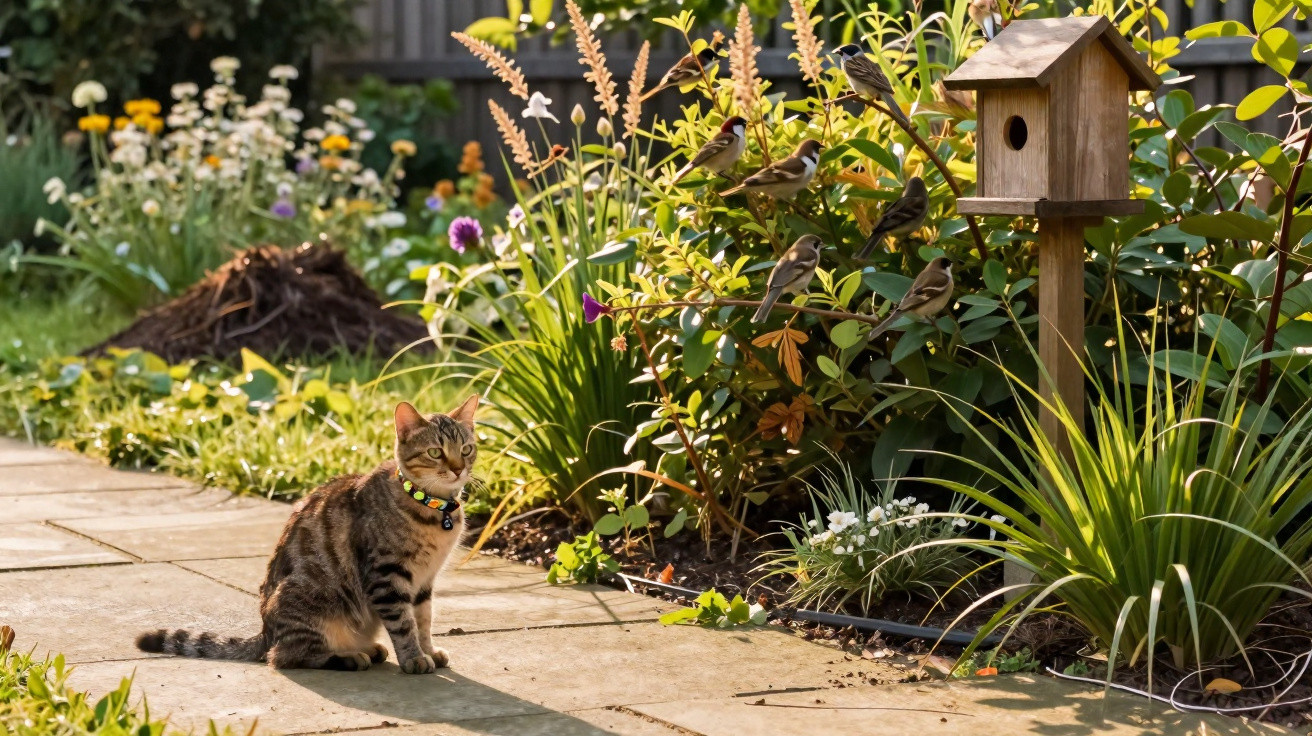
No more drama, no more feathers on the ground.
Many owners know the uncomfortable feeling: they love their cat, but they also enjoy the cheerful birdsong in the garden. When their feline companion repeatedly catches blackbirds, sparrows or robins, it leaves a sour taste. This is where a simple yet surprisingly effective approach comes in: rather than keeping the cat indoors, reshape the garden so birds can live far more safely while the four-legged resident remains content.
How serious the problem really is
What many people underestimate is that domestic cats may seem harmless, but biologically they are fully capable hunters. Studies from several countries indicate that they kill millions of songbirds every year. In places with a high density of cats, populations of familiar garden birds in particular come under pressure.
The explanation is straightforward: cats do not hunt solely because they are hungry; their instinct is triggered. Even the gentlest sofa cat with a full food bowl will stalk prey when it spots something fluttering. Around densely built-up residential areas, all these supposedly small hunts add up to a major problem for biodiversity.
“Even a single cat can noticeably affect a local bird population in a small garden over a number of years.”
The period from mid-March to late July is especially critical. Many species are nesting then, while fledglings sit on or close to the ground and are only just learning to fly, making them easy prey for cats.
Why a perfect lawn becomes a trap for birds
Many gardeners work hard to keep everything tidy: lawns cut short, hedges neatly trimmed, and leaves and branches thoroughly cleared away. It looks well maintained, but from a bird’s perspective it is an open battlefield.
What is missing are hiding places and areas with broken sightlines. Without tall grass, dense shrubs or wilder corners, young birds have little chance of escaping a sprinting predator. The cat can see every flap of a wing, has a clear run and can easily corner its prey.
- Flat lawn = a clear line of sight for cats
- No shrubs = hardly any cover for fledglings
- No dead wood or leaf piles = fewer insects, less food and fewer birds
Treating a garden like a golf-course lawn unintentionally removes every protective feature. The space becomes an ideal hunting ground - and that is exactly where the alternative approach begins.
The garden as a safe haven: how the principle works
The key step is remarkably simple: deliberately turn part of the garden into a bird “refuge”. It does not require a concrete wall or a cage for the cat, but a consciously imperfect, natural area.
“Rather than banning the cat, its success rate is reduced by making the space for prey less predictable and harder to see through.”
The four building blocks of a bird-friendly garden corner
Anyone wanting to begin in their own garden can use this basic structure as a guide:
- A tree or tall hedge as a focal point
Native species that produce fruit or berries are ideal. They provide food, perching spots and nesting opportunities. - Dense planting at ground level
Ground-covering plants with plenty of leaves and stems disrupt a cat’s sprinting route. The cat sees less clearly, gets caught up and loses speed. - Shrubs and thorns as a “protective belt”
Dense, preferably prickly bushes create escape spaces. Birds can get inside, whereas cats struggle to follow. - Untidy crowns and branches overhead
Branched, slightly tangled tree canopies deny the cat a clear view. Targets become more difficult to pick out.
A possible plant selection for gardens in the UK and similar temperate climates:
| Element | Suitable examples | Benefit for birds |
|---|---|---|
| Tree / tall shrubs | Rowan, hawthorn, hazel | Nesting sites, berries, insects |
| Ground cover | Cranesbill, sedges, ground-cover roses | Cover and escape routes |
| Thorny bushes | Dog rose, blackthorn, firethorn | Safe retreat, nest protection |
| Additions | Deadwood piles, leaves, stone banks | Insects as a food source |
A pause in maintenance is important: from mid-March until late July, leave this area as undisturbed as possible. Do not prune it or thin it out heavily. This preserves the structure birds need during the breeding season.
Safe nesting sites: giving cats little chance
Relying on natural hiding places alone is rarely enough. Anyone who genuinely wants to make a difference can add strategically positioned nest boxes to the garden - provided they are installed correctly.
- Put nest boxes at a height of around 3 metres.
- Avoid placing easily accessible branches directly beside them as a “ladder”.
- Keep roughly 15–20 centimetres between the entrance hole and the base of the box.
- Do not fit wide ledges or perches where cats can get a grip.
The more difficult the climbing route, the safer the nest. Birds quickly become accustomed to well-sited boxes and often use them for years once they have accepted them.
How owners can support their cat
Designing the garden is the first step. The second is guiding the cat’s behaviour without causing frustration.
Limiting seasons and times of day
During the main breeding season from March to July, it is worth planning outdoor access more carefully. Reducing exposure during birds’ usual hunting-risk periods is particularly effective:
- Dawn and dusk are the main periods of bird activity.
- If a cat is mainly outdoors during the day, its catch rate falls noticeably.
- Songbirds are generally quiet at night, although other animals are active, so much depends on the local setting.
Many owners report that even a modest change in routine has noticeable effects - for instance, allowing the cat outside only after breakfast and bringing it in earlier in the evening.
Bright colours against surprise attacks
Visibility is another useful tool. Native birds respond strongly to colour and movement. Very colourful collars or specially designed “bib” covers can use this principle by making the cat more conspicuous.
The idea is that a bird notices the approaching animal sooner and can get to safety. Combined with indoor hunting games - feather wands, balls and puzzle boards - this keeps the hunting instinct engaged without harming real prey.
Why this approach works so well
The greatest advantage of this strategy is that it does not remove the cat’s freedom; it changes the environment instead. Hunting becomes harder work, less successful and, in some cases, simply frustrating. After a while, many cats give up on their own and would rather watch from the patio than squeeze through dense undergrowth.
“Anyone who creates a garden with varied structure, a little more wildness and deliberate untidiness protects birds - and also gains more life, colour and sound right outside the door.”
There is another benefit: more plants, dead wood and leaf litter attract insects, spiders and small creatures. This develops into a small ecosystem that is more stable and more resilient during heatwaves or dry spells. Birds find more food, hedgehogs and amphibians appear more often, and children have something to observe outdoors again.
Anyone unsure which plants are suitable locally can consult local conservation groups or council parks and green-space departments. They often provide recommendations for native species that are both easy to maintain and wildlife-friendly.
There will never be zero risk: a cat remains a predator. But the more owners turn their gardens into small safe havens, the more birds will make it through the critical breeding season. The effort is manageable, the effect in the immediate area is clear - and the guilt felt when looking at the snoozing house cat becomes noticeably lighter.




Comments
No comments yet. Be the first to comment!
Leave a Comment