
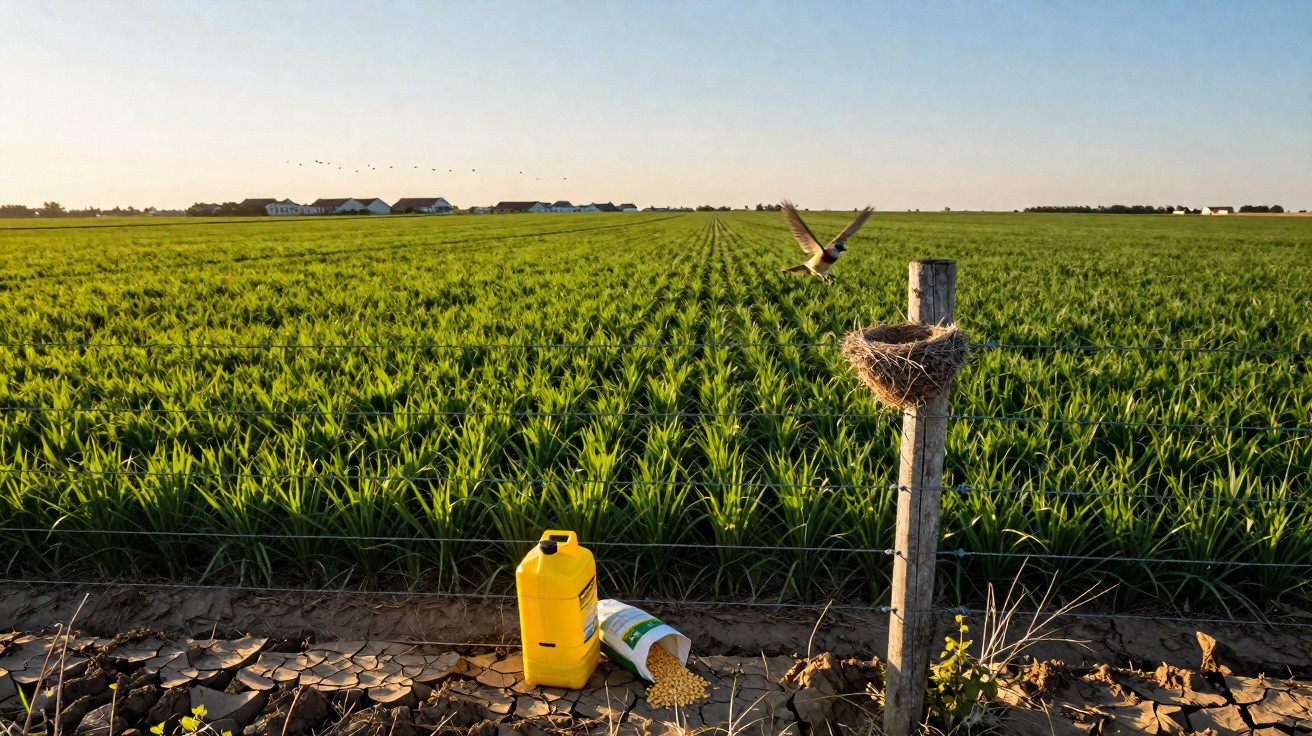
For decades, North America was regarded as a paradise for birdwatchers, with vast migration routes and spectacular flocks. A large-scale assessment of long-term data now shows that the continent’s birdlife is under severe pressure – and increasingly intensive agriculture is accelerating the decline.
Study using 35 years of data: the decline is speeding up
An international research group led by ecologist Petr Keil of the Czech University of Life Sciences Prague and biologist François Leroy of a US university assessed records from more than a thousand observation sites across the United States. Volunteers and professionals have counted birds at these locations at regular intervals for decades, including through nationwide monitoring schemes.
The researchers examined 261 common bird species, asking two questions: how much have populations changed since the late 1980s, and is the pace of that decline itself changing?
The alarming finding: almost half of the species examined are clearly in decline, and for many of them the rate of loss continues to increase each year.
The data reveal the following details:
- Almost 50 per cent of species show a clear, long-term decline.
- The decline is accelerating for 63 species: on average, more individuals disappear each year than in the preceding year.
- Around 60 species are still increasing, but their growth is slowing – and they cannot offset the losses among the other species.
This is therefore no longer simply a slow fading of populations that might play out over generations. Much points to a tipping point at which entire ecological communities in agricultural landscapes rapidly fall out of balance.
Intensive agriculture is the main driver – ahead of climate
The assessment combines population records with land-use and climate information. This makes it possible to identify the regions where the downward trend is accelerating most sharply and the factors that dominate there.
The pattern is clear: areas of intensive agricultural production are particularly badly affected. Vast monocultures, heavy pesticide use, and the loss of hedgerows and wetlands all directly affect birds that live in and around farmland or forage there.
Where agricultural landscapes have become production factories, bird populations are collapsing at a particularly rapid pace.
The researchers therefore view agriculture as a key force intensifying other environmental pressures. Climate change also plays a part, for instance through altered rainfall, heatwaves and shifts in breeding periods. Yet in many regions, pressure from land use appears to be the more immediate and severe blow. It also worsens climate impacts, as peatlands dry out, soils become depleted and more fertiliser enters rivers.
Farmland bird losses and a few urban-edge winners
The accelerating decline chiefly affects species dependent on open farmland or wetlands. Typical “losers” in these systems include:
- Meadow-nesting birds such as larks and snipes, which require undisturbed grassland
- Farmland birds that breed in cereal and maize belts or hunt insects there
- Waterbirds and waders whose feeding and stopover sites have been drained
Some generalist species – those able to cope with a broad range of habitats – are faring better. A few may even benefit from habitat features on urban fringes, in parks or in low-density suburbs. Some woodland bird species also appear more stable, at least where substantial areas of forest remain intact.
Even so, the losses in agricultural landscapes carry far greater weight. The limited gains cannot compensate for the major collapses among characteristic farmland and wetland birds. Ecologically, this creates an impoverished bird community: fewer species, fewer specialists and more resilient, widespread birds.
Why bird decline affects everyone
At first glance, this may seem like an issue for ornithologists, but it concerns vital ecosystem functions – and ultimately agriculture and food security as well. Birds pollinate far fewer plants than insects, but they perform numerous other roles.
| Role of birds | Example from agricultural landscapes |
|---|---|
| Pest control | Songbirds catch caterpillars and beetles that could otherwise damage crops. |
| Seed dispersal | Berry-eating birds spread shrubs and trees that provide shelter from wind and shade. |
| Indicators of environmental condition | Population declines provide early warning of problems with pesticides or water quality. |
| Nutrient cycling | Colonies of waterbirds transfer nutrients between water bodies and land. |
If these functions break down, the long-term effects may also extend to yields, soil quality and pest pressure. Many experts therefore describe birds as the landscape’s “fever thermometer”: when the temperature rises, the problem is usually not confined to a single population.
North America as a warning sign for Europe
Although the findings directly concern North America, they fit alarmingly well with developments in Europe. Farmland bird populations here have also been shrinking for years. Studies by the BirdLife partnership and European research institutes show that birds in farming-dominated regions, above all, are suffering major losses, while some urban species remain comparatively stable.
The North American study now adds an important detail: the decline is not linear, but is accelerating in many places. Policies based on the assumption of slow change spread across generations may therefore arrive too late.
Those who wait until species are close to disappearing must invest disproportionately more – and still face lower chances of success.
What the study means for agricultural policy and practice
The data point to a simple but uncomfortable conclusion: without fundamental reform of intensive agriculture, the decline in bird populations is unlikely to be halted. Individual protected areas are not enough if vast areas between them are, in practice, uninhabitable for wildlife.
In practical terms, experts repeatedly identify similar measures:
- More hedgerows, field margins and flowering strips, offering food and cover for insects and birds
- Fewer pesticides and targeted support for beneficial organisms
- Protection and rewetting of wetlands and ditches
- Later mowing and adjusted harvesting times in breeding areas
- More varied crop rotations instead of extensive monocultures
Such measures require money and land, but they can also benefit farmers through more stable yields, more pollinators, reduced pest pressure and improved conditions for soil organisms.
How members of the public can respond
Not everyone manages hundreds of hectares of land. Nevertheless, private choices also influence whether birdlife continues to thin out or begins to recover. Domestic gardens, balconies and municipal green spaces can play a surprisingly important role, especially as stepping stones between larger habitats.
Practical options include:
- Planting native shrubs and trees that provide berries and insects
- Avoiding gravel gardens and allowing diverse, flower-rich areas instead
- Feeding birds with clean food and cleaned feeding stations, especially in winter
- Putting up nest boxes and creating year-round refuge areas
- Supporting political pressure for farming policy that is more compatible with nature
These steps cannot replace reforms across large areas, but they can ease local pressure on bird populations and strengthen their resilience.
Background: what “accelerating decline” actually means
Until now, many studies have considered only whether populations are increasing or decreasing. The current assessment goes one step further by examining changes in the speed of that trend. Put simply, there is a difference between a species declining by two per cent every year and that figure suddenly becoming three, four or five per cent.
In population biology, this is described as negative acceleration: the annual loss becomes greater over time. The effect can remain unnoticed for a long period, particularly when total numbers are initially still high. At some point, however, the system reaches a tipping point: breeding pairs cannot find enough food, fewer young birds survive, and the species becomes extremely sensitive to further disturbance.
This is precisely the dynamic that now appears to be taking hold in many North American agricultural landscapes. The continent once known for spectacular migratory bird movements is thus sending a clear warning signal – including to regions such as Central Europe, where farming systems have become similarly intensive.



Comments
No comments yet. Be the first to comment!
Leave a Comment