
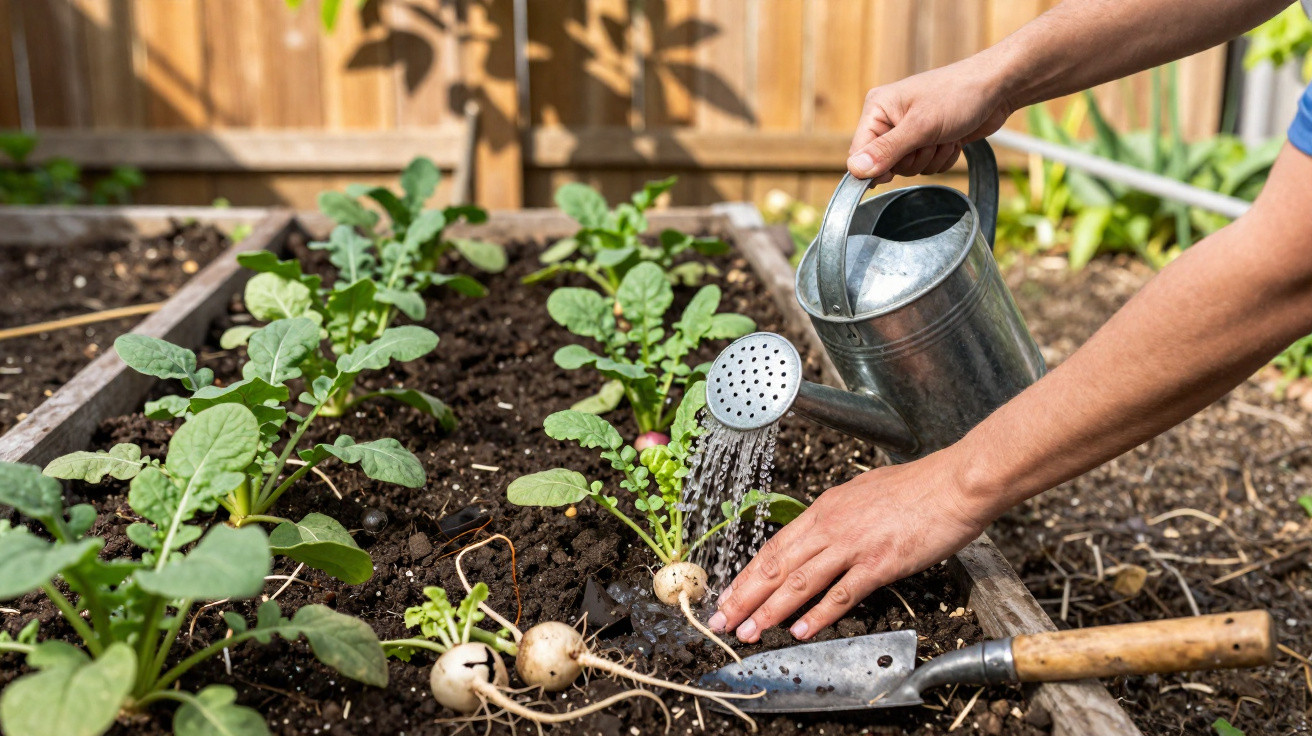
A simple watering trick changes everything.
Radishes are often considered the perfect vegetable for beginners: fast-growing, straightforward and almost foolproof. In reality, things frequently turn out differently. The roots become hot, split or remain tiny. The answer is less often fertiliser than the combination of position, soil, watering, and sowing and harvesting at the right time.
Why radishes become hot, woody or split
Radishes grow at remarkable speed, yet they are highly sensitive to stress. Fluctuations in their water supply in particular quickly affect both flavour and texture.
“The most important trick for perfect radishes is not a miracle product, but a bed that stays evenly moist – without extreme dry spells and without waterlogging.”
When the opposite happens, familiar problems arise:
- Prolonged drought: The roots become hot, tough and fibrous.
- Heat and blazing sunshine: These encourage pungency and make the roots turn woody quickly.
- Sharp changes in moisture: Following dry conditions with a great deal of water can rapidly cause the roots to split.
Radishes make their stress very obvious. To harvest them crisp, mild and juicy, give them conditions that are as steady as possible – especially where watering is concerned.
The simple watering trick: consistency rather than downpours
The real “secret tip” is not spectacular: radishes do not want a weekend watering binge, but constant moisture in the topsoil.
A few straightforward measures make this possible:
- Water modestly and regularly: It is better to give a little water every day or every other day than a large amount every five days.
- Water the soil only: Apply water directly along the rows instead of spraying the foliage. This saves water and helps prevent fungal issues.
- Check the moisture level: Push a finger 2–3 cm into the soil. Water if this layer feels dry.
- Use mulch sparingly: A thin layer of grass clippings or fine compost helps retain moisture without smothering the small plants.
Warm, windy spells in spring are particularly tricky. The surface then dries out extremely fast, even though there may still be some moisture beneath the soil crust. It is precisely these changes that put plants under strain. Those who maintain an even water supply at this point will notice the difference in the bed and later on the plate.
The best place for radishes: soil, light and temperature
Radishes forgive a lot, but they have clear preferences when it comes to their growing spot. Meeting them makes gardening easier.
The right soil for crisp radish roots
A loose, humus-rich soil that holds water well without becoming waterlogged is ideal. Heavy, compacted soil produces bent or misshapen roots, dries quickly at the top and stays soaking wet below.
For a productive bed, it is worth doing the following:
- Loosen the soil and break up large clods.
- Work in mature compost if the soil is very sandy.
- Avoid waterlogging, for example with slightly raised beds or effective drainage.
Very fresh fertiliser with a high nitrogen content, however, does not benefit radishes. It encourages plenty of leaf growth while the roots stay small or become hot.
Light and temperature – sunny, but not relentless
A sunny position with a little partial shade is ideal. Full midday sun combined with heat on bare, dark soil stresses the plants. For many home gardeners, a spot receiving sun in the morning and late afternoon works best.
Radishes prefer cooler conditions. Early varieties grow well while nights are still fresh. In high summer, it is better to choose more heat-tolerant varieties or use lightly shaded areas.
Planning radish sowing properly: spacing, depth and the best rhythm
Anyone sowing radishes like carrots – densely and without a plan – should not be surprised by tiny roots later on. Spacing determines whether the roots can develop properly.
The key measurements: depth and spacing
Successful sowing only requires a few simple steps:
- Make a shallow drill around 1 cm deep.
- Place the seeds in the drill, spacing them 3–5 cm apart.
- Leave roughly 15 cm between rows.
- Cover with fine soil or sieved compost, then water gently.
If seeds are sown too closely, thinning is necessary after they emerge. Otherwise, the plants compete for space, water and nutrients, leaving the roots thin and misshapen. When thinning, a distance of 5–8 cm is sensible, depending on the variety.
“Sowing too densely is one of the most common reasons for disappointing radish harvests – not a lack of fertiliser.”
Succession sowing: no more radish glut
Another professional trick is to grow them in “batches”. Rather than filling an entire seed bed in one day, divide sowing into small portions.
A practical schedule for an average garden:
- Sow a short row or a small bed every two weeks.
- Only sow as much as the household can realistically eat in one week.
- During hot periods, consider skipping a sowing and continuing later instead.
This provides a continuous supply of fresh roots from the garden without suddenly having to use up a whole sink full of radishes. The soil remains actively used, while gaps in the bed can be filled neatly.
The right time to harvest: earlier is better than later
Radishes are among the fastest-growing vegetables of all. Depending on the variety and weather, they are often ready to harvest after just 4–6 weeks. Many people wait too long, with noticeable consequences for texture and flavour.
| Feature | Ready to harvest | Harvested too late |
|---|---|---|
| Size | From hazelnut-sized up to a maximum of walnut-sized | Sometimes considerably larger and uneven |
| Flesh | Firm, juicy, delicate | Spongy, fibrous, hollow inside |
| Flavour | Mildly hot, pleasantly savoury | Aggressively hot, unpleasant |
If unsure, simply pull one root from the row as a test. If it is still very small, wait a few days. If it already seems large and the nights are warm, do not delay much longer.
One advantage is that radishes keep well for a few days in the salad drawer if the leaves are removed and the roots are stored in a container or wrapped in a damp cloth. Leaving them “parked” in the bed, on the other hand, works poorly – their quality declines there almost daily.
Using radishes intelligently in bed planning
Thanks to their rapid growth, radishes are perfect for spring crops and catch crops. They make use of periods when other vegetables are only just getting started.
Popular combinations in the bed include:
- Between lettuce plants: Radishes are ready before the lettuce needs much room.
- As marker sowings: Sow between slow-growing crops such as carrots or parsnips so the rows become visible early.
- Before heat-loving vegetables: Radishes make use of spring until tomatoes, peppers or courgettes are planted out.
This lets the same square metre of soil work several times a year without becoming exhausted – provided enough organic matter and compost are returned to it.
Avoiding common mistakes – and using radishes creatively
Many unsuccessful radish crops can be traced back to a handful of recurring errors:
- Irregular watering with long dry spells
- Sowing too densely without thinning later
- Harvesting too late during warm spells
- Heavy, compacted soil that has not been loosened
- Choosing unsuitable varieties for the season
Keep these points in mind and you have already done almost everything right. Any remaining variation will then add character rather than result in complete failure.
It is also worth looking beyond the classic bread-and-butter topping. Radishes work raw in colourful bowls, in potato salad, as a crisp addition to Asian-inspired dishes, or lightly fried in a pan, where they become milder and sweeter. Once thoroughly washed, the leaves can be used for pesto, soup or blended into smoothies, rather than being discarded in the food-waste bin.
There is another point that many underestimate: for anyone gardening regularly with children, radishes are an ideal introduction. Seedlings appear quickly, success is visible, and the short period from sowing to harvesting keeps the excitement high. At the same time, young gardeners learn directly how strongly water, sunlight and timing shape the quality of vegetables.
Comments
No comments yet. Be the first to comment!
Leave a Comment