
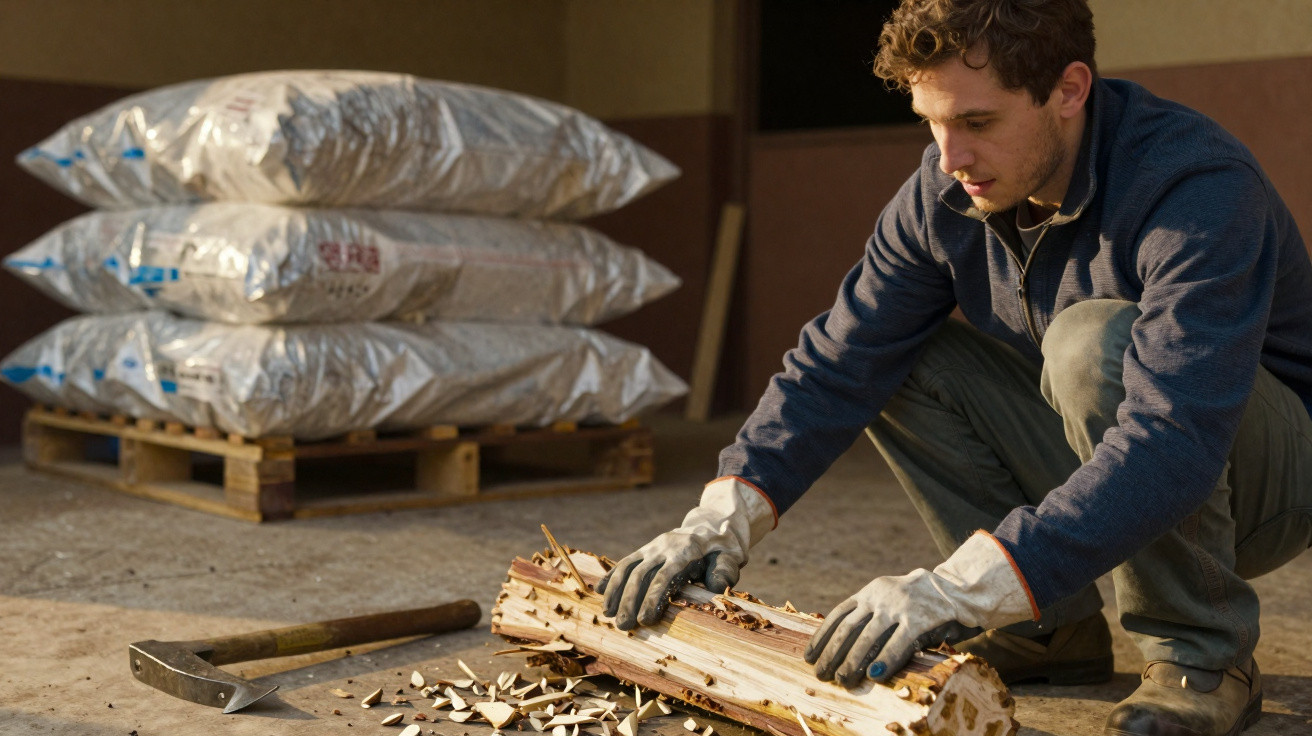
The smell hits you first: damp and sour, rather like a basement left closed for too long. A man unlocks his shed wearing a smile that is equal parts proud and uneasy, prepared to reveal the firewood he piled up “for the whole winter.” Then the expression vanishes. Every log is soft, dark at the ends and covered in furry mould. He picks one up and it breaks apart in his hand. Months spent cutting, carrying, stacking and “being prepared” have simply disappeared.
He makes a joke of it, though his clenched jaw says otherwise. Beyond the shed, the wind feels that bit harsher. With energy prices climbing, the electricity supply seeming uncertain and his emergency reserve now reduced to compost, the loss stings. Online, people are already ridiculing “city folks who don’t know how to store wood.”
Nobody had told him there was a proper way to do it.
When your winter backup plan becomes a rotting heap
We all recognise that moment: you believe you have finally acted sensibly and responsibly, only for reality to prove you wrong. This year, thousands of people across Europe and North America hurried to buy firewood. Some had never lit anything beyond a scented candle. They packed garages and sheds with it, or covered stacks beneath balconies with tarpaulins. It seemed like a quiet way to push back against high bills and power cuts.
Then the first proper cold spell arrived. When people tried to light their “emergency stash”, they found wet logs, mouldy bark and unhealthy-looking steam rather than clear flames.
Marie, 39, who lives in a small Vermont town, sent me a photograph that looked made for a meme. Her large woodpile had been proudly arranged against a concrete wall and tightly covered with a heavy blue tarpaulin. Underneath, though, it was all black and spongy. “I thought I was being clever,” she wrote. “The guy who delivered it just dumped it and left. No one said anything about airflow or seasoning or whatever.”
Her experience is being repeated everywhere at the moment. Reddit is full of posts about ruined stacks. Facebook groups are filled with people wondering whether they can “dry wet logs in the oven.” Local firefighters are discreetly cautioning against burning half-rotten, smoky wood in stoves that were already only just adequate.
The most unusual thing is not the firewood that has rotted, but how people respond to it. Beneath almost every post in which someone admits they stored wood badly, there is a stream of mockery: “Basic survival, dude.” “My grandpa taught me this at five.” “If you don’t know how to stack wood you deserve the bill.”
That is the obvious joke. The more difficult reality is that an entire generation was raised with central heating rather than woodpiles. No one took them into the garden and showed them why wood needs a year, why ground contact ruins it, or why plastic tarpaulins can become deadly saunas for logs. This know-how gradually left everyday life and moved into YouTube tutorials - and some people only encounter that missing knowledge when their winter reserve falls apart in their hands.
How firewood survives for months without turning soft
People who genuinely depend on wood heating will say the answer is unexciting: drying and ventilation. It is not about an expensive axe or an Instagram-ready stack, but time and room around the wood. Newly cut “green” wood can contain more than 50% moisture. For it to burn hot and cleanly, that figure must fall to around 20%. It will not happen on its own.
The most dependable approach is almost too straightforward. Split the logs. Raise them above the ground using pallets, rails, old bricks or anything similar. Arrange them so air can travel between the rows. Protect only the top, while leaving the sides exposed. Then leave the stack alone for a year - or two if the wood is a dense hardwood.
The major error this winter was not purchasing firewood, but handling it as though it were food shopping. People stored damp logs in sealed garages, pushed tightly against walls and, in some cases, shrink-wrapped beneath plastic “to keep the rain off.” It looked neat from outside. Within those stacks, however, the moisture had no way out. Mild days, cold nights, condensation and mould followed. By December, many piles had become little more than fungus farms.
In truth, few people will do this every day, but checking once or twice a season with an inexpensive moisture meter can prevent plenty of frustration. Press it into the newly split face of a log. Below 20%? Fine. Above it? The wood may still be “cooking”, regardless of how dry its exterior appears.
Why do experienced wood-stackers react with such exasperation? Pride plays a part. For anyone who spent each summer stacking cords, this is not “knowledge”; it is muscle memory. Yet muscle memory cannot be passed on through the internet, and shaming anyone has never dried a log.
Basic physics is what stops wood from rotting: airflow carries away moisture, a roof keeps off direct rain, and time lets nature work slowly. Rot thrives on three things - dampness, darkness and contact with soil or concrete. Give it any two, and your “security stash” can begin decomposing months before you light the first match.
From online mockery to practical firewood skills: what people need to hear
There is an unspoken moment just before a person gives up. You have read three smug replies, watched half a tutorial and are looking at a miserable damp woodpile, thinking, “Maybe I’m just not the kind of person who does this.” That is precisely when one simple, practical action could make all the difference. Start here: if the wood is directly on the ground or resting against a wall, the first act of “basic survival” is not chopping it. It is raising it up.
Push pallets underneath it. Put down lengths of timber. Use old concrete blocks. Any option that creates a few inches of air beneath the logs will help. Next, expose the sides. Pull back a fully wrapped tarpaulin and use it as a roof covering only the upper third.
Many of this winter’s viral failures came from a well-meaning but damaging urge: keeping every single drop of water away. That instinct makes sense if you live in a flat, where a leaking window can spoil an entire week. Wood follows a different logic. It behaves less like a sofa and more like washing. Trap it in the name of keeping it “safe”, and it never properly dries. Think “umbrella”, not “plastic bag.”
Time is another factor people frequently underestimate. Buying logs in October for a February emergency may sound sensible, but for many wood species and climates it is merely wishful thinking. Experts refer to “next winter’s wood” as the minimum. That is not gatekeeping; it is physics and patience.
“Mocking people for not knowing how to store firewood is like laughing at someone for not knowing how to hand-milk a cow,” says Jonas, 57, who heats his whole house with a single old stove. “We stopped passing this stuff down. That’s on us, not them.”
When I asked several experienced wood-burners what they would actually advise beginners, most offered the same four or five straightforward rules. There was nothing mystical or macho about them - just a short mental checklist:
- Split wood as soon as possible. Large rounds remain damp at their centre for a very long time.
- Keep logs raised off the ground and prevent direct contact with walls.
- Cover the top of the stack, but leave its sides open to sun and wind.
- Plan one or two winters ahead rather than preparing for a single storm.
- Trust your hands and eyes: lighter logs, cracked ends and a hollow sound indicate drier wood.
When “basic survival” is no longer basic
A quiet resentment runs beneath all those posts about spoiled firewood. It is not solely about the cost or the labour that went to waste. It comes from feeling that life has misled you. We were taught that working and paying the bill meant the heating would come on. Now people feel expected to turn overnight into electricians, gardeners and amateur preppers - and when they get it wrong, comment sections descend on them.
The straightforward truth is that much of what was once everyday knowledge now sits at the edges of society, held by enthusiasts, older people and dispersed rural families. A bridge needs rebuilding between them and the millions who suddenly need to think about backup heating.
Perhaps it begins with small actions that barely register. A neighbour could come over and help restack a mouldy pile instead of laughing. A local hardware shop could print a one-page guide and give one out with every bundle of logs. A YouTube channel could move beyond “don’t do this” and spend three minutes explaining “do this instead.” None of it is glamorous, and it will not become viral in the way a photograph of a collapsed woodpile might.
But such actions transform embarrassment into skill. When the lights flicker and a room begins to cool, skill can gradually feel much like dignity.
This winter, some people will sit by stoves burning damp, smoky logs, with windows ajar to release fumes, wondering where they went wrong. Others will run their hands across dry stacks that look reassuringly ordinary and feel a quiet sense of capability. There is no genetic distinction or “survival gene” between those scenes. There are simply a few pieces of advice that nobody thought to share until it was nearly too late.
Perhaps the real subject is not firewood at all. It is how much supposedly “obvious” knowledge we have allowed to disappear, and how severely we treat anyone who finds that gap by being burned - or, in this case, by watching carefully stored logs gradually decay into the ground.
| Key point | Detail | Value for the reader |
|---|---|---|
| Drying and airflow | Split wood, stack it above ground, cover only the top and leave the sides open | Prevents rot and mould, ensuring your wood burns when it is needed |
| Time matters | Allow one to two winters for proper seasoning rather than only a few months | Cuts smoke, improves heat output and avoids wasting money on ruined loads |
| Learning, not shaming | Replace mockery with straightforward shared know-how and local support | Makes “basic survival” skills available even to those who did not grow up with them |
FAQ:
- Question 1 How can I tell whether my firewood has already begun to rot?
- Answer 1 Check for soft, spongy areas, a strong musty odour, and dark or fuzzy growth on the bark. If a log crumbles easily or feels heavier than it appears, it is generally saturated and beginning to rot.
- Question 2 Can I “save” wood that became wet beneath a tarpaulin?
- Answer 2 Sometimes, yes. Take it apart, move it onto pallets or blocks, then restack it loosely with gaps and cover only the top. Allow weeks or months of sun and wind. If it remains soft or mouldy well inside, it is more suitable for compost than for a stove.
- Question 3 Is burning mouldy or very wet wood dangerous?
- Answer 3 It can be. Damp or mouldy logs create more smoke, creosote and fine particles. This raises the chance of chimney fires and worsens indoor air quality, particularly for children or people with asthma.
- Question 4 What is the simplest “beginner” method of stacking wood when I have very little room?
- Answer 4 Place a narrow rack or two pallets against a wall, leaving a gap of a few inches. Build a single row, with bark facing upwards where possible, and fit a small sloping roof or sheet above it. Keep the front and sides completely open for air.
- Question 5 Do I genuinely need a moisture meter, or is it excessive?
- Answer 5 It is not essential, but an inexpensive meter can offer reassurance if you are new to this. You can manage without one, but for the price of a couple of coffees, it provides a clear reading instead of constant guesswork.






Comments
No comments yet. Be the first to comment!
Leave a Comment