
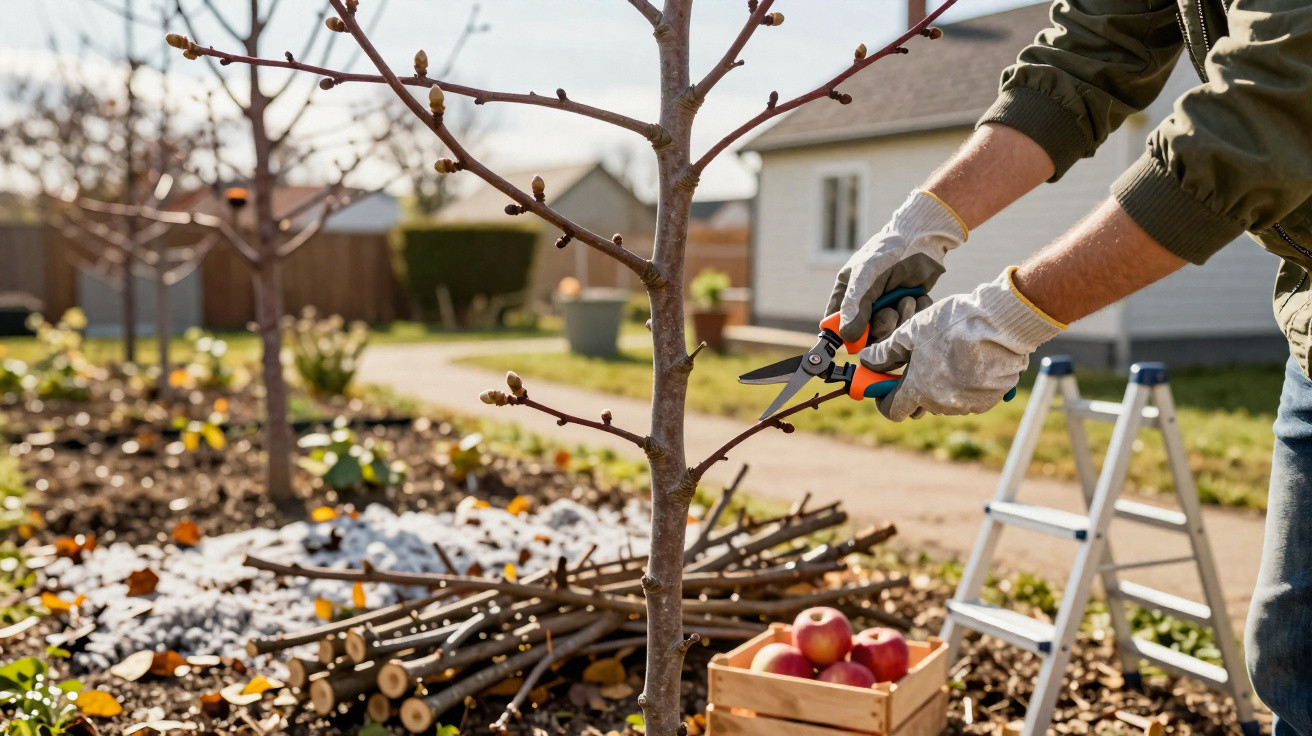
Many amateur gardeners wait for the first blossom to appear – and in doing so give away a large share of their potential crop. February in particular, despite seeming uneventful, determines whether an apple tree will later be laden with fruit or produce only a few lacklustre apples. Targeted pruning directs the tree’s energy towards blossom and, ultimately, the fruit bowl.
Why late winter is the best time for apple trees
In February, the garden can appear frozen in time. An apple tree stands bare and still. This is precisely what makes the period so valuable: the plant is dormant, sap flow is greatly reduced, and the tree concentrates its energy on its roots.
If you pick up the pruners now, the tree responds calmly. Pruning wounds bleed very little and cutting causes less stress. Before spring growth begins, it has time to seal the cuts and support fresh buds.
“If you thin out and shorten an apple tree properly now, you can directly influence where blossom – and later fruit – will develop in summer.”
By contrast, waiting until buds have already started growing deprives the tree of energy it has put into shoots and leaves. The result is fewer flowers – and sparse baskets in autumn.
Poor tools turn pruning into a risk
Before removing the first twig, take a look in the shed. Blunt blades tear the wood instead of cutting cleanly through it. Such wounds heal poorly and can quickly become entry points for disease.
- Bypass pruners for thinner branches and young shoots
- Loppers with long handles for thicker branches within the crown
- Hand saw for genuinely thick limbs forming the tree’s framework
- Disinfectant (such as alcohol) to clean blades between trees
A few minutes spent maintaining tools – using a sharpening stone, adding a drop of oil and cleaning them – prevents plenty of trouble later. Otherwise, diseases such as canker and fungal infections can spread unnoticed from one tree to another.
Look first, then cut: learning to read the tree
Before shortening anything, walk around the apple tree. From a few metres away, it is easier to spot areas that are too crowded, too dark or growing too wildly.
What to look for in the crown
- Branches that cross or rub against one another
- Shoots growing inwards towards the centre of the crown
- Very steep, upright shoots (“water shoots” or “gourmands”)
- Dead, dried-out or visibly diseased branches
An ideal crown should look open and bright. In summer, sunlight needs to reach right into its centre. Only then can leaves and fruit dry quickly after rain, fungi have far less chance to establish themselves, and apples develop their colour.
“A simple rule to remember: in summer, every fruit should hang where a ray of sunshine could reach it.”
The key technique: fruit pruning rather than cosmetic pruning
February pruning is not about creating a “pretty shape”, but about fruit quality. The aim is to retain fewer buds that are better supplied, allowing them to produce firm, juicy apples.
The three-bud rule for side shoots
An easy technique to remember is to work with three buds. Here is how it works:
- Find a side shoot growing from a stronger branch.
- Starting at the point where the shoot joins the branch, count three buds along it.
- Make the cut just above the third bud.
- Where possible, this bud should face outwards, away from the centre of the crown.
This channels sap into a small number of well-positioned buds. They are more likely to form flowers and short fruiting shoots rather than long, unproductive stems.
The cutting angle matters too: always cut at a slight slope away from the bud. Rainwater will then run off the cut surface instead of collecting around the sensitive bud.
Common mistakes that weaken apple trees
Two extremes cause the greatest damage: doing nothing at all or cutting the tree back hard.
Pruning too little: the tree wastes its energy
Anyone who avoids pruning through fear of making mistakes leaves the tree in charge. It continually produces new shoots and the crown becomes denser. The consequences are:
- Lots of small, poorly ripened fruit
- More shade and moisture, and therefore a greater fungal risk
- Branches breaking under excessive weight in good apple years
Pruning too much: the tree switches to defence mode
Overly drastic pruning triggers the opposite response. The tree enters an emergency programme, sending masses of steep, energy-draining shoots into the middle of the crown. These “gourmands” produce hardly any fruit while consuming a huge amount of energy. The tree can then spend years repairing itself instead of cropping reliably.
“Clever pruning is more like fine-tuning than clear-cutting – deliberate, considered and with pauses to check your work.”
Protecting large cuts and using the prunings
Branches thicker than a few centimetres leave noticeable wounds. Fungi and other pathogens can readily gain a foothold at these points. A wound sealant based on resin or clay may help the healing process, especially on older trees or in areas with frequent rain.
Do not simply leave the material cut from the tree beneath it. A quick inspection of the branches is enough:
- Healthy wood: shred and compost it, or use it as mulch
- Suspicious areas (discolouration, swellings or fungal fruiting bodies): remove these from the garden
This helps stop disease organisms building up in the soil and striking again in the following years.
How proper pruning affects the apple harvest
The benefits of good winter pruning do not take years to appear. You can notice the difference in the very first autumn, in the size, consistency and flavour of the fruit.
| Without pruning | With targeted fruit pruning |
|---|---|
| Many small apples | Fewer but noticeably larger fruits |
| Irregular harvests with major fluctuations | Trees crop consistently over many years |
| Dense, shaded crown | A light-filled, well-ventilated crown |
| More fungal and pest problems | Less disease pressure because foliage dries faster |
A few practical examples from everyday gardening
Many gardeners report that a neglected apple tree seems to “wake up” after two or three gentle, well-planned winter prunings. A tree that previously bore hardly any fruit every other year can suddenly crop more evenly and yield apples of much better quality.
Those with little experience are best advised to start with younger trees. Their branches are thinner and their response to pruning is easier to predict. Older specimens that have been neglected for years may need a form of gradual “renovation” over several years before they regain a healthy balance.
Risks, limitations – and how to stay calm
Naturally, pruning does not always go perfectly: a branch may fall in the wrong direction or a shoot may be cut too short. The good news is that apple trees are forgiving. The main concern is when large branches are damaged directly at the trunk or sizeable wounds are left exposed without protection.
If you are unsure, proceed gradually and give each tree two sessions during winter rather than attempting everything at once. This keeps your perspective fresh and makes mistakes easier to correct.
It also helps to remember two things. First, every tree responds somewhat differently according to its variety, location and age. Second, you are always working with a living organism. Fixed rules are useful guide rails, but in the end they are replaced by experience – and that grows with every cut.

Comments
No comments yet. Be the first to comment!
Leave a Comment