
Yet one little-known perennial can transform these troublesome spots surprisingly easily.
Many amateur gardeners know the frustration: nothing grows beneath the large tree by the patio, the ground is hard, the lawn is patchy, and the whole area looks grey and dusty. This is precisely where a particular shade perennial comes into its own – quietly, perhaps, but with an impressive effect on the garden as a whole.
Why nothing seems to grow beneath trees
Anyone trying to create an attractive planting scheme beneath a pine, oak or dense hedge will often fail repeatedly. The symptoms are much the same in every case:
- Lawn turns yellow or disappears altogether
- Beds dry out quickly despite watering
- Roots sit almost at the surface
- Flowers die in their second year or merely struggle on
Gardeners call this a “dry shade position”. It may sound harmless, but it is among the most challenging growing conditions of all. Trees draw moisture from the soil, their canopy blocks the light, and their roots compact the ground. Many of these areas receive less than two hours of direct sunshine per day, yet are still often bone dry.
Some tree species add another complication: they release substances into the soil that inhibit other plants, an effect experts refer to as allelopathy. For conventional border plants, this combination of drought, root competition and lack of light is almost impossible to overcome.
“Beneath old trees, there is a brutally tough battle for water, light and nutrients – ordinary border perennials nearly always lose it.”
Why popular shade plants fail here
In desperation, many people turn to classic “shade plants”: hostas, astilbes and ferns. They appear perfectly suited in catalogues and garden centres. They like shade and cool positions – so they should work, surely.
The catch is that these plants do not enjoy parched, dusty shade. Instead, they prefer partial shade and fresh soil that is deep, rich in humus and evenly moist. Beneath an old tree, they find exactly the opposite conditions. The consequences soon become clear:
- Leaf edges scorch or the foliage becomes blotchy
- Flowers fail to appear or are very sparse
- Plants retreat further year after year
- Eventually, bare soil is all that remains
Many gardeners then give up in frustration, cover the area with bark mulch and accept the “dead corner”. Yet there is a particular perennial that copes remarkably well with precisely these conditions.
Epimedium, or barrenwort: the game-changer for dry shade
The plant in question is Epimedium, more commonly sold as barrenwort. It often sits inconspicuously among the perennials at garden centres, overlooked beside more showy plants. Yet it offers qualities that owners of large trees can only wish for.
What barrenwort looks like
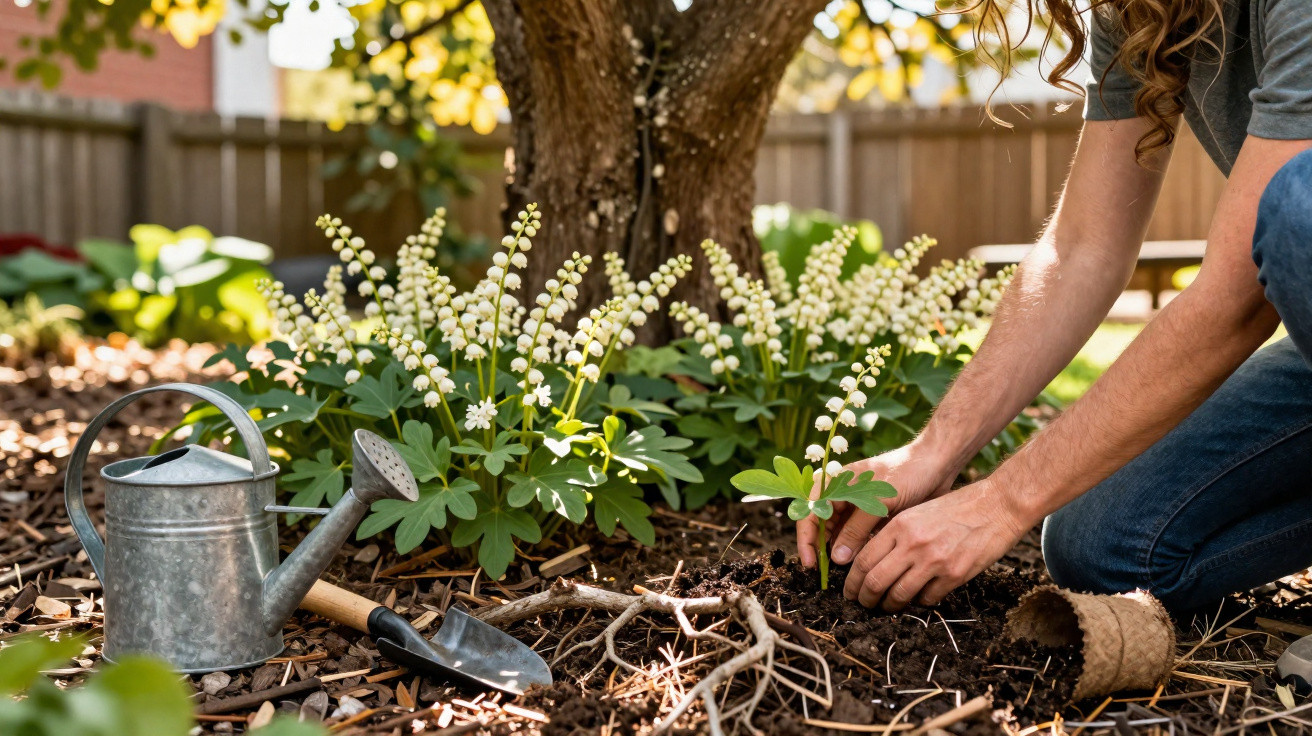
Epimedium forms dense carpets of delicate, often heart-shaped leaves. Depending on the variety, the foliage remains green throughout winter or develops warm tones. In spring, usually during April and May, it produces airy sprays of flowers in white, yellow, pink or coppery orange; some varieties are even bicoloured.
Its real appeal, however, is in the way it grows. Fine rhizomes allow the plant to spread slowly but steadily, filling gaps in the ground. It is not invasive like ground elder, but predictable and easy to control.
“Epimedium combines something rare: a delicate, elegant spring display with tough ground cover against drought and root competition.”
Why Epimedium succeeds in a problem site
Once barrenwort is well established, it handles dry shade far better than most perennials. Its dense layer of leaves prevents further moisture loss from the soil, suppresses weeds and creates a microclimate in which other suitable plants can also thrive more comfortably.
One point matters: this perennial needs a little help when first planted – loose soil, a portion of leaf mould and dependable watering during its first few months. After that, it largely looks after itself.
Step-by-step plan: planting in difficult shade
The best time to plant
Autumn is the ideal time to begin planting, once the first heavier rains arrive. The soil is still warm, receives free moisture from above, and the roots can establish themselves well before winter.
Preparing the soil without damaging tree roots
Avoid major digging with a spade or rotavator beneath old trees. Instead, gently loosen only the uppermost layer:
- Scratch up the soil to a depth of around 5–10 cm with a hand cultivator or claw
- Avoid thick roots and cut only fine feeder roots
- Work in a thin layer of leaf mould or well-rotted compost
This recreates the natural woodland soil, which consists largely of decomposed leaves.
Getting plants established properly
Before planting, immerse each pot-grown plant in a bucket of water for around 15 minutes, until no more air bubbles rise. This thoroughly saturates the rootball, so it does not begin life in the new bed dried out.
For a fully covered area, plant barrenwort roughly 30 centimetres apart, preferably in staggered rows like brickwork. This allows the carpet to fill in evenly over time.
“Anyone who waters consistently during the first twelve months lays the foundation for many years of largely maintenance-free ground cover.”
Water thoroughly after planting, then water again during prolonged dry spells in the first two years. A light covering of leaves acts as natural mulch: it retains moisture while feeding soil life at the same time.
Which plants combine well with barrenwort
To make the area not merely green but full of life, add suitable companion plants. They should enjoy the same conditions while providing visual highlights.
Two especially rewarding companions
- Lady’s mantle (Alchemilla mollis): forms loose, light-green mounds and produces clouds of yellow-green flowers in early summer, visibly brightening dark, shady corners.
- Lesser periwinkle (Vinca minor): creeps low across the ground, tolerates root pressure and poor soil, and bears violet or white flowers for months.
Together, they create a layered carpet with something to offer from spring through autumn: barrenwort flowers in spring, lady’s mantle in early summer, and periwinkle as a calm backdrop punctuated with colour.
Example scenario: from dusty circle to woodland-floor dream
Take a typical situation: an old pine or oak trunk surrounded by hard, cracked soil, where the lawn has long vanished and roots are exposed. Earlier attempts with hostas, hydrangeas or roses have failed.
Using the approach described above, this area can be transformed step by step:
- Loosen the surface carefully without harming the tree
- Scatter a thin layer of leaf mould or fine compost
- Plant barrenwort in a grid about 30 cm apart, filling gaps with lady’s mantle or lesser periwinkle
- Water deeply and spread leaf mulch
Even in the first year, the area will look green again, although some gaps may still be visible. By the second year, the carpets begin to meet, spring flowers add touches of colour, and the previously bleak base of the tree resembles a small woodland edge.
Long-term care worth knowing
Once established, barrenwort is among the less demanding perennials. A few measures will keep the area looking attractive over the long term:
- From late winter onwards, cut old or damaged leaves back close to the ground so the fresh shoots can show properly.
- Every few years, scatter a little leaf compost to mimic natural woodland litter.
- Where root pressure is especially strong, plant smaller groups more frequently rather than expecting an instant covering effect.
If you have heard the term “allergic tree” used in a gardening context, it usually refers to the allelopathic effect of certain species. Barrenwort responds far more calmly to it than many other perennials, making it especially valuable beneath pines or old oaks.
The effect on the garden’s overall climate is also worth noting: dense ground cover such as Epimedium reduces evaporation, protects soil life and offers small creatures shelter. Solving a problem in one place therefore also improves your garden’s ecological balance almost incidentally.

Comments
No comments yet. Be the first to comment!
Leave a Comment