
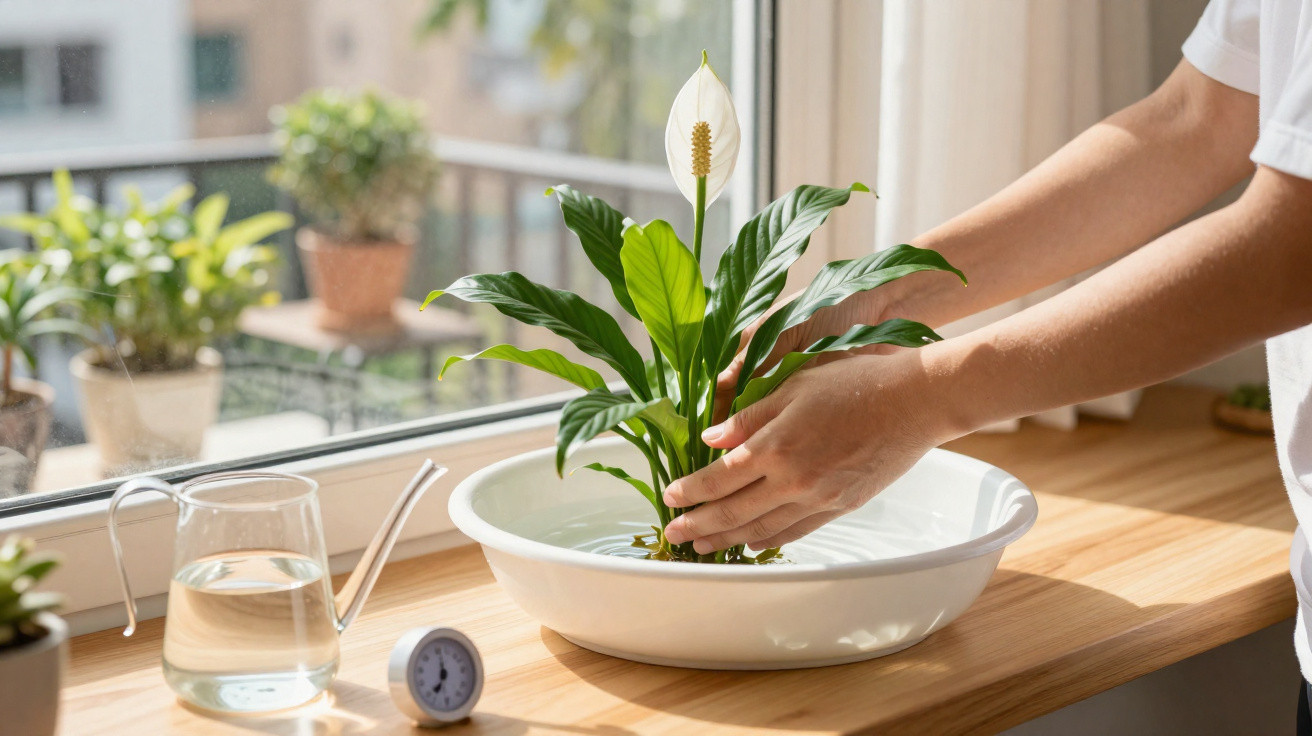
A small watering trick can change everything.
In countless living rooms, a lush green peace lily sits in its pot, looking healthy with glossy leaves – yet the hoped-for elegant white flowers never appear. Feeding, repotting, moving it to a new position: many people try every possible solution without success. In most cases, the crucial factor is far more basic: how water reaches the roots.
Why your peace lily survives but does not truly flower
The peace lily (botanical name Spathiphyllum) originates in tropical forests. There, it grows beneath the shade of larger plants in soil that stays consistently fresh without ever becoming a soggy pool. That is precisely the condition it needs in a pot, too.
In many homes, the opposite happens: it is watered only occasionally, once the leaves are already drooping badly. Or the pot is left permanently in a saucer of water, allowing the roots to rot gradually.
The plant does not think: “How can I flower beautifully?” Instead, it thinks: “How do I survive?” – and flower production is the first thing it cuts back.
When water is regularly lacking, the peace lily switches into emergency mode. It struggles to stay alive but produces hardly any new flower stems. If it is kept too wet all the time, on the other hand, the roots are deprived of oxygen and begin to rot; flowers will then either fail to appear or stop developing early.
The simple finger test: how to spot the ideal time to water
Rather than watering according to a schedule, use an old-fashioned but highly dependable approach: the finger test. It makes watering intuitive and naturally adapts to the temperature, season and position.
- Push your finger around two to three centimetres into the compost.
- If the top layer feels dry but it is still slightly fresh underneath, it is the ideal time to water.
- If it is dry throughout, including deeper down, the plant urgently needs water.
- If the compost is clearly damp all the way down, leave the watering can where it is.
The peace lily also “communicates” through its leaves: pronounced drooping means it is thirsty. If you respond promptly with water, the leaves will usually stand back up within a few hours. If this happens repeatedly, the watering interval is too long – it is better to water a little earlier, before visible stress occurs.
Adjusting for the seasons: how often you should really water
A fixed watering timetable such as “Mondays and Fridays” will rarely get it right. Depending on the season and indoor climate, the plant needs entirely different amounts of water.
| Season | Typical watering frequency | Note |
|---|---|---|
| Spring | 1–2 times per week | Growth begins, so check the compost more often |
| Summer | 2–3 times per week | Warm rooms dry the compost more quickly |
| Autumn | Every 7–14 days | The plant slows down slightly |
| Winter | Every 10–21 days | Cooler air means less evaporation |
These figures are only broad guidelines. The finger test, rather than the date on the calendar, should always determine when you water.
Let it draw water rather than overwatering: bottom watering as a secret weapon
One common issue for houseplant enthusiasts is adding too much water each time because they fear the plant drying out. With a peace lily, this can quickly lead to root rot.
Bottom watering lets the plant take control: it absorbs only as much water as it genuinely needs.
To do this, place the pot in a tray, sink or larger bowl filled with water. Follow these steps:
- Pour lukewarm, settled water into the container to a depth of around two to five centimetres.
- Put the pot into it so that the drainage holes at the base are in the water.
- Allow the plant to absorb water for 10–15 minutes. The compost will draw it upwards from the bottom.
- Remove the pot and let any excess water drain away thoroughly.
- Return it to its decorative outer pot only once no more water is dripping from the holes.
This technique stops the surface from remaining constantly wet, which can attract fungi or fungus gnats. At the same time, it protects the roots from standing water at the bottom of the pot.
Light, position and humidity: even the best watering method needs them
Even an excellent watering routine will achieve little if the plant is in the wrong place. Peace lilies prefer bright but indirect light. Direct sunshine at south-facing windows scorches the leaves, while darker corners restrict flower production.
- Ideal: A bright spot one to two metres from a window, without intense midday sun.
- Difficult: Directly by a south-facing window or in dark hallways with no daylight.
- Critical: Immediately above radiators, where the air is very dry.
As a tropical plant, the peace lily appreciates slightly higher humidity. The air in many homes is too dry, particularly during winter. A few simple measures can improve this easily.
On warm days, you can lightly mist the leaves with low-limescale water. Alternatively, place the pot on a saucer containing damp expanded clay balls. The plant should sit on the balls, rather than directly in the water. As the moisture evaporates, it creates a small pocket of humidity around the plant.
Reading warning signs from your peace lily
Anyone who observes their plant closely will soon notice whether its care is suitable. Common signs and their causes include:
- Limp, drooping leaves and bone-dry compost: Too little water; water thoroughly straight away.
- Yellow leaves, soggy compost and a musty smell: Too much water; root rot is a risk, so allow the pot to dry out or repot it.
- Brown tips: Often caused by overly dry air or water high in limescale.
- Lots of leaves but hardly any flowers: Too little light or an unsuitable watering rhythm; check its position.
If leaves turn yellow and soft from the bottom upwards, inspect the root ball. A strong smell from the compost or black, soft roots indicates that the plant has been kept permanently too wet. The only solution is to remove old, rotten parts, place it in fresh, loose compost and water more carefully in future.
Which water, pot and compost? Small details with a big effect
Tap water is often suitable, provided it is not extremely high in limescale. Peace lilies can react sensitively in areas with very hard water. Brown leaf edges are one indication. Filtered water or settled rainwater is worthwhile in these cases.
The choice of pot is equally important. A sealed decorative pot with no drainage holes is risky. Ideally, use an inner pot with holes in its base inside a decorative outer pot. This ensures surplus water can always drain away.
For the growing medium, choose a loose, structurally stable houseplant compost. It should retain water effectively without becoming compacted. When repotting, it is worth adding a layer of expanded clay or coarse gravel to the bottom of the pot. This improves drainage and significantly reduces the risk of waterlogging.
When to expect new flowers
If you change your watering method, patience is needed. A peace lily often responds fairly quickly with more vigorous leaves, but new flowers usually take several weeks to appear. It will only start growing properly again once it has built up sufficient energy reserves and its position is suitable.
When the balance of slightly moist compost, indirect light and somewhat higher humidity is right, the peace lily will often flower several times a year.
A light foliage plant feed in spring and summer, used at the dosage stated on the packaging, supports flower production but never replaces a suitable watering routine. Anyone who only feeds the plant while continuing to overwater or underwater it is unlikely to see much success.
Of particular interest to many amateur gardeners is that the basic principles that work for a peace lily – compost that is slightly moist but never wet, the finger test instead of a watering calendar, and bottom watering – can be applied to many other houseplants. Once this routine becomes second nature, it can often save other peace lilies, calatheas and tropical species from stunted growth and leaf loss.

Comments
No comments yet. Be the first to comment!
Leave a Comment