
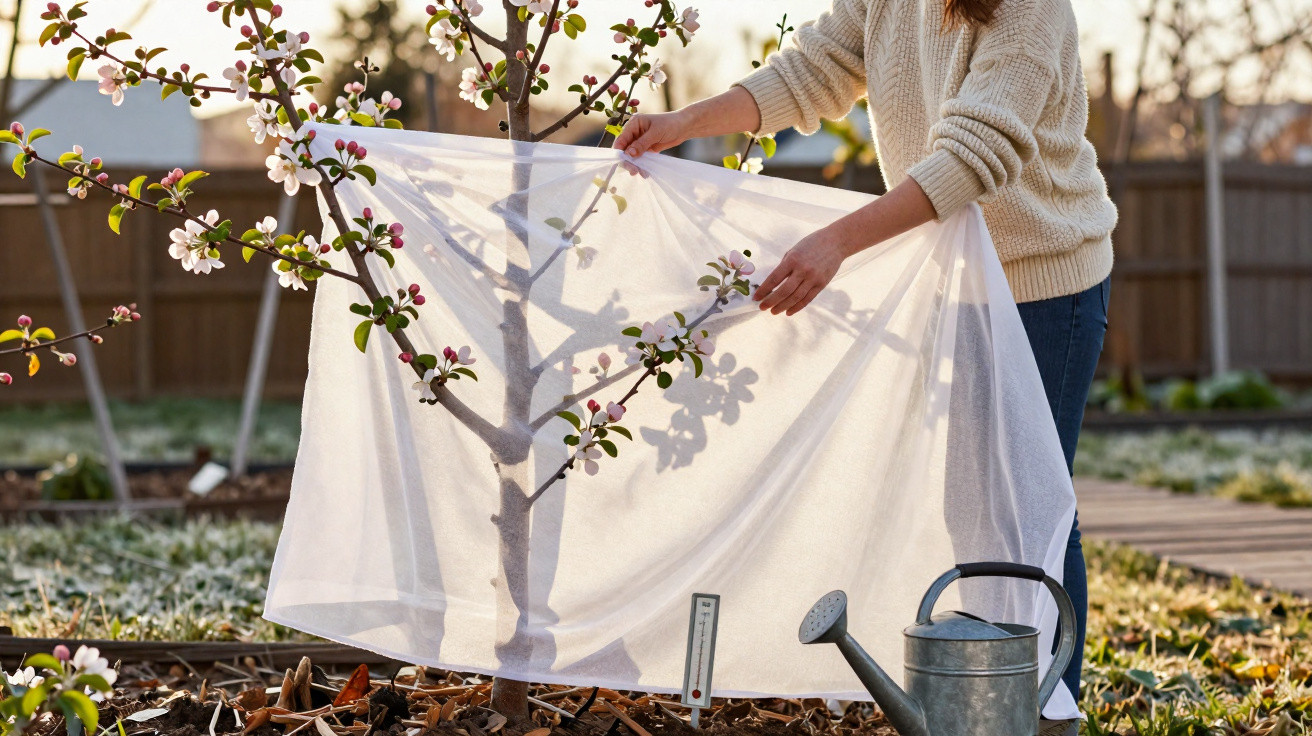
If you have apple, cherry or apricot trees in your garden, you will know the problem: the trees are covered in glorious blossom, bees are busy at work – then one frosty night can wipe out almost the entire crop. With some forward planning and a few targeted steps, however, the risk can be reduced considerably.
Why fruit trees suddenly become so vulnerable in spring
During the depths of winter, fruit trees remain dormant. Sap barely moves, buds are tightly shut and the wood is hard. At this stage, even temperatures well below freezing affect them surprisingly little.
This changes once buds begin to swell in late winter or early spring. The plant’s metabolism accelerates, water enters the buds, and the cells become soft and full. This is when conditions become critical:
- As buds break, many species can withstand only around –2 to –4 °C.
- At full bloom, temperatures of just –1.5 to –3 °C may be enough to freeze the flowers.
- Newly fertilised tiny fruits can suffer damage from approximately –0.5 to –2 °C.
The result may be brown flowers, soft fruitlets and entire branches without a single fruit. From the outside, the tree can still appear healthy, while everything inside the flowers has been destroyed.
“The difference is not the tree’s winter hardiness, but the stage of development of its buds and flowers.”
Climate trends add to the problem: mild winters and early warm spells are bringing blossom ever earlier, while late frosts remain normal until mid-May. Early-flowering species in particular, including apricot, peach, almond and many cherry varieties, are therefore on the front line when cold air returns.
Identifying typical frost traps in the garden
Whether a tree freezes is determined not only by the air temperature, but also by its position in the garden. Cold air is heavier than warm air: it flows downhill like water and gathers in low-lying areas.
The most troublesome positions include:
- Low spots in the garden or pronounced hollows
- Areas close to the ground with little or no air movement
- Places where hedges or walls trap cold air
A tree on a gentle slope or in front of a heat-retaining house wall will often experience night-time temperatures two to three degrees higher. That can mean the difference between a harvest and a complete loss.
What to do the day before a frosty night
As soon as the weather app forecasts clear skies and sub-zero temperatures, garden owners should take action. In private gardens, straightforward measures that require little effort are usually sufficient.
Horticultural fleece: the most effective immediate protection
The classic option is lightweight horticultural fleece. It is especially suitable for smaller fruit trees, trained fruit trees and trees in containers. Applying it correctly is important:
- Make a simple frame from stakes or bamboo canes so that the fleece does not rest directly on the flowers.
- Put the fleece cover in place in the late afternoon or early evening if frost is expected.
- Remove it again the following morning so that light and air can reach the plant.
If the tree also stands in front of a south- or south-east-facing stone or brick wall, the wall stores heat during the day and releases it overnight. This often provides an increase of two to three degrees compared with an exposed location.
Soil, water and mulch: small measures with an effect
In addition to covering the tree, the soil can also help provide protection:
- A generous mulch layer: Straw, leaves or woodchips stabilise soil temperatures and protect the roots and graft union.
- Protecting the graft union: An extra “collar” of fleece or insulating material around the root collar reduces frost damage in the most sensitive area.
- Watering in the evening: Damp soil holds daytime warmth better than dry soil. A thorough watering in the late afternoon can make a difference of one degree.
For fruit trees in pots, a few additional measures can help: move containers nearer to a sheltered house wall, mulch the growing medium, wrap the entire pot in hessian or bubble wrap, and cover the crown with a fleece hood.
“Those who temporarily wrap their most sensitive trees like a tent often give them exactly the temperature buffer needed to save the blossom.”
Professional measures – usually excessive for home gardeners
Large commercial fruit farms use substantial equipment when frosty nights are forecast. This includes:
- Heating candles or frost-protection candles placed among the trees
- Oil or gas burners that blow warm air through the orchard
- Wind machines that mix layers of cold air
- Continuous overhead irrigation, where ice formation releases heat and keeps blossom just above 0 °C
All of these methods are expensive, require constant overnight monitoring and make little sense in a private garden. For home gardeners, horticultural fleece combined with a well-chosen site remains the most practical solution.
Preventing frost damage when planting fruit trees
The most effective frost protection begins years before the first harvest: when the fruit garden is being planned. Following a few basic principles can reduce the risk substantially.
Choosing the right location for fruit trees
Fruit trees should, wherever possible, not be planted in frost pockets. Better choices include:
- A gentle slope, slightly above the lowest point in the garden
- A position in front of a warm house or garage wall, ideally facing south or south-east
- Trained fruit trees directly against masonry that stores solar warmth during the day
Standard trees have a modest advantage: their crowns sit higher up and are therefore often above the coldest layer of air, which collects close to the ground.
Using variety selection and pruning strategically
In areas where late frosts are common, it is worth choosing late-flowering varieties when buying trees. Advice from a local nursery that understands the regional conditions can be useful here.
Pruning also affects flowering time. Some species can tolerate later pruning in late winter or very early spring. This delays bud break by several days – often exactly long enough for the worst frosty nights to have passed.
“Choosing later-flowering varieties and adjusting pruning accordingly shifts the sensitive flowering phase beyond the traditional frost period.”
How to recognise frost damage reliably
After a clear, icy night, damage can usually be assessed as early as the following day. Typical signs include:
- Flower petals turn brown, grey or glassy, then soon fall off.
- The inner part of the flower, especially the ovary, becomes dark in colour.
- Tiny newly set fruits stop growing, shrivel and drop off.
A few frozen flowers are not yet a disaster. However, if whole flower clusters have frozen on many branches, this often means a major loss of yield. Sometimes the tree will still produce a few fruits in more sheltered areas.
Making frost protection part of everyday garden care
Anyone repeatedly caught out by late frost each year should establish regular routines. This includes checking the forecast as soon as trees begin budding or flowering. Many weather apps now also show the risk of ground frost, which is a useful indicator for gardeners.
It is practical to keep horticultural fleece, stakes and mulch material readily available. When an afternoon weather forecast suddenly predicts frost, there is no time left to buy supplies. Pre-prepared emergency kits for the most sensitive trees save stress in these moments.
If you have children, frost protection can become a hands-on family activity: putting up fleece, carrying buckets of water and spreading mulch are tasks in which everyone can help. At the same time, children learn very directly how sensitively nature responds to differences in temperature.
In the long term, this attention pays off: trees that are protected regularly, pruned sensibly and positioned wisely produce reliable harvests over many years. And if there is still a complete crop failure, it is usually due to extreme weather conditions – not because nothing was done.


Comments
No comments yet. Be the first to comment!
Leave a Comment