
With a few straightforward measures, this can easily be avoided.
As soon as the first spring day arrives, gardeners are eager to get started. Colourful seed packets promise plump, juicy roots, but the outcome is often different: seeds germinate poorly, plants remain stunted or disappear altogether. The problem is rarely the variety; it is almost always the method. Anyone who understands the needs of beetroot seeds and follows a few basic rules can dramatically improve their chances of success.
The temperature factor: little happens below eight degrees
Why a soil thermometer is more useful than watching the sky
For successful beetroot sowing in March, soil temperature is the key variable. It is not the air temperature but the warmth of the soil that determines whether seeds begin growing or remain dormant. Germination only starts reliably once the soil reaches around 8 °C.
If the soil temperature stays below eight degrees, you risk rotten seeds rather than young plants.
Many people sow during the first mild days while the ground is still cold from winter. Although the seeds swell after their first contact with moisture, they do not properly begin to grow. Fungi can then take hold easily, and the seed is lost. A simple soil thermometer provides more dependable guidance here than any weather app.
How to warm the soil deliberately in March
To help the ground reach the required eight degrees more quickly, create a small build-up of warmth. Just two materials are needed:
- Clear plastic sheeting or horticultural fleece: Cover the bed a few days before sowing. The sun will warm the soil beneath it as if it were a mini greenhouse.
- Cover it in the evening, ventilate during the day: Briefly uncover the bed in sunny daytime conditions so the soil does not overheat and can dry out well; close it again overnight to retain the warmth.
Gardeners wanting an early start can prepare the bed in late February or very early March, then allow it to warm up under sheeting for one to two weeks. This gives the seeds a far more favourable microclimate from the outset.
Placing beetroot seeds properly: shallow, airy and methodical
The right row spacing for healthy plants
Once the soil is sufficiently warm, the layout of the bed determines the eventual yield. Beetroot needs air and room. Rows spaced at roughly 30 centimetres have proved effective. This distance ensures that:
- air circulates well between plants;
- moisture dries more quickly;
- fungal diseases have fewer opportunities to develop;
- there is enough room to use a hoe and watering can comfortably.
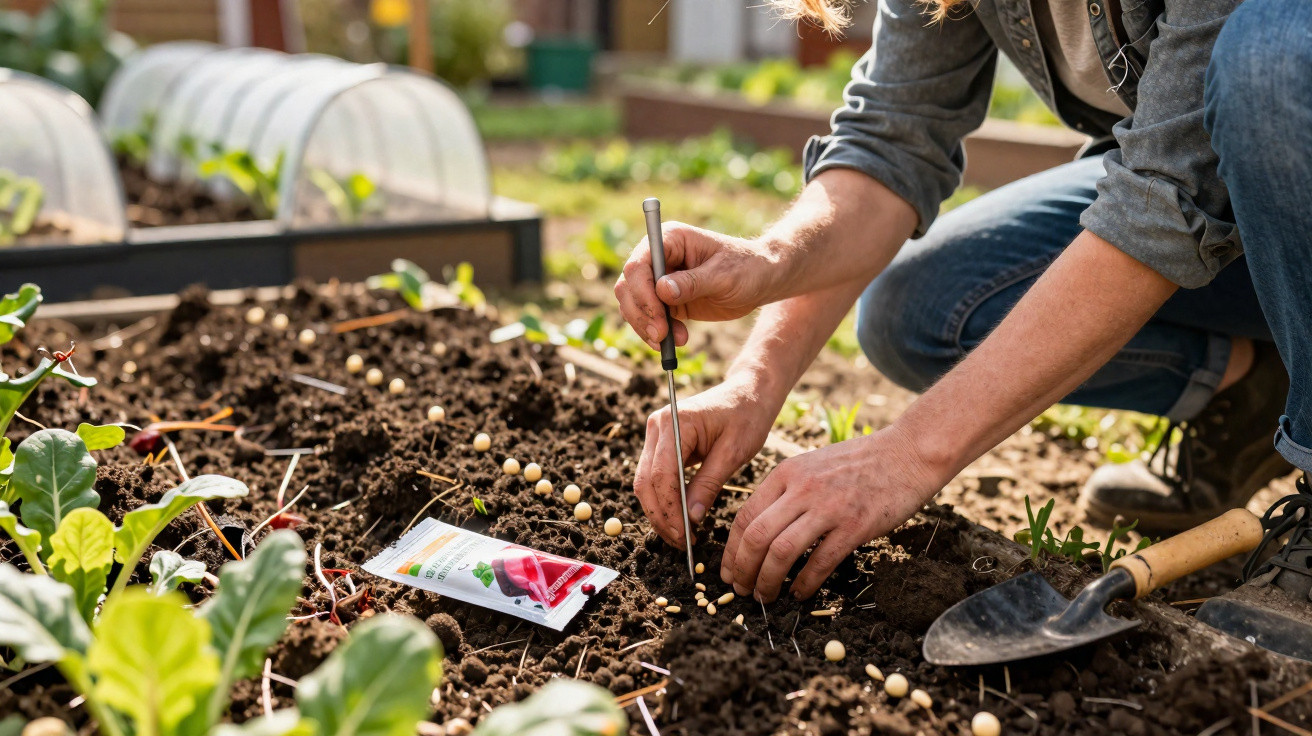
Mark the rows using a handle or the edge of a rake. The important point is not to make deep trenches: beetroot seeds should sit only shallowly beneath the soil.
The two-centimetre rule: why sowing too deeply holds back seedlings
The beetroot seed cluster, known as a glomerule, is not one individual seed but a cluster containing several seeds. This small packet should be placed only around two centimetres deep in the soil.
A depth of more than two centimetres makes the seedling use up unnecessary energy – and it may not reach the surface at all.
A practical tip: if you do not have a ruler at hand, use your finger as a guide. Half a fingertip is usually very close to two centimetres. Place the seeds, cover them lightly with soil and level the surface gently – that is all that is needed.
After sowing: use the right amount of pressure and water
Why gently firming the soil makes a difference
Many gardeners sow, rake over the bed briefly and move on. It is better to add one further step: gently firm the soil. Gardeners call this “plombieren”, or simply treading it down, though without stamping. Suitable methods include:
- running the back of a rake along the rows;
- or using a flat-soled shoe to apply light pressure without compacting the soil.
This brings the soil into closer contact with the seeds. It creates a moist, slightly warmer microclimate that supports germination and prevents larger air pockets.
The crucial ten days: consistently moist, not waterlogged
The period immediately after sowing is decisive. For the first roughly ten days, the seedbed must not dry out, but it must not sit in water either. The ideal is an evenly moist, crumbly texture.
Several light waterings are better than one heavy soaking that washes out the rows.
This is easiest to achieve as follows:
- Water with a rose attachment or a fine watering can; never use a hard jet.
- In sunny, windy weather, check the bed briefly every day: if the surface becomes pale and cracked, water again.
- During prolonged rain, protect the bed with horticultural fleece if necessary so that the soil surface does not become sealed.
Very sandy soil will need watering a little more often, whereas heavy clay soil generally needs it less frequently because it retains moisture for longer.
The ‘multiple-seed’ trick: thinning is essential
What many people do not know about beetroot seed clusters
One aspect repeatedly surprises gardeners: a single, slightly knobbly seed cluster usually contains two to four embryos. With enough water, they all emerge at almost the same time. The result is small clusters of young plants growing tightly together.
If nothing is done at this stage, the eventual harvest may contain many roots, but they are usually small and misshapen. The plants compete for light, water and nutrients. Thinning is therefore an essential part of beetroot care, even if it initially seems wasteful.
How to thin correctly – without feeling guilty
As soon as the young plants have two to three true leaves – rather than just their seed leaves – the time is right for the first intervention. Work along the rows as follows:
- Keep only the strongest, straightest-growing plant in each cluster.
- Carefully snip or pull out the others at their base using two fingers.
- Maintain a gap of around 10 centimetres between the remaining plants.
Those who thin consistently harvest fewer plants, but substantially larger and more even roots.
Many gardeners also use the tender pulled seedlings as a vitamin-rich addition to salads. That way, the ‘loss’ goes straight onto the plate.
Why early sowing offers major benefits
A longer growing period and stronger growth
Sowing in March with this method gives the plants a head start. The roots can develop over many weeks, benefiting from both the damp spring months and early summer warmth. This results in:
- stronger roots;
- better-developed beetroot roots;
- sturdier plants that cope better with dry spells.
Beetroot sown early is often ready as young vegetables in high summer, while later sowings may still be at an immature stage.
Targeted preparation for a reliable summer harvest
The combination of warmer soil, correct sowing technique and consistent thinning produces even stands of plants. Beetroot given enough room makes optimum use of the nutrients in the soil. The yield can often seem “spectacular”, even though the approach is simple and down to earth.
Paying attention to well-prepared soil also reduces stress factors: a loose topsoil, compost worked in and no perennial root weeds. This leaves more energy for developing roots instead of merely surviving.
Useful additions for even better results
Suitable varieties and companion-planting ideas
In home gardens, varieties approved for early sowing have proved especially reliable. They germinate quickly and form roots comparatively fast. Beetroot rows work well in beds alongside:
- onions and shallots;
- lettuce, as an early preceding crop;
- herbs such as dill or summer savoury.
Close planting with spinach and chard is less suitable, as they belong to the same plant family and have similar nutrient needs. This increases the risk of soil fatigue and disease pressure.
Common mistakes that are easy to prevent
Keeping the following pitfalls in mind will significantly increase the likelihood of a fully planted beetroot bed:
| Mistake | Effect | Better approach |
|---|---|---|
| Soil that is too cold | Germination is delayed or fails | Wait for a soil temperature of at least 8 °C |
| Sowing too deeply | Weak emergence or none at all | Sow only around 2 cm deep |
| Irregular watering | Seedlings dry out or rot | Keep evenly moist for 10 days |
| No thinning | Many roots, but small and misshapen | Leave 10 cm between each plant |
Anyone who notes these key points and applies them step by step will soon see that beetroot is not a difficult vegetable, but a reliable source of colourful, healthy cooking – provided that sowing time, soil temperature and care all work together.

Comments
No comments yet. Be the first to comment!
Leave a Comment