
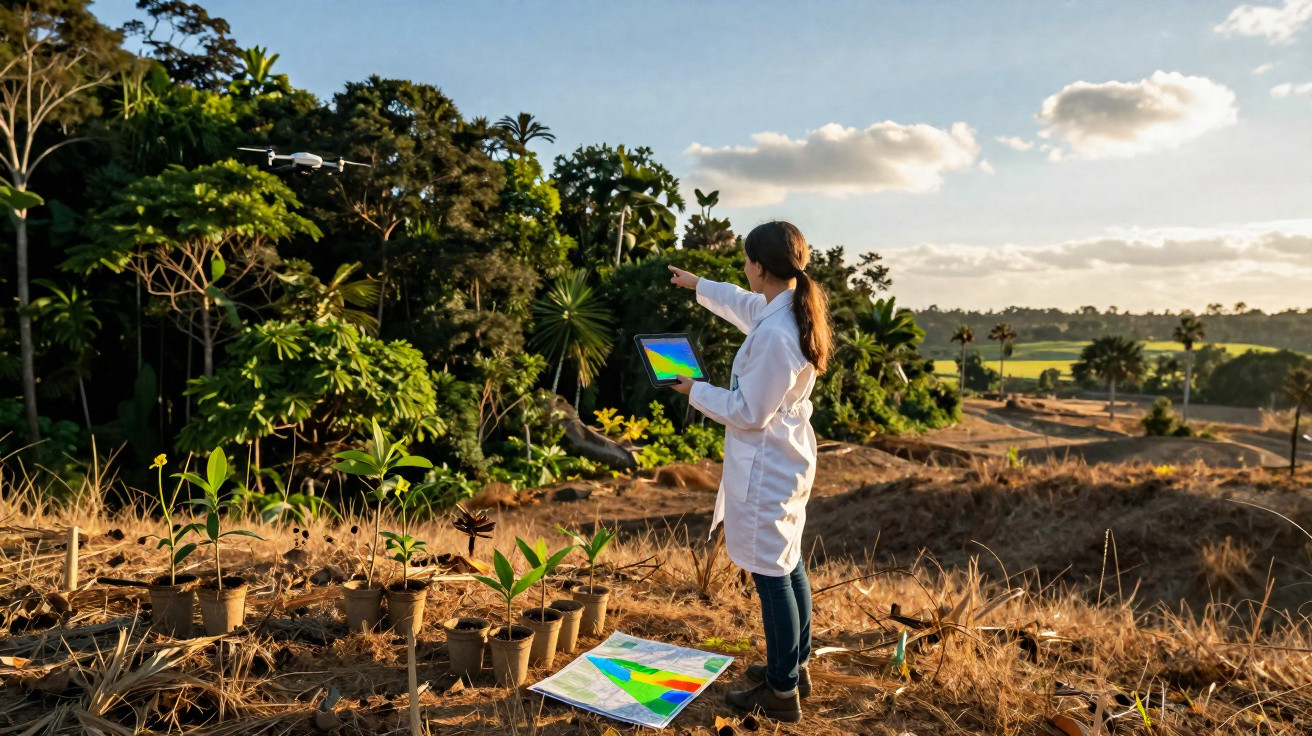
New data indicates that location determines whether woodland cools the planet or warms it.
Reforestation schemes are proliferating around the world, from corporate offset programmes to vast government-led initiatives. The calculation appears straightforward: more trees, less CO₂, a cooler Earth. However, a recent study puts this assumption into perspective, making one point clear: what matters most is not the number of saplings, but where they are planted.
Why trees do not affect the climate equally everywhere
Trees are often described as nature’s air conditioning. They draw carbon dioxide from the atmosphere, store carbon in their timber and soils, and release oxygen. This reduces the burden on the atmosphere and slows the greenhouse effect. That is the conventional view.
Yet the new research shows that the CO₂ effect represents only one part of the calculation. Forests also alter the physical properties of the Earth’s surface, influencing temperatures, cloud formation and rainfall. This is precisely what determines whether woodland delivers global cooling overall or can even contribute to warming in particular regions.
Three climate levers of forests
Three processes are particularly important:
- CO₂ absorption: Through photosynthesis, trees remove carbon dioxide from the air and store it over the long term.
- Albedo effect: Dark forest cover absorbs more sunlight than lighter surfaces, such as snow, farmland or steppe.
- Evaporation: Forests release substantial amounts of water through leaves and soil, cooling the air around them.
“The study shows that the same cooling effect can be achieved using roughly half as much land – if forests are planted strategically in locations with particularly strong climatic effects.”
Put simply, a hectare of forest does not have the same value everywhere. In some places it works like highly effective natural air conditioning; elsewhere, it darkens the ground and therefore makes it warmer despite storing CO₂.
Where reforestation cools the Earth most effectively
Researchers assessed the climatic impact of forests across the globe. Their conclusion is clear: the tropics offer the greatest potential for global cooling.
Tropical forests as a brake on warming
In tropical regions such as the Amazon, Central Africa and South-East Asia, reforestation projects provide several benefits at the same time:
- Trees grow rapidly and absorb large quantities of CO₂.
- They evaporate significant volumes of water, strongly cooling the surrounding air.
- There is little snow cover whose reflectivity would be lost beneath dark forest.
Together, these effects mean forests planted in these areas can stabilise the climate especially efficiently. The study concludes that, by locating global reforestation areas wisely in such regions, the same cooling performance can be achieved with substantially fewer hectares.
When reforestation has the opposite effect
The balance looks very different at high latitudes, including Canada, Scandinavia and Siberia. Snow cover plays a major role there. Bare snow reflects much of the incoming solar radiation back into space. Dense reforestation on these surfaces creates a darker landscape:
- Reflectivity falls, and the ground absorbs considerably more energy.
- Warming caused by lost albedo can partly, or even entirely, cancel out the beneficial CO₂ effect.
- In certain circumstances, newly established forests in these regions may warm the local climate rather than cool it.
Forests also affect atmospheric airflows. They may change rainfall patterns or intensify and weaken temperature waves, including thousands of kilometres from the project area itself. A regional reforestation plan can therefore produce unintended effects elsewhere.
What the study means for climate policy and offset projects
For years, international initiatives have promoted plans to plant a billion, or even trillions, of trees. Many businesses sell CO₂ certificates based on reforestation. Such campaigns almost always focus on totals: the number of saplings, hectares or tonnes of CO₂ by 2050.
The new analysis suggests this logic does not go far enough. Approaches centred solely on scale waste valuable potential and risk delivering little cooling in some projects.
“Numbers on posters make an impression, but the real climate benefit depends on location, tree species and integration into the regional ecosystem.”
Targeted reforestation rather than indiscriminate tree planting
Researchers argue for a far more nuanced strategy. Key considerations include:
- Location selection before planting targets: Projects should prioritise regions where forests provide a clear cooling effect, especially in the tropical belt.
- Near-natural mixed forests: Monocultures are vulnerable to pests, disease and fire. Mixed forests support climate stability and biodiversity more effectively.
- Long-term thinking instead of a quick certificate: A forest takes decades to develop its full climatic effect. Short-term ‘Plant & Forget’ approaches are insufficient.
- Involving local people: Areas will remain stable over time only if local communities benefit, for instance through sustainable use, shade and water.
The study also stresses that reforestation alone can slow the rise in temperatures by the end of the century only marginally. Even under the most favourable scenario, large-scale reforestation would reduce the global average temperature by around 0.25 degrees by 2100. This is a contribution, but not a replacement for a rapid move away from coal, oil and gas.
Where reforestation remains indispensable
This is not a licence to reject forests. On the contrary, carefully planned reforestation serves several purposes at once, extending well beyond climate action alone.
| Function | Benefit |
|---|---|
| Carbon storage | Removes CO₂ from the atmosphere and locks it away long term in biomass and soils. |
| Habitat | Protects biodiversity, creates wildlife corridors and preserves genetic diversity. |
| Water cycle | Stabilises rainfall, stores water in the soil and reduces flooding. |
| Protective function | Prevents erosion, stabilises slopes, and reduces damage from dust and storms. |
| Social effects | Provides income, timber, fruit and recreational spaces for local communities. |
Targeted restoration can ease several crises at once, particularly in degraded tropical landscapes, former rainforest areas and severely eroded slopes: the climate crisis, biodiversity loss, water scarcity and soil degradation.
What individuals and businesses can learn from the new findings
Anyone donating a tree or buying a CO₂ certificate intends to do something positive. Nevertheless, it is worth examining projects critically. A few questions can help assess them:
- Which region is the reforestation taking place in, and does it match the climate benefits described above?
- Are native species and mixed forests being used, or fast-growing monocultures?
- Is there a long-term management plan, including protection against slash-and-burn clearance and illegal logging?
- Are local communities involved, and do they benefit financially and socially?
Projects that answer these questions transparently are far more likely to provide genuine climate benefits rather than merely a green image.
Key terms explained briefly
What exactly does albedo mean?
Albedo describes the proportion of solar radiation that a surface reflects back into space. Fresh snow has a very high albedo and acts like a mirror. Dark forests and asphalt have low albedo, absorbing most of that radiation. When dense woodland grows on light-coloured land, albedo decreases and more energy remains on Earth, which can intensify local warming.
What is evaporative cooling?
Plants absorb water from the ground and release it through their leaves. This process requires energy, which is taken from the surrounding air. The result is a cooling effect comparable to sweat evaporating from skin. In tropical regions with abundant moisture and intense sunlight, this evaporative cooling is particularly powerful, which is one reason forests there have such a strong climatic effect.
The new study draws a clear distinction: reforestation remains an important part of tackling climate change, but it works properly only when locations, tree species and regional characteristics are taken seriously. Anyone genuinely seeking to protect the climate must act on two fronts: strengthen forests in the right places while drastically cutting greenhouse-gas emissions.



Comments
No comments yet. Be the first to comment!
Leave a Comment