
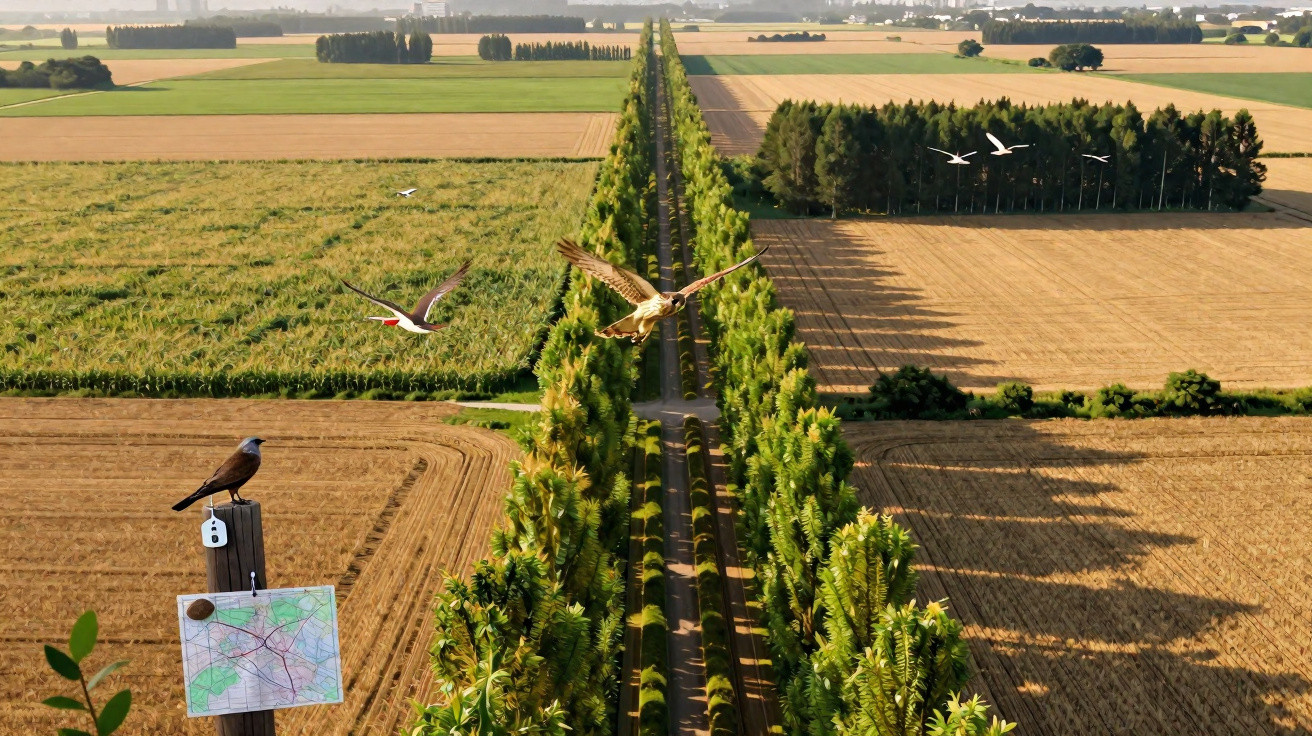
Across Europe’s agricultural landscapes, forests have been divided into isolated fragments, forcing birds to cross a broken-up environment where travelling between habitats is increasingly difficult.
New research indicates that poplar plantations - frequently established for commercial purposes - may help restore these links, but only if they are located strategically.
Placed as stepping stones among existing woodland, these plantations can transform separated fragments into routes that birds can use.
Farmland influences bird movement
In two European river basins dominated by intensive agriculture, forest remnants and plantation parcels created the setting in which ecological links either worked or broke down.
By analysing these mapped networks, Sara Pineda-Zapata of the University of Eastern Finland (UEF) found that the position of a plantation determined whether it provided birds with a route through the landscape.
In Spain, certain plantations improved movement because they were close to existing chains of forest. In France, however, many stood too far apart to offer comparable benefits.
This contrasting outcome highlighted an important constraint: having tree cover alone was insufficient, prompting the question of why some bird species gained more than others.
Why poplar plantation location matters
Beneficial tree cover does more than increase foliage: it affects functional connectivity, meaning how readily animals can travel among habitat fragments.
A plantation is useful if a bird can reach it, pause to feed or rest, then move on to another woodland patch without excessive energy use. Where a patch is too distant, extra tree cover adds habitat area rather than creating a functional link for local birds.
“Plantations can act as stepping stones between forest patches, although their effectiveness depended strongly on their location within the landscape,” Pineda-Zapata said.
Small forest patches alter bird movement
The scale made the findings more striking. Forests selected for the study accounted for 19 percent of each basin, whereas poplar plantations occupied under one percent. The mapped areas contained more than 4,500 forest and plantation patches in Spain, and over 6,500 in France.
Although most plantations were very small compared with natural woodland, even small parcels can alter movement if they bridge the right gap. Consequently, area by itself was not a reliable measure of bird movement or conservation value in either landscape.
Bird movement varies by species
Species reacted differently because each has a distinct travel range, called dispersal capacity, which determines the possible distance of each step between habitats.
The common chaffinch (Fringilla coelebs) averaged only 0.79 km, making many gaps impossible to cross. Great spotted woodpeckers (Dendrocopos major) averaged 6 km, while Eurasian blackcaps (Sylvia atricapilla) travelled about 17.5 km.
These contrasts were particularly evident in Spain, where plantations generated the greatest improvements for birds with longer ranges.
For the great spotted woodpecker, connected habitat rose by 21.6 percent when plantations were added to the wider forest network - the study’s largest increase.
River margins acted as natural corridors, allowing shorter flights to work more effectively and making suitably positioned groves valuable connections across farmland.
Distance disrupts forest links
France demonstrated the limitations of the strategy. Plantation parcels increased the amount of tree cover but seldom reinforced the broader network.
For common chaffinches in protected areas, connected habitat rose by only 0.94 percent - the lowest increase observed.
Larger separations between patches meant that many birds encountered gaps they could not readily traverse. Planting additional trees alone would not resolve this unless new plantings bridged the real breaks between woodlands.
Protected sites faced the same issue. Forests inside Natura 2000 - Europe’s network of protected conservation sites - still relied on the surrounding landscape to sustain connectivity.
In Spain, plantations close to protected forests supplied around 14 percent of blackcaps’ overall connection value.
In France, natural forests performed almost all of this function, illustrating how poorly distributed planting can restrict the gains.
Plantations are not natural forests
Plantations remain a compromise: orderly stands of fast-growing poplars grown for timber cannot replicate mature natural forests.
Natural woodland supports trees of different ages, deadwood, cavities and layers of vegetation required by many forest specialists.
Increasing tree cover may also damage open-habitat species - animals dependent on fields or meadows - by reducing open, sunlit land.
This balance means plantations should support conservation efforts, rather than serve as a lower-cost replacement for genuine habitat in the long term.
The value of strategically placed trees
Decisions made before planting can determine whether farms and restoration schemes genuinely benefit wildlife: the important question is not merely how much land is planted, but where planting occurs.
Policy is beginning to reflect this change. The EU Nature Restoration Regulation, for instance, requires countries to restore degraded ecosystems.
More recent proposals suggest that incentives should favour intelligent placement, including linking forests, safeguarding river margins and retaining open meadows where birds need them most.
Without this emphasis, programmes could promote dispersed tree planting that captures carbon yet does little to enable birds to move through fragmented landscapes.
This reframes the role of poplar plantations. They assist bird populations only when their position converts isolated habitat fragments into connected pathways across productive farmland. Increasing tree cover alone will not achieve this.
“What our results show is that in fragmented landscapes, well-placed plantations can become part of the solution, opening up interesting possibilities for designing productive landscapes that are also more supportive of biodiversity,” Pineda-Zapata said.


Comments
No comments yet. Be the first to comment!
Leave a Comment