
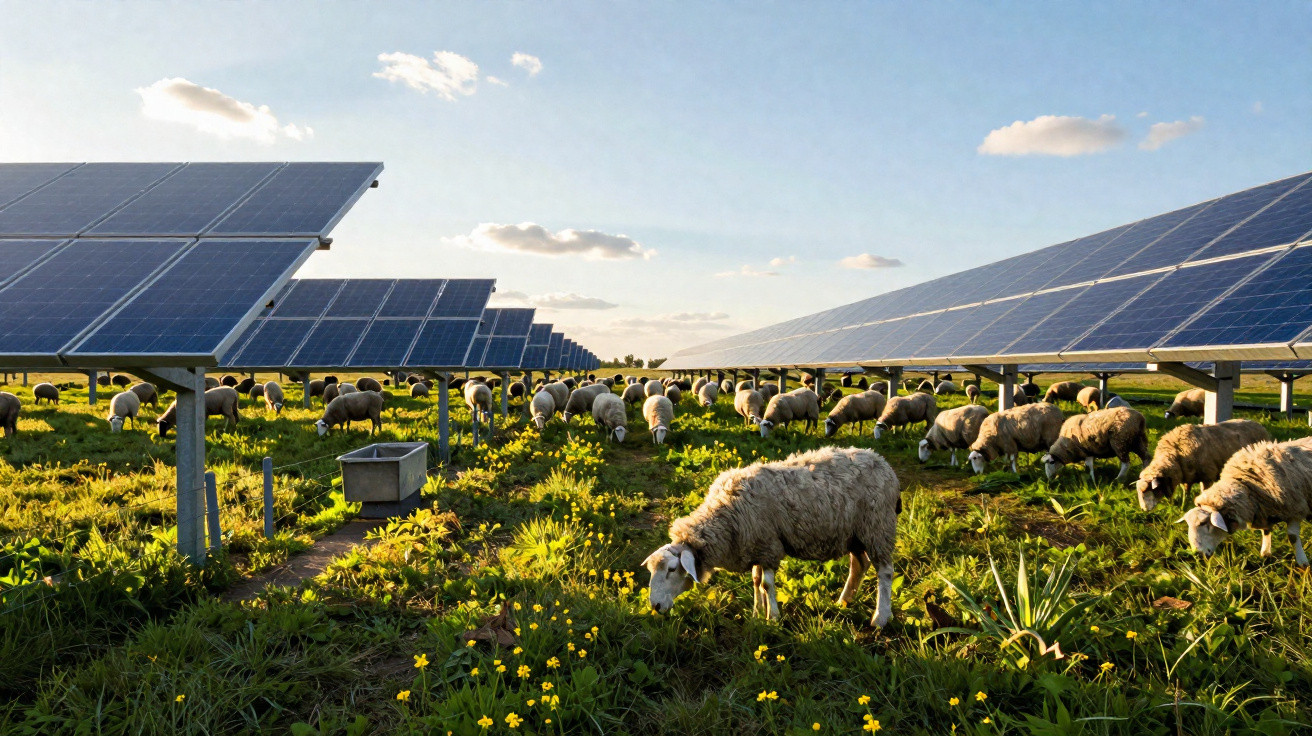
Around 40 sheep now move among the panels at the Westmill solar park in southern England, carrying out a job that would usually require machinery: keeping vegetation under control. By grazing, the animals keep the grass short without disrupting electricity production, while also making the power station’s land productive for livestock farming. This approach is known as solar grazing.
Why does a solar farm need regular vegetation cutting?
Large photovoltaic sites have access lanes and open strips between their rows of modules. Vegetation keeps growing in these spaces and, without management, can obstruct inspections, restrict access and become tall enough to cast partial shade over the panels.
The usual solution is to use brush cutters, tractors or other machinery. Sheep, however, can reach the narrow sections and the ground beneath the structures, where machines may have greater difficulty operating.
- They eat vegetation growing between the rows of modules;
- They can graze in areas directly beneath the panels;
- They may reduce how often mechanical cutting is needed;
- They help keep maintenance access routes clearer;
- They allow the land to remain in use for a rural activity.
How did 40 sheep come to share the Westmill solar park with its panels?
At the Westmill solar park, close to the boundary between Oxfordshire and Wiltshire, the flock is brought onto the site during planned periods. The number of sheep must match the amount of grazing available, as the aim is not to remove every trace of vegetation, but to keep it at a height that is suitable for the facility’s operation.
Why can the panels themselves benefit the sheep?
The panel structures provide shaded spots and shelter from rain and wind. Research carried out in other agrivoltaic systems has identified changes to the microclimate beneath modules and, in certain conditions, differences in the quality of the forage available in those areas.
The arrangement is mutually beneficial. The sheep use the site as grazing land, while their manure returns nutrients to the ground and their feeding reduces the need for mechanical maintenance.
- The modules provide patches of shade;
- The land continues to produce forage;
- Grazing manages some of the naturally occurring vegetation;
- Manure returns organic matter and nutrients to the soil;
- Farmers can make use of land that might otherwise be reserved solely for electricity generation.
Why can the sheep not stay there all year round?
At Westmill, the grazing timetable also takes biodiversity into account. Keeping the animals on the site continuously could reduce flowers used by pollinators or disturb birds nesting close to the ground. Seasonal management therefore allows certain areas to grow back and flower at times that are important for wildlife.
- Stocking levels must reflect the quantity of food available;
- Excessive grazing can compact and degrade the ground;
- Flowering periods may require the sheep to be removed;
- The breeding cycle of birds must be factored into the timetable;
- Water, fencing and animal health monitoring are still required.
The sheep do not change the solar panels, but they change how the land is used
The innovation is not about making each photovoltaic module generate more electricity. Studies of solar grazing indicate that the main advantage lies in land management: vegetation and flocks can be incorporated into the operation of a solar farm, reducing reliance on mechanical cutting while allowing the same site to retain an agricultural purpose.
That combination is what makes Westmill’s 40 sheep relevant to the future of solar energy. The panels still perform their original role of producing electricity, but the spaces between them are no longer treated as empty ground that simply needs cutting back. With an appropriate number of animals and a planned timetable, the same property can generate energy, feed a flock and preserve some vegetation at the same time.

Comments
No comments yet. Be the first to comment!
Leave a Comment