
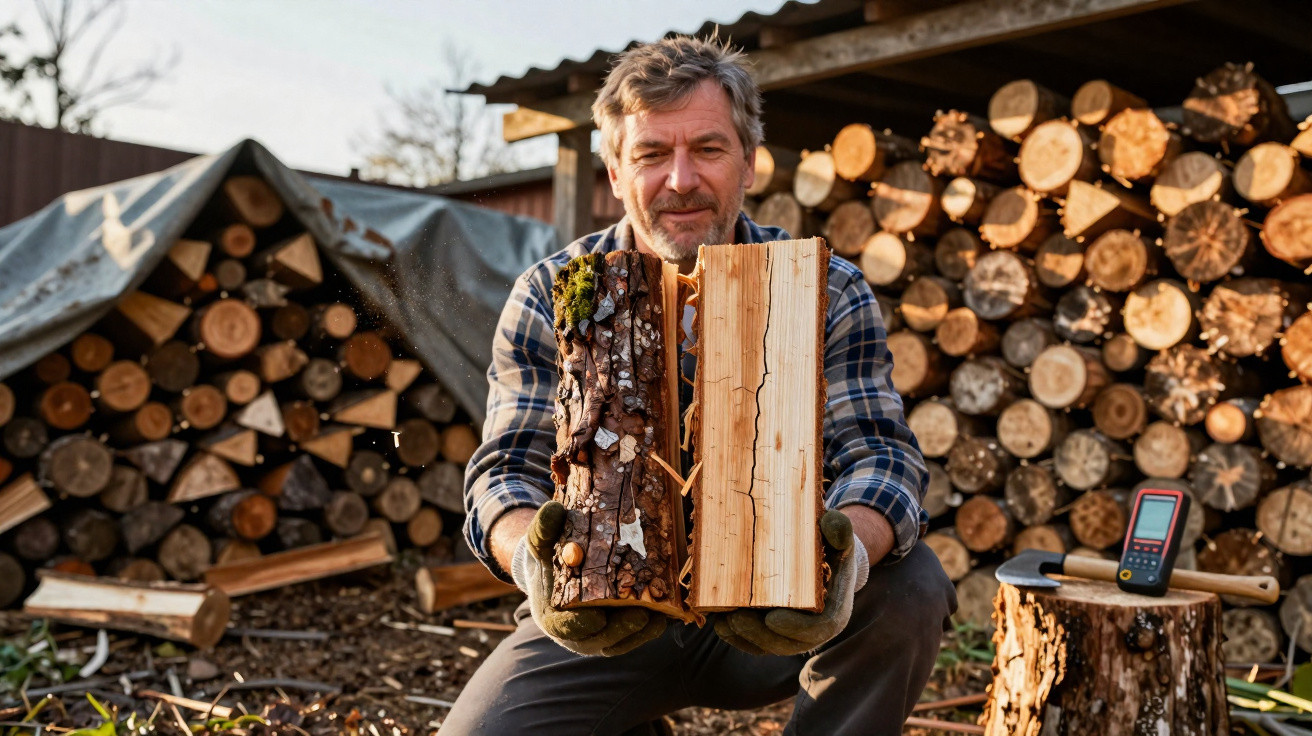
Stacked from floor to ceiling, their firewood resembled a Pinterest post: orderly, compact rows, every piece of bark facing the same direction, with the scent of the forest still lingering around it. Months earlier, they had split, carried and positioned every log themselves. Their backs recalled every barrow-load. So did their bank balance.
Then they struck a match. Nothing happened. The logs hissed and smoked, releasing a faint, acrid odour. Flames caught for a moment before fading, leaving a black, wet mark on the timber. Hours went by. The kindling was used up. So was their patience. That “perfect” stack of wood proved to be a quiet, weighty disappointment. Nobody had ever properly shown them what to do. That was when the uncertainty began to set in.
When a beautiful woodpile becomes a silent disaster
The first surprise is nearly always identical: the wood appears perfectly sound. It feels dry, seems light to lift and is stacked in neat rows like something from a catalogue. In theory, everything is as it should be. In practice, the stove glass turns black, the chimney has little draw, and the sitting room fills with that unpleasant combination of cold air and pretend warmth. You stand there with a poker, watching the logs sulk rather than burn.
On a sharp evening, that kind of failure feels especially harsh. Firewood is more than fuel; it represents a promise. The promise of warmth after a day outdoors, soup bubbling away and a book you might finally get round to finishing. When that promise turns into smoke and frustration, it can feel strangely personal. You put in all that work, only for the outcome to resist you. Worse still, you cannot say precisely where you went wrong.
This is the point at which many people become stuck. They blame the stove, chimney or weather. They buy costly firelighters. Some even wonder whether the wood merchant has misled them. More often, though, the problem is right in front of them: storage. The months between cutting and burning determine everything. Poor airflow, a bad location or the wrong timing can gradually turn a handsome pile into half-dry, half-rotten logs that will never burn properly. At least, not in the way you expected.
Firewood storage: what nobody tells you
Proper storage begins well before the first log is pulled into the garden. The stack’s form, how far it sits from a wall and the space beneath it all determine whether firewood seasons or suffocates. Timber requires airflow more than it requires cover. A log enclosed in a sealed shed and pressed tightly against concrete is like a sponge inside a plastic bag: it remains damp, no matter how many months pass.
Use one straightforward principle: allow air to move underneath, around the sides and above the stack. Raise the wood on pallets or cross-poles, leave roughly a hand’s width between it and the wall, and do not lay tarpaulins flat over it like blankets. What you need is a roof that keeps off rain while allowing air to circulate. An open-fronted lean-to works well. So does a properly ventilated carport. Even a basic frame of posts with corrugated sheets can do the job if the breeze can pass through. Firewood does not need luxury; it needs room to breathe.
Once you have seen a well-built woodpile, it becomes instantly recognisable. The logs have been split small enough to season, their cut ends face outwards, and the bark generally sits at the top and sides. The stack is secure without being compressed, left slightly loose with small channels through which air can rise. Then there is the matter of time. Genuine seasoning is measured in seasons rather than weekends. Oak, beech and ash need one to two years. Softwood requires at least six to twelve months. A log that appears “dry” can retain a wet centre for a very long time. The only completely reliable judges are a moisture meter… and the way the fire performs.
Small habits that turn firewood into dependable fuel
The action that makes the greatest difference often starts at the splitting block. Split wood early, and make the pieces smaller than your pride might prefer. A large round that looks impressive on Instagram will need an age to dry. Halved or quartered logs season more quickly, particularly when plenty of end grain is exposed. Those pale cut surfaces are where moisture escapes. Every split is like opening a window in the wood.
Next comes where you place it. Build rows rather than heaps. Keep the first row slightly above ground level, straight but not tightly packed, with the cut ends facing the prevailing wind where possible. If covering is necessary, choose a solid roof or secure a tarp over the top only; never wrap the pile as though it were a present. Keep the sides exposed. Rotate the supply too: place the oldest wood at the front and the newest at the back. The order in which it burns matters. Wood that has experienced more summers should be used first.
Let’s be honest: nobody really does all of this every day. You will not stand outside inspecting each log, tapping it or judging its weight in your hand. Life gets busy, rain comes and work demands attention. This is why straightforward, forgiving systems are so valuable. Choose a dedicated wood area with good drainage. Use pallets that can stay in place year after year. Get into the habit of splitting wood as soon as it arrives, rather than waiting until you “have time”. These modest choices create a reserve of well-seasoned wood that accommodates your future lack of effort.
“The day I stopped treating firewood as ‘just wood’ and started treating it as a slow project, everything changed. Now my fire lights in one match. It feels like cheating.”
When planning or checking a stack, keep these points in mind:
- Lift wood 10–15 cm above the ground to prevent moisture from the soil and rot.
- Keep 5–10 cm between the stack and any solid wall to maintain airflow.
- Cover the top only, leaving the sides open to sunshine and wind.
- Season hardwood for 18–24 months and softwood for at least one complete summer.
- Check with a moisture meter and aim for below 20% before burning.
Why some firewood burns brightly while other logs always sulk
Behind every fire that lights effortlessly lies a quiet reality: somebody made room for it months earlier. They allowed the timber to dry completely. They shielded it from the heaviest rain without depriving it of air. They understood that firewood is slow technology in a fast-moving world. You cannot force water out of a log more quickly than the seasons permit.
On a human level, that delay alters how the fire feels. Work done yesterday becomes comfort today. The late-summer afternoons spent splitting wood, with sweat stinging your eyes, return as a steady January flame. There is a connection between the person who prepares the wood and the person who warms their hands months later. That connection runs directly through the woodpile. It delivers either warmth or annoyance.
We have all had the moment of looking at stubborn, smoking logs and thinking, “Maybe I’m just bad at this.” The reality is kinder. Most people have never been clearly taught how to store wood beyond being told to “keep it dry”. Yet “dry” contains an entire world: air movement, timing, tree species, split size and stack design. Once those elements become clear, your next pile of firewood stops being a gamble and becomes a calm, dependable promise waiting beneath a simple roof.
| Key point | Detail | Benefit for the reader |
|---|---|---|
| Wood breathing space | Air must circulate below, at the sides and above; never use a closed, airtight tarp | Understand why apparently “dry” wood can remain unusable for months |
| Real drying time | One summer is not always enough, particularly for dense hardwoods | Avoid wasting an entire season with a stack that is still too damp |
| Small winning habits | Split early, raise the stack, cover only the top and rotate the stock | Turn a chore into a simple system that produces a fire that lights first time |
FAQ
- How do I know whether my firewood is genuinely dry enough? Check a freshly split log face with a basic moisture meter; below 20% is ideal. Without a meter, dry wood feels lighter, makes a sharp sound when two pieces are knocked together and often has small radial cracks at the ends.
- Is storing wood in a closed shed or garage a problem? Keeping green or partly seasoned wood in a sealed space traps moisture and makes drying extremely slow. Season it in an airy, open-sided space, then take it indoors only after it has fully dried.
- Can I burn logs that have become slightly mouldy in the stack? A light surface mould on otherwise dry wood will normally burn away, but extensive mould or a musty, rotten odour indicates poor storage and high moisture. Such wood will smoke, pollute and provide little heat.
- Does the way I stack the wood actually matter? Yes. Overly tight, compressed stacks prevent airflow and hold moisture in the pile. Slightly loose rows, with visible gaps between logs, let wind and sun reach the timber and speed up seasoning.
- What is the most common mistake with tarpaulins? People wrap the whole stack “like a sausage”, which traps humidity. Cover only the top to protect against rain and snow, while leaving the sides open so the stack can breathe throughout the year.






Comments
No comments yet. Be the first to comment!
Leave a Comment