
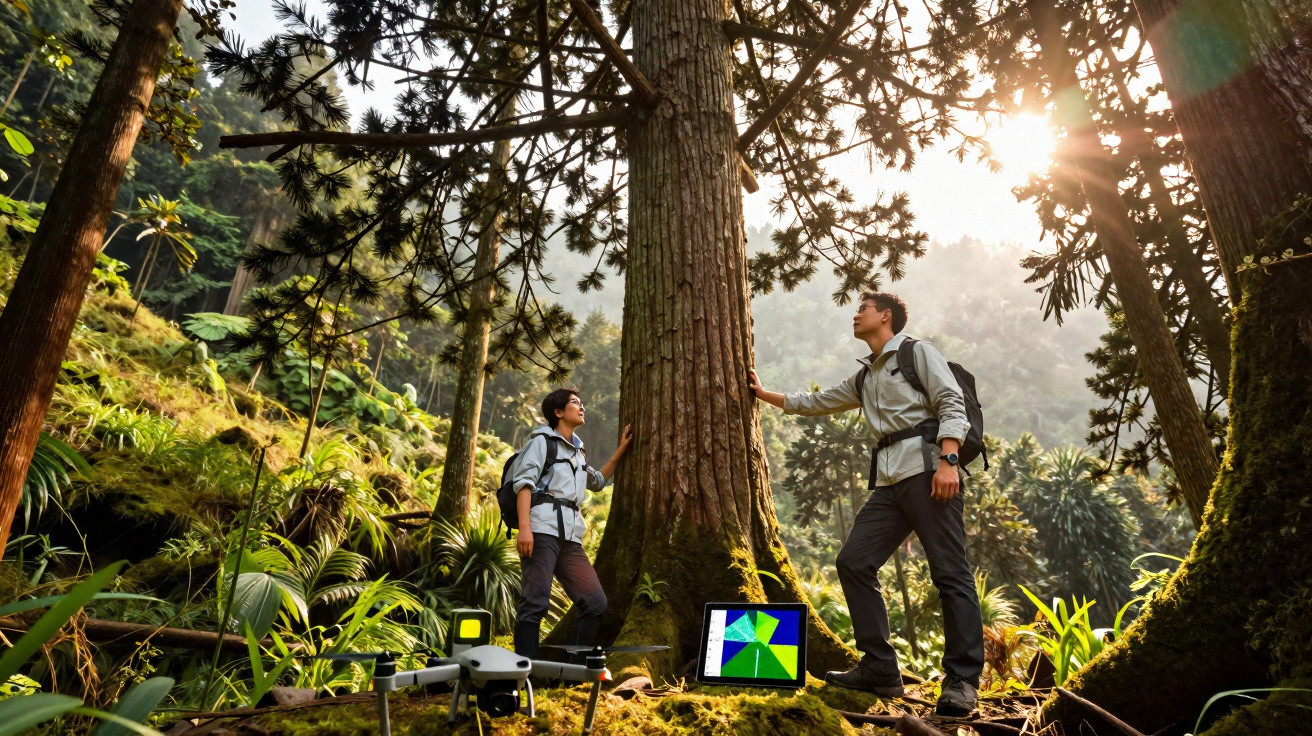
For years, a tree taller than many buildings remained almost invisible among Taiwan’s mountains. In 2023, researchers finally reached it and verified that it stood 84.1 metres tall. The Taiwania cryptomerioides specimen, nicknamed the “Da’an River Heavenly Sword”, became the tallest known tree in East Asia.
How did a tree of this size remain hidden?
Taiwan’s interior combines steep mountains, dense woodland and valleys that are difficult to reach. According to a study published in 2026 in Frontiers in Forests and Global Change, this terrain helped protect old-growth forest areas, even after decades of logging elsewhere on the island.
Scientific efforts to locate giant trees intensified in 2014. Simply spotting canopies from a distance, however, was not enough to establish which individual trees were truly the tallest. Some expeditions required several days of walking, while the forest itself concealed both trunks and treetops, making conventional measurements exceptionally challenging.
How did LiDAR identify Taiwan’s forest giants?
The researchers used airborne LiDAR, a technology that sends laser pulses towards the ground and measures how long they take to return. These readings can be used to create three-dimensional models of vegetation and estimate canopy heights over very large areas, without having to visit every individual tree.
The approach nevertheless faced an unexpected problem: cliffs confused the algorithms. In one example described in the study, a tree measuring under 25 metres initially appeared to be around 90 metres tall because it was growing beside a sharply sloping hillside. The eventual solution brought together technology, specialists and hundreds of volunteers.
- The initial survey identified 57,065 potential locations linked to exceptionally tall trees.
- A team of 372 volunteers helped visually assess the remote-sensing data.
- The filtering process produced a map of 941 confirmed trees taller than 65 metres.
- The strongest candidates were checked in the field through climbing and direct measurement.
How did scientists verify the 84.1 metres?
In January 2023, the team set out for the most promising candidate shown on the map. According to an account published by Frontiers, the expedition involved travelling approximately 20 kilometres along a river, followed by two more days climbing steep ground to reach the tree in the Sheshan Mountains.
Confirmation came through a remarkably straightforward method: a climber reached the canopy, then lowered a measuring tape to the ground. It recorded 84.1 metres. The study by Rebecca Chia-Chun Hsu and colleagues identified the specimen as the tallest tree ever documented in Taiwan and East Asia.
Watch the video shared by the YouTube channel Treasure Of World, showing the imposing tree concealed within a forest in Taiwan.
Why do these trees matter beyond their height?
The research uncovered more than isolated record-holders. Near Mount Benya, scientists recorded 11 trees exceeding 65 metres within just one hectare. In another location, around 30 large Taiwania specimens were seen growing together, forming clusters that the researchers called “temples of giants”.
Large trees also have an outsized ecological role. The scientific paper highlights earlier studies linking old trees with carbon storage, biodiversity and microclimate regulation. An assessment in the Tao Tree Valley found a carbon density of 1,384.5 Mg per hectare, excluding root systems.
How many more giants may still be hidden?
By the start of 2026, the project had already located and climbed ten Taiwania specimens taller than 70 metres, including two over 80 metres. The researchers themselves stress that the survey of 941 giants provides an important foundation for monitoring these forests and guiding their conservation in a region with exceptionally complex terrain.
The discovery of the Heavenly Sword shows that even an 84-metre tree can remain unknown when it grows in the right location. Finding these giants now is about more than pursuing records: it means identifying ancient, vulnerable ecosystems before climate change, droughts, storms and landslides permanently alter the forests that managed to conceal them for centuries.


Comments
No comments yet. Be the first to comment!
Leave a Comment