
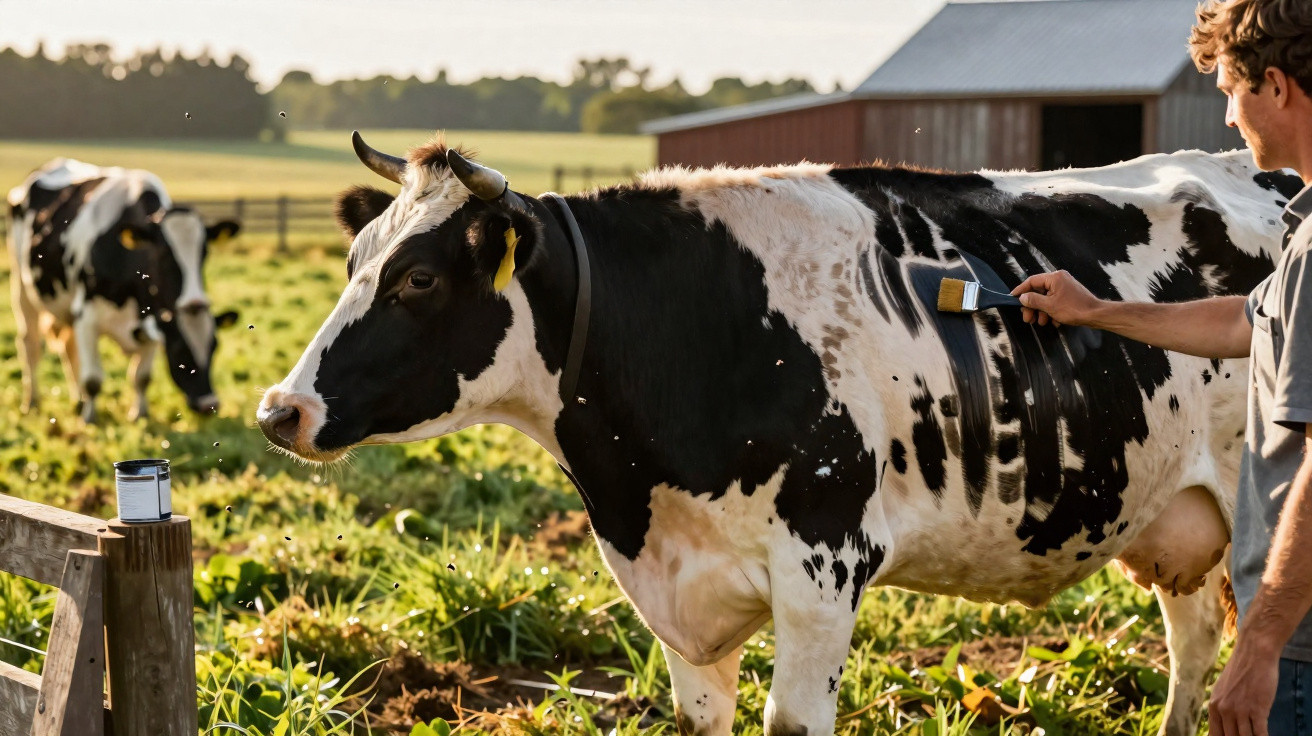
Japanese scientists painted black cows with zebra-like stripes to examine whether this visual pattern discouraged biting flies. The striped animals recorded roughly half as many landings as unpainted cows, supporting the theory that zebra colouring acts as a natural defence against insects.
How was the cow experiment carried out?
The research involved six Japanese Black cows. Every animal experienced three separate conditions: black-and-white stripes were applied, only black stripes were painted on, or the coat was left untreated. This approach allowed the team to establish whether the result came from visual contrast rather than simply having paint on the animals' coats.
- The stripes measured about 4 to 5 centimetres wide;
- The paint was applied by hand using a water-based product;
- Each cow underwent all three treatments;
- Researchers photographed the animals' bodies and legs;
- Flies landing on them were counted from the photographs;
- Movements used to drive insects away were also recorded.
What happened to cows painted like zebras?
Cows given black-and-white stripes attracted nearly 50% fewer flies than both unpainted animals and those painted only with black stripes. Since there was no meaningful difference between the latter two groups, the researchers determined that neither the smell of the paint nor its application alone accounted for the finding.
The zebra-painted cow experiment also showed fewer head, ear, leg and tail movements intended to repel insects. Altogether, these defensive behaviours fell by around 20% in the striped animals.
Why do stripes make it harder for flies to land?
The exact mechanism has not yet been fully explained. One leading account is that the contrast between light and dark bands disrupts flies' visual perception as they approach, making it more difficult for them to regulate speed and make a stable landing on the animal.
- Flies use brightness, movement and contrast to find hosts;
- Narrow bands may change the light reflected by a surface;
- The pattern may confuse the systems that guide their approach;
- Insects still approach, but more often fail when attempting to land;
- Uniform black or white surfaces generally receive more landings.
Does this result explain why zebras developed stripes?
The experiment strengthens protection from biting flies as one of the best-supported explanations for the evolution of stripes. Earlier studies had already found that insects land less frequently on striped surfaces and on horses covered with fabrics designed to resemble zebra patterns.
This does not mean that one study involving six cows has completely settled the evolutionary debate. Ideas including camouflage, predator confusion and temperature control have received less support across different research, but stripes may have more than one effect on the animal, even if only one was decisive in their evolution.
Can painting cattle replace insecticides?
The researchers viewed the technique as a potential alternative for reducing cattle exposure to flies and improving animal welfare. Fewer bites may mean fewer disruptions to feeding and resting, as well as less energy spent shaking the head, stamping the legs and swishing the tail.
Practical use still has limitations. The paint used in the experiment faded within a few days, whereas fly season can last for several months. Larger studies must assess safety, cost and durability before the stripes can be regarded as a visual repellent able to replace conventional farm methods.






Comments
No comments yet. Be the first to comment!
Leave a Comment