
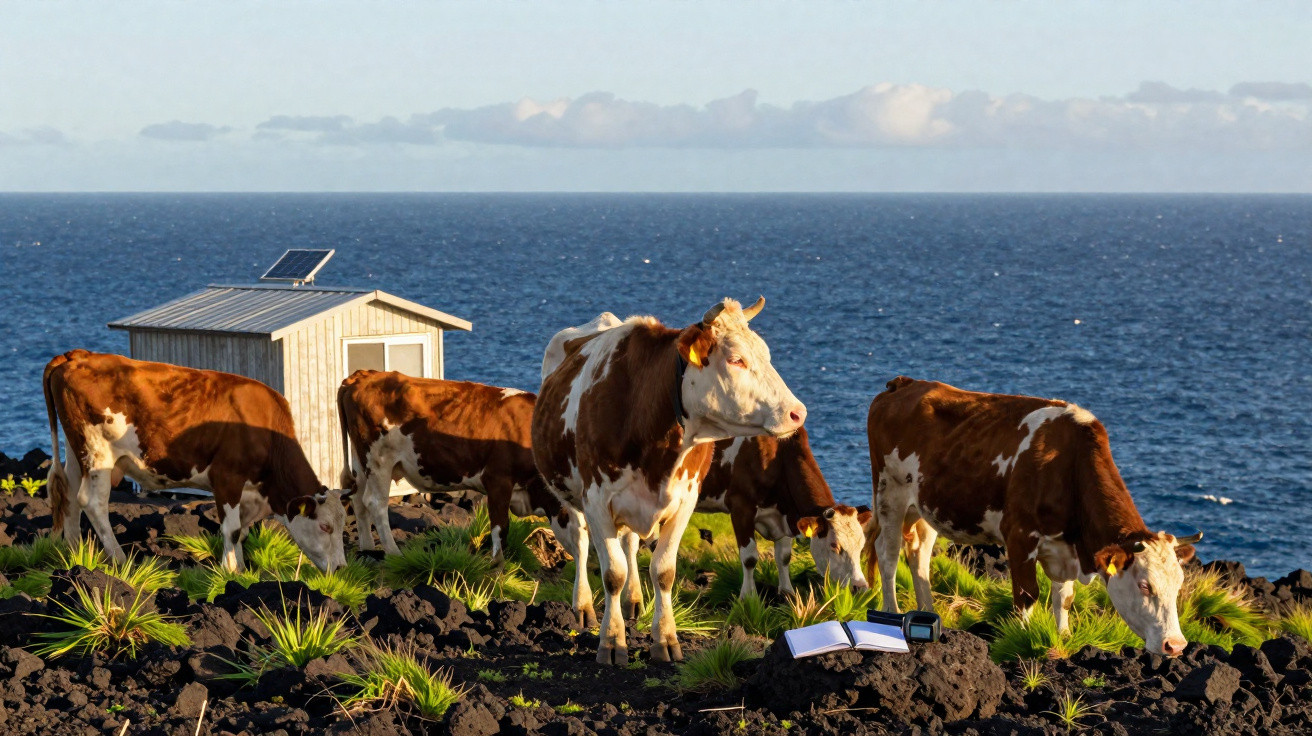
Amid the Indian Ocean, Amsterdam Island appears to drift alone across a vast expanse of grey and blue. In 1871, a farmer is said to have left five cows there, never suspecting that this ordinary act would become, more than a century later, a puzzle for geneticists. The animals lived far from roads, veterinary care, modern fencing and any regular arrival of new livestock. They became an isolated herd, exposed to wind, volcanic slopes and sometimes scarce food. When scientists examined their descendants roughly 130 years later, they identified an inbreeding rate close to 30%. Yet no obvious genetic disease was found within the group. It is a story that seems almost too neat to be true.
Five cows against the ocean: an unintended experiment on a forgotten island
The scene is easy to picture: a handful of cattle brought ashore on dark, wet land battered by gusts. On Amsterdam Island, a French territory isolated in the southern Indian Ocean, these animals had no neighbouring farms, livestock market or lorry to replenish the herd. Their entire world covered an island of 55 square kilometres. Over successive generations, their descendants bred with one another because there was no alternative. This is precisely the situation livestock farmers fear when a population becomes too small. In everyday life, we all know how a minor problem left unattended can eventually take over everything. Here, that “minor problem” had horns.
Available accounts refer to the arrival of five cattle in 1871, abandoned by passing men who probably hoped to create a future meat supply. It was a rough, almost improvised plan. The animals adapted and then multiplied, forming a herd of several hundred head during the 20th century. Researchers who analysed their DNA in the early 2000s found an exceptionally high degree of relatedness: around 30% inbreeding. In other words, their genomes bore the marks of very closely shared ancestors. On paper, this should have set off a long list of health warnings. It did not produce as many as expected.
Inbreeding is not a disease in itself. It raises the likelihood that two copies of the same harmful gene will meet in a calf, like drawing two unlucky cards from the same pack. In a small herd, damaging mutations are less likely to be “masked” by broad genetic diversity. Even so, the Amsterdam cattle showed no widespread inherited deformities or clearly identified genetic syndrome, based on the available observations. Nature did not follow the bleakest storyline. The lack of visible illness did not mean the animals were invulnerable; rather, it pointed to slow, harsh and silent selection driven by isolation.
Why high inbreeding did not necessarily destroy everything
To make sense of this case, it is necessary to consider what biologists call “genetic purging”. The phrase is stark, but the process is straightforward: in a highly inbred group, some severely harmful genes are expressed more quickly. Animals carrying them may reproduce less successfully or survive for less time. Over generation after generation, the most damaging variants can therefore become less common. It is a form of natural sorting, without intention or gentleness. This interpretation must remain cautious: it does not make inbreeding a good practice. It simply helps explain why a small population can occasionally appear remarkably healthy after a lengthy period of isolation.
The island’s climate probably also played a part. Cattle able to withstand cold, rain, local parasites and limited resources left more descendants. The others disappeared from the landscape, with no record telling their story. To be honest, nobody really does this every day: following a free-roaming herd on a volcanic island for 130 years. Scientists therefore did not witness every stage of this selection. They reconstructed part of the picture through samples, archives and comparisons with other cattle breeds. The absence of known pathology must never be mistaken for a complete absence of biological vulnerability.
The most useful approach is to keep separate three questions that are often confused: the level of relatedness, the genetic diversity that remains, and the observed state of health. An animal may look resilient while carrying weaknesses that will only emerge during drought, an epidemic or a change in diet. Specialists therefore assess DNA, but also fertility, growth, calf survival and clinical signs.
“An isolated population can remain stable for a long time without being protected from a shock,” summarises the idea supported by many conservation geneticists.
- Measure genetic diversity rather than relying solely on the animals’ appearance;
- Monitor fertility and mortality over several generations;
- Avoid presenting a rare case as a universal rule.
The Amsterdam herd: a fascinating but uncomfortable lesson
This story is compelling because it overturns a widespread assumption: with only five founders, everything appeared destined to collapse. Instead, their descendants survived for a long time, occupied the island’s grasslands and defied some of the most alarming predictions. Their local success, however, came at a cost. The herd altered natural habitats, trampled some plant-covered areas and made the protection of endemic species more difficult. The cattle were eventually removed from Amsterdam Island as part of ecological restoration work. Their genetic history cannot therefore be separated from its impact on the surrounding living world. An animal population can fascinate researchers while also creating a genuine conservation problem.
The common mistake would be to draw a reassuring conclusion from this example: “Inbreeding is not that serious, because these cows were fine.” That would overlook how chance, environment and time shaped a highly unusual situation. In farm animals as in threatened wild species, low genetic diversity remains a serious risk factor. A single new disease can overturn a balance that had appeared robust. Herd managers therefore aim, where possible, to introduce new bloodlines without erasing local characteristics. It is less dramatic than a remote island and five forgotten cows, but it is often the wiser choice.
There remains something deeply human about this episode. An action taken in 1871, probably for practical reasons, created a small animal society cut off from the rest of the world. For 130 years, it lived under its own constraints, unaware that scientists would one day read its history in its chromosomes. The mystery is not that the cows survived. The real mystery is what their survival reveals about how we predict the living world. We like clear rules, decisive figures and neatly ordered scenarios. Amsterdam Island reminds us that ecosystems can retain an element of unpredictability, even when DNA appears to have already delivered its verdict.
| Key point | Detail | Value for the reader |
|---|---|---|
| Origin of the herd | Five cattle left on Amsterdam Island in 1871 | Understand how a very small population can become a scientific case |
| Observed inbreeding | Around 30% among the descendants studied | Assess the difference between genetic risk and visible disease |
| Ecological lesson | Adapted animals can also weaken an island environment | Connect genetics, livestock farming and biodiversity protection |

Comments
No comments yet. Be the first to comment!
Leave a Comment