
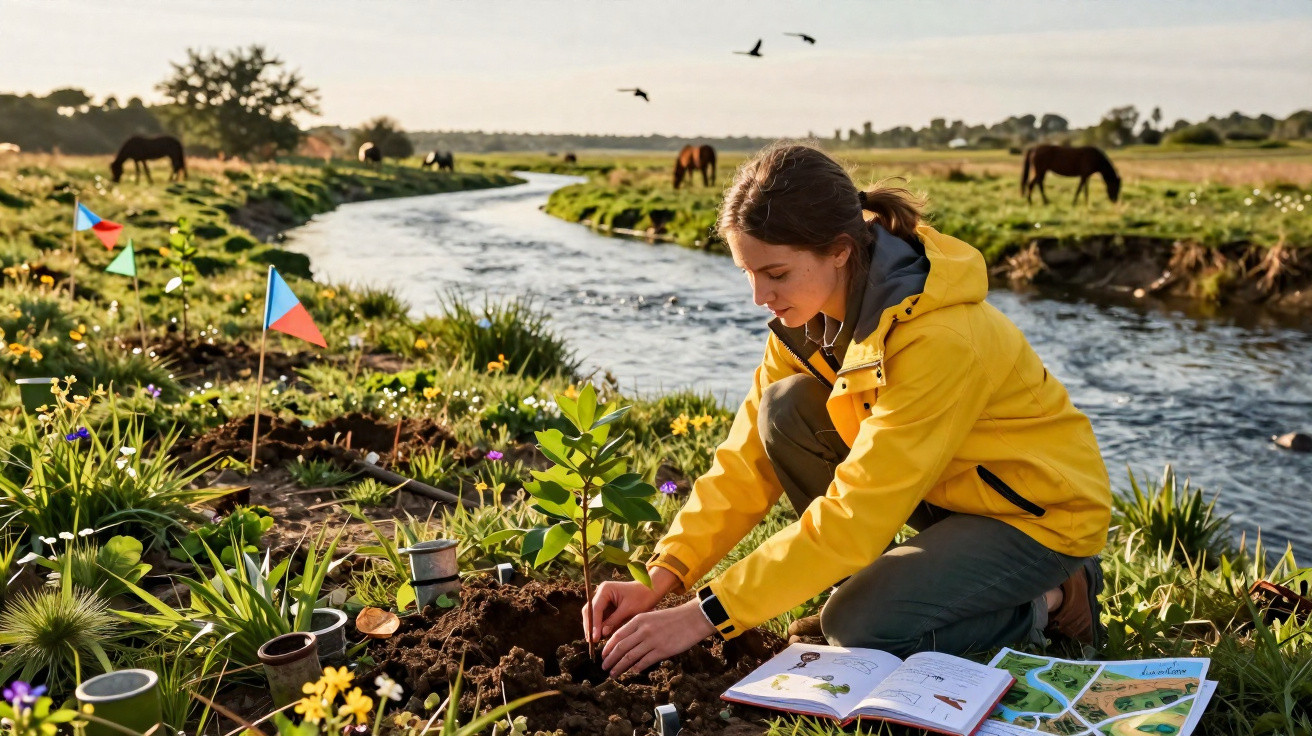
Most days, environmental news can feel overwhelming. Temperatures are climbing, habitats are contracting and wildlife is vanishing. It can appear that the future is already beyond saving. Yet that is not the whole story.
Across the world, a less visible narrative is emerging: one of restoration rather than destruction, and recovery rather than loss.
Rewilding is increasingly central to this change, demonstrating that nature can recover when it is given the opportunity.
Rewilding: a movement driven by action
At its heart, rewilding is straightforward. It involves allowing nature to lead once more. This may mean regenerating forests, reconnecting rivers, reintroducing lost species or simply standing back so ecosystems can repair themselves.
This is not a far-off concept. It is already taking place in real locations and delivering real outcomes.
Wetlands are being revived, once again helping to absorb floodwaters. Grasslands are regenerating and drawing carbon out of the atmosphere. Wildlife is reappearing in places from which it had been absent for years.
People from every background are participating across continents. Farmers, researchers, local communities and volunteers all play their part in different ways. These are not separate, disconnected actions: together, they are producing change that can be seen.
Why rewilding matters to people
Thriving ecosystems offer more than benefits for animals and plants. They sustain human life in ways that often become apparent only after they have been lost.
Clean water, productive soil and reliable weather patterns all rely on natural systems working properly. Rewilding helps to restore those systems.
As forests return, they cool the surrounding air and retain water in the ground. Free-flowing rivers can lower flood risk while supporting fisheries.
Greater biodiversity also makes ecosystems more stable and more capable of coping with pressure.
There is a further human benefit that is more difficult to quantify. Those living near restored landscapes often describe a deeper feeling of connection and improved well-being.
Access to nature is associated with lower stress and stronger mental health. This is not solely about survival; it is also about quality of life.
A growing global moment
World Rewilding Day falls on 20 March each year, the date of the spring equinox. It brings people around the world together to acknowledge what has been achieved so far and what may yet be possible.
Its timing is significant. The equinox represents equilibrium, when daylight and darkness are equal. It reminds us that change is continual and that natural cycles include moments of transition.
This year’s message centres on choice, not as an abstract idea but through everyday decisions.
The message is simple: a better future is not something to wait for. It is something we choose and are already helping to create.
Science supports nature’s recovery
Research shows that ecosystems can recover more rapidly than expected once damaging pressures are removed.
Studies of forest regeneration, for instance, indicate that secondary forests can regain much of their biodiversity within decades.
Marine reserves have revealed comparable results, with fish populations recovering when overfishing ends.
Major projects have produced measurable outcomes too. In parts of Europe, rewilding initiatives have supported the return of species including wolves, bison and lynx.
In North America, river restoration schemes have reopened thousands of kilometres of waterways, improving habitats for fish and other wildlife.
These developments are more than symbolic. Their effects on biodiversity, carbon storage and ecosystem resilience can be measured clearly.
Rewilding in action around the world
Restoring nature may sound theoretical until it can be witnessed in specific places. In the Pacific, Rapa Nui has made a significant move by safeguarding one of the world’s largest marine protected areas. That work is already bringing results.
Whale sightings have risen, suggesting the return of marine life that had been declining for a long time.
A different form of rewilding is emerging in urban areas. The organisation SUGi is creating dense pocket forests of native species in cities.
These compact yet influential green spaces are now found in 62 cities and reach more than 90,000 young people.
Their value extends beyond appearance. Supported by urban ecology research, these forests reduce extreme temperatures, provide for wildlife and enhance day-to-day well-being.
Further south, Rewilding Chile is supporting the recovery of the guanaco, a native species that had been forced out of much of its historical range.
The animals can now move once again through the Route of Parks of Patagonia, an extensive network spanning one-third of the country and more than 90% of its protected land.
The area has become a sanctuary not only for guanacos, but also for hundreds of species reliant on healthy, connected landscapes.
Rewilding on the front lines
Organisations such as Re:wild are taking rewilding to some of the planet’s most isolated and demanding environments.
Its work extends across more than 80 countries and encompasses hundreds of millions of hectares, with the aim of safeguarding ecosystems and supporting species recovery.
In many places, this involves working closely with Indigenous communities and local partners who understand the land most deeply. Such partnerships are fundamental to the approach.
Conservation is not dictated from outside. Instead, it is developed with the people who live in these places, bringing scientific methods together with local knowledge to safeguard forests, monitor wildlife and stop habitat loss.
Rediscovering what was lost
A particularly remarkable aspect of Re:wild’s work concerns species that had gradually disappeared from scientific records.
In a number of instances, animals believed to be lost have been rediscovered through detailed field research and cooperation with local communities.
In Mexico, for example, researchers verified the presence of a rabbit species that had gone unrecorded for decades, following surveys at several sites over a number of years.
Related work has uncovered previously unknown populations of other rare animals. It shows that some ecosystems contain more life than expected when they receive attention and protection.
A future shaped by genuine change
These initiatives demonstrate something significant. Rewilding is neither a remote ambition nor merely an optimistic concept. It is already transforming ecosystems, from seas and cities to mountain landscapes.
The scale differs from place to place, but the direction remains consistent. Life returns when space is restored. Natural systems begin to mend themselves. People start to recognise what can happen when nature is allowed to recover.
Choices continue to arise every day. Some may be minor, while others have greater consequences. Collectively, they shape what follows.
The expanding rewilding movement delivers a clear message: the future is not something we simply await. It is something we are already making.

Comments
No comments yet. Be the first to comment!
Leave a Comment