
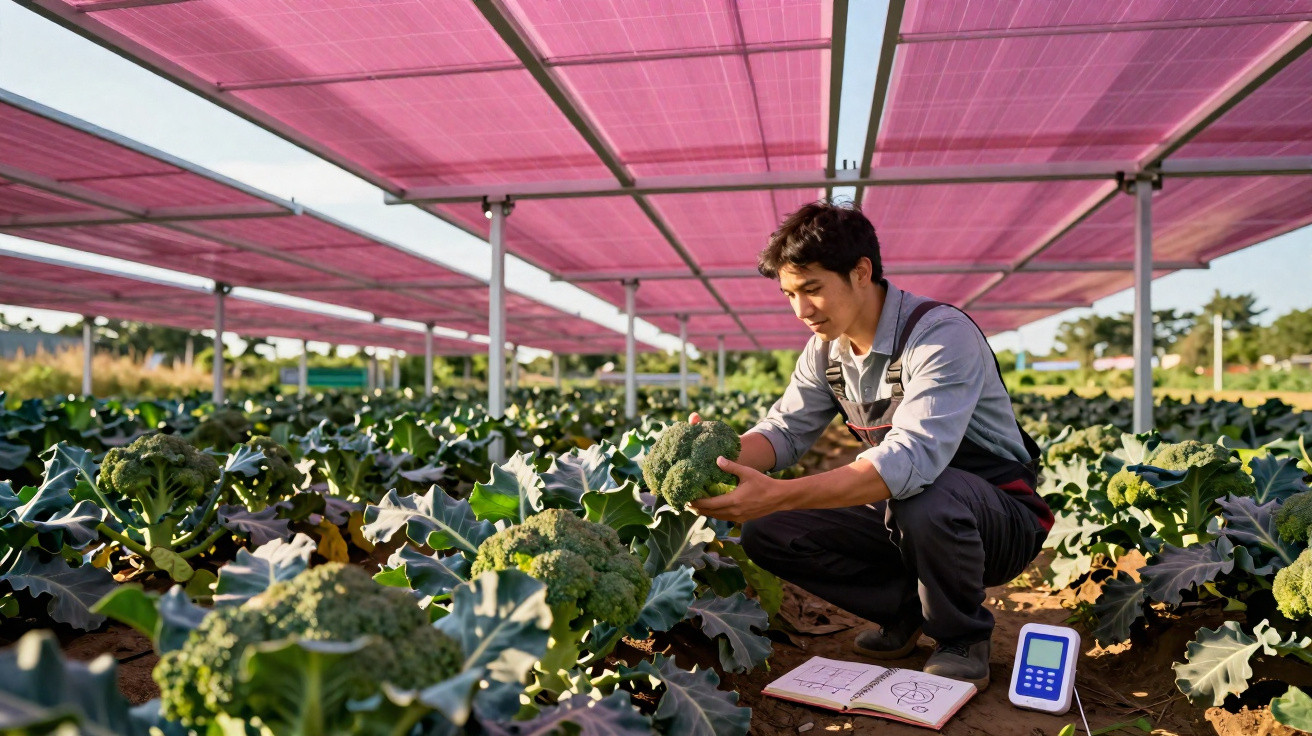
Plants were nature’s first solar panels, remarkably capable of converting light into energy - particularly red and blue wavelengths.
But could solar panels work alongside crops by collecting the light plants do not need, while still transmitting those red and blue wavelengths?
A team led by Silvia Ma Lu at Mälardalen University in Sweden has explored that possibility in a new study. The researchers tested semi-transparent, rose-coloured solar panels that allow selected wavelengths to reach plants below while harvesting solar power to generate electricity.
Their prototype has been described in the scientific journal Cell Reports Physical Science.
"The basic concept is quite straightforward," Ma Lu says.
"The solar panels use part of the incoming sunlight to generate renewable electricity while allowing part of the light to pass through to the crops growing underneath."
Ma Lu says sunlight may be used more efficiently by assigning different parts of the solar spectrum to crop production and electricity generation.
The magenta panels used in the study are closer to an early prototype than a finished product, however. Their colour filters out light in the green spectrum, although the solar cells do not currently capture the energy contained in that green light.
Even so, the experiments indicate that this could become possible in future.
Magenta solar panels and broccoli growth
To test the magenta solar cells, Ma Lu and her colleagues selected broccoli as their crop.
As a cultivar of Brassica oleracea, broccoli belongs to the same species as several other commercially grown crops, including cabbage, cauliflower, kale, Brussels sprouts and kohlrabi. If broccoli can grow successfully beneath the rose-coloured shade of the solar cells, other crops from the same species may be able to do so as well.
The researchers established three separate plots, each covering 20 square metres, for growing broccoli.
One plot grew broccoli in full sun, providing a benchmark for ‘normal’ growth without solar cells.
Broccoli in the two remaining plots was cultivated below magenta solar cells. The panels over one plot had 50 percent transparency, while those above the other had 70 percent transparency.
"One of the most interesting findings was how similarly the broccoli performed under the two solar panel systems despite their different transparency levels," says Ma Lu.
"However, these findings are specific to our experimental conditions and should be validated across additional growing seasons and system configurations."
At harvest, yields were similar across all of the broccoli plants. However, the broccoli grown beneath the magenta panels needed an extra 25 days to reach harvest.
Because these plants received substantially less light than the broccoli grown in full sun, the result suggests they used the available light more efficiently: 4.5 times greater beneath the more densely shaded, 50-percent-transparency panels, and 2.8 times greater under the 70-percent panels.
How the semi-transparent solar cells work
The magenta colour is not the only factor changing the light that reaches the plants.
The cells’ active material, opaque cadmium telluride (CdTe), is set into strips running across the glass panels.
This design feature is what makes the solar panel capable of transmitting light. Closely spaced CdTe strips enable the cell to absorb more sunlight and produce more electricity, but they also reduce the amount of light reaching the plants beneath.
This creates an obvious question: if CdTe strips transmit light irrespective of the glass colour, why do the panels need to be magenta at all?
In reality, they do not. Neutral glass could serve equally well.
The magenta panels were originally designed for buildings, where they were intended to cast a rosy glow inside while also generating some electricity. They were used in this experiment simply because they were already commercially available and suitable for repurposing.
The magenta filter transmits two light spectra that are important for plant growth: red and blue. Yet the green light blocked by the filter is not necessarily collected by the solar cell.
Consequently, the study does not fully establish whether broccoli growth was influenced by the magenta filter containing the CdTe strips or by the overall level of light. It also does not account for the greenhouse effect created by placing glass over growing vegetables.
More comprehensive experiments will be required to separate these variables.
Potential for small-scale solar panel use
As these rose-coloured panels are already commercially available, Ma Lu says they could provide households and community groups with a practical way to get more from limited space.
"Configurations similar to our prototype may currently be suitable for smaller-scale applications, such as community gardens, or for integration into greenhouse roofs rather than immediate deployment over large agricultural areas," she says.
In principle, filtering different light spectra and assigning their energy to separate purposes - plant cultivation and electricity production - is logical. Yet there appears to be further work needed before a solar panel of this kind would be worthwhile for large-scale commercial use.
"From an engineering point of view, this is about getting the best overall use from sunlight and land," explains power systems engineering expert Ramesh Rayudu, who was not involved in the study.
During the growing period, the magenta cells generated approximately 224.7 MWh of electricity per hectare in the experiment - roughly 100 MWh per hectare less than conventional solar panels of a comparable size.
"Depending on the value of electricity and the price received for broccoli, that lost electricity could require roughly 1.2 to 3.2 tonnes of additional broccoli per hectare to offset its value," Rayudu says.
"The real question is whether the extra complexity of wavelength-selective solar panels produces enough additional agricultural value to compensate for lower electricity generation. That is the comparison I would like to see next."
The research has been published in Cell Reports Physical Science.
This article was fact-checked by Fiona MacDonald and edited by Fiona MacDonald. Although we take pride in our process, we are only human. If you notice an error, please let us know.
Comments
No comments yet. Be the first to comment!
Leave a Comment