
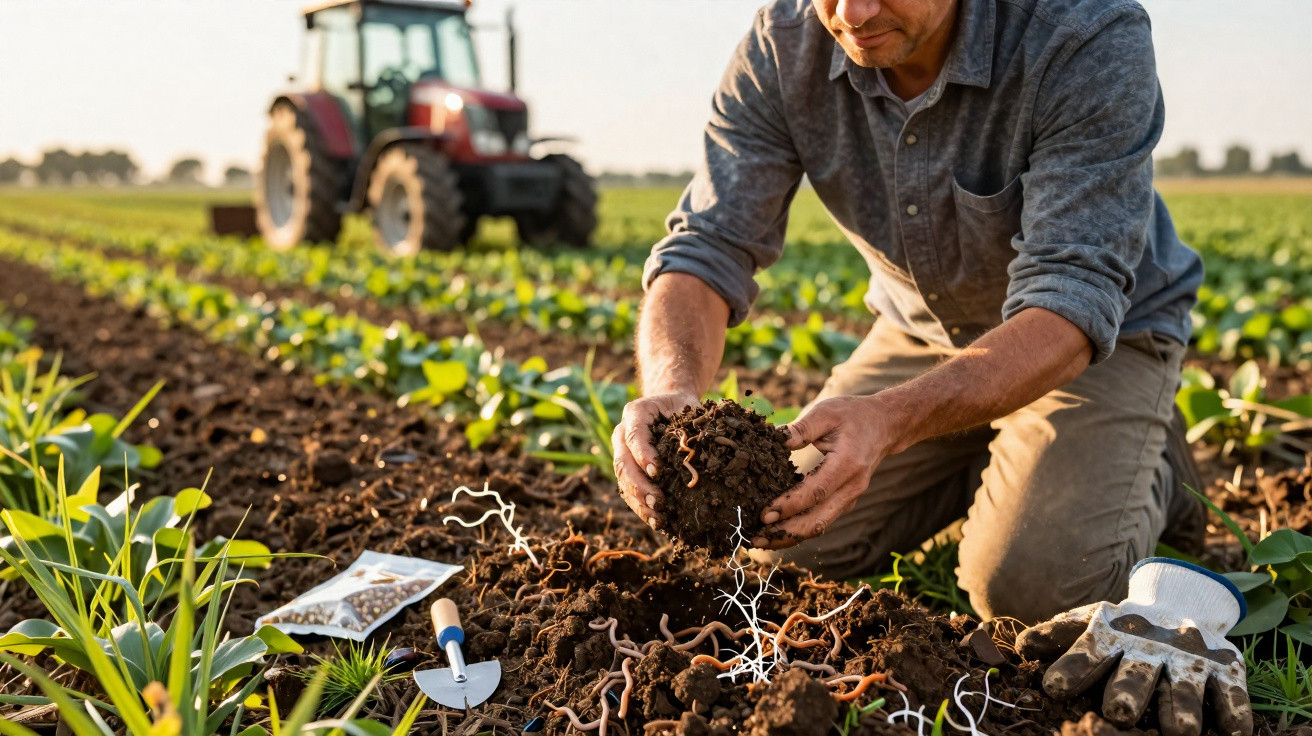
No engine rumble from tractors, no steel scraping over parched earth - only boots softly crunching across a field that had once been as unyielding as a car park. It is early morning, with the sort of misty light that makes spider webs shine between cover-crop stems. A farmer crouches down, drives a small spade into the ground and raises a clod. Last year, this would have been a lifeless grey slab. Now it contains tunnels, roots and glossy creatures wriggling away from the sudden daylight.
He smiles, rubbing soil between his thumb and fingers as it falls apart rather than cracking like concrete. “They’re back,” he says quietly, as though he were speaking of old friends returning after a long war. Earthworms, springtails and hair-fine fungal threads: life below ground is stirring again in a field that had been compressed for years.
This happened because he stopped crushing the soil - or, more accurately, because he did it far less often.
When the ground can finally breathe again
A compacted field can appear perfectly ordinary at first: sufficiently green, planted in neat rows, with large machinery operating “efficiently”. Walk over it after rainfall, however, and the problem is obvious. Puddles remain for days, boots slip, and the surface has an unusual slickness. The soil is no longer taking in water. It is suffocating.
Farmers may discuss lost yields and agronomists may refer to bulk density, but the process underground is more straightforward. Roots cannot force their way through dense layers. Worms cannot create burrows. Air and water are restricted to moving like rush-hour traffic in a single narrow lane. The ground is quiet for all the wrong reasons.
Choosing to reduce soil compaction is seldom a dramatic turning point. It is closer to removing a heavy rucksack you had not realised you were carrying. Gradually, the soil releases tension and begins to function again.
On a small eastern English farm, that rucksack took the form of 10-tonne tractors and a sprayer that left ruts deep enough to stumble into after dark. For years, the farmer blamed the weather: too wet, too dry, never quite suitable. Then, during one exceptionally wet autumn, he watched topsoil wash down the field and gather at the gate like chocolate pudding. That was the moment he decided things had to change.
He moved towards lighter equipment, lowered tyre pressures and introduced controlled traffic lanes, ensuring wheels travelled along the same routes rather than crossing the whole field. Yields did not suddenly soar, and no money appeared overnight. Yet the following spring he noticed something unexpected: water drained more rapidly from the tramlines, while the rest of the field did not harden into brick during the first heatwave.
After two years, soil testing showed increased organic matter, improved structure and more visible life. Counting worms, once a rather dispiriting exercise, became straightforward. One spadeful after another displayed the same signs: dark aggregates, a crumbly consistency and a faint mushroom-like scent. The underground neighbourhood was being repopulated.
Scientists can explain this gradual recovery clearly. Compaction presses out the pores that normally store both air and water. Roots and microbes receive less oxygen, water stagnates more easily, and there are fewer channels through which living organisms can travel. Microorganisms that depend on oxygen decline. Worms stay away from the most densely packed layers. Fine roots grow sideways instead of downwards, leaving crops thirsty during dry periods and under pressure in hot weather.
Reducing compaction does not so much “add life” as stop forcing it out. Pores begin to open, rainwater infiltrates rather than runs off, and organic matter can build up rather than being lost. This forms micro-habitats in which bacteria, fungi and tiny arthropods can establish themselves. In time, their activity holds aggregates together and creates natural structure that machinery cannot genuinely reproduce.
It becomes a positive cycle: less crushing brings more life; more life produces stronger soil; stronger soil reduces the need to take heavy equipment onto wet land. Many of the remarkable changes beneath our feet are simply physics working alongside patient biology.
How farmers quietly changed their habits
The most important adjustment often begins with one unremarkable decision: stay out of fields that are too wet. The English farmer started by setting a clear rule, both mentally and in his diary. If soil adhered to his boots in large clumps, or if his heel failed to leave a distinct print, the tractor remained in the shed. There were no exceptions, even if contractors applied pressure or neighbouring farmers had already started work.
He supported this with another change: reducing tyre pressure to enlarge the contact area and distribute weight more evenly. Whenever practical, he changed to dual wheels or wider tyres run at lower pressure, which “floated” over the soil rather than cutting into it. On certain fields, he also combined jobs to reduce the number of passes, drilling and applying fertiliser in fewer journeys. None of these measures looked impressive from the road, but the soil responded.
Let us be honest: nobody manages this perfectly every day. The pressure to establish crops, make the most of a weather window and keep pace with the farm down the road is real. In a difficult year, refusing to enter a field can feel like setting fire to money. This is why many farmers who make the change successfully begin with a trial on one plot.
One vegetable grower chose his poorest, most compacted block as an “experiment”. He cut machinery passes by a third, replaced deep ripping with light, shallow cultivation, and sowed a dense cover-crop mixture containing large taproots. Yields barely changed in the first season, and he came close to abandoning the approach. In the second year, however, the crop coped with a severe summer drought far better than crops elsewhere on the farm. By year three, his agronomist asked, “What did you do here?” That small, slightly untidy trial area became the model for the rest of the farm.
From a technical perspective, controlled traffic farming (CTF) can be transformative where it is feasible. It confines heavy wheels to permanent lanes, leaving 70–80% of the field untouched by machinery weight. Combined with cover crops whose roots penetrate old plough pans, the results can be striking. Vertical root channels become visible, earthworm “motorways” appear, and there are fewer of the unattractive horizontal smear layers that can completely halt infiltration.
Not every farmer can adopt CTF fully or invest in new machinery. This is where modest but reliable choices can accumulate: shallow cultivation rather than annual deep ploughing, varying cultivation depth, or applying organic materials to feed soil biology instead of depending entirely on synthetic inputs. Each adjustment weakens compaction’s hold and gives more control back to the organisms living below the surface.
Common mistakes, quiet wins, and what the soil is really asking for
There is one practical step any grower can take: dig more holes. It does not require a complicated assessment, only a spade and five minutes. Go into a field, lift out a block of soil and gently break it apart by hand. Soil that fractures like a dry brick or separates into plates is signalling compaction. Soil that crumbles into uneven pieces with gaps between them is moving in the right direction.
Carry out this spade assessment after rainfall as well as in dry conditions. Over time, patterns become apparent: the headland that is consistently worse, the tramline that never quite recovers, or the corner with poor drainage. Many farmers use this informal field “map” to identify where lighter equipment, more cover crops or fewer passes are needed. It is low-tech and almost old-fashioned, but it connects surface decisions with what is taking place underground.
At a vineyard in southern France, the manager replaced regular deep ripping with a combination of shallow cultivation and permanent grass strips. Each season, he walked between the rows with a spade and recorded how roots explored further down year after year. After ten years, he says the vines withstand intense rainfall and late-summer drought with less stress. He gestures towards the soil profile as if it were a family photograph album: here is the former compacted layer, and here is where roots and worms finally broke through.
The same errors are common. Some people purchase a subsoiler and believe one deep pass will “fix” several decades of compaction. Others reduce the number of passes yet still drive onto saturated land. Some sow cover crops, then flatten them with heavy machinery at exactly the wrong moment, losing much of the benefit. Others become disheartened because the soil still appears exhausted after only one season of gentler management.
The reality is that compacted soil resembles a body recovering from burnout. One gym session will not repair it. It needs relief from continual pressure, time to rebuild strength and a proper diet. In this case, that diet is organic matter: roots, crop residues, manures and composts. Without it, soil biology has little to work with.
The most relatable advice is therefore also the least glamorous: select one or two changes that you can genuinely maintain, and continue them over several seasons. Use lighter machinery where possible. Avoid that single pass on a wet day. Sow a robust cover-crop mixture after harvest. Above all, pay attention to what the spade, the smell and the feel of the soil reveal.
“We didn’t bring life back to the soil,” the English farmer said, watching earthworms twist away from the light. “We just stopped pushing it out, day after day.”
That change in perspective often extends into unexpected parts of farm life. Some growers describe developing a calmer pace, spending less time frantically chasing perfect timing and paying more attention to patterns rather than isolated events. In human terms, reducing soil compaction becomes part of a broader choice to work within limits instead of continually trying to bulldoze through them.
In practical terms, these are a few straightforward field-side questions that many farmers now keep in mind:
- Is soil sticking to tyres or boots in heavy clumps?
- Can I cut the number of passes by combining tasks today?
- Do I actually need to cultivate at this depth, or am I doing it from habit?
- Where might a cover crop or organic amendment allow biology to do some of the heavy work?
What returns when we stop crushing the ground
As compaction reduces, recovery involves more than worms and roots. It also alters the way the wider landscape responds to weather that we call “extreme”, although it increasingly feels like the new normal. Better-structured fields soak up sudden downpours rather than becoming shallow lakes. They retain moisture through extended dry spells, supporting crops for a crucial extra week or two before stress takes hold.
There is also a psychological change. Farmers who once regarded soil as a static growing medium begin describing it as an ecosystem. They spot fungal networks, notice the sweet scent of a woodland floor, and sense the contrast between dead dust and living crumb. On a difficult day, that connection does not make bills vanish. Even so, it can restore a sense of purpose that paperwork and pressure had buried years earlier.
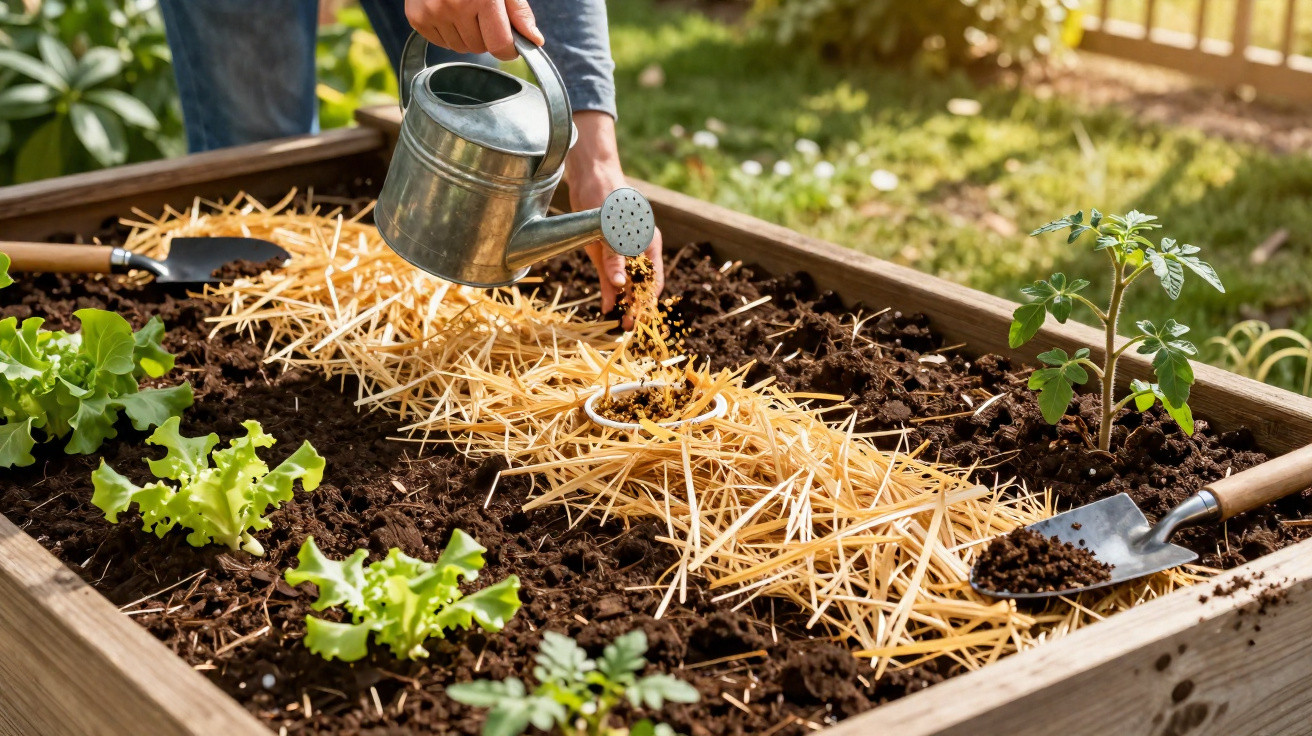
Gardeners and small-scale growers see similar effects in raised beds and gardens. There is the moment when water finally soaks in rather than sitting on the surface, or when a pulled-up plant reveals a fine web of roots growing deeply and widely instead of circling in only the top few centimetres. We have all seen a plant suddenly flourish in a place that used to be a graveyard, and realised that the soil itself has changed.
Reducing soil compaction is not a cure-all for climate shocks, increasing costs or unstable markets. It is more like restoring the foundations of a house that has been quietly cracking. The drama may not be visible from a distance, but the stability is felt every day.
Walking through a recovering field brings a subtle springiness beneath your feet. Birds trail behind, searching the loosened soil for insects. After rain, even the air seems different. Beneath the surface, innumerable unseen creatures are reconstructing a world that we rely on yet rarely consider.
That is the quiet revolution taking place on farms, allotments and vineyards: people choosing, through small but determined actions, to press less and listen more. They are treating soil not as a surface to conquer, but as a living partner that remembers what is done to it.
As the scars left by compaction gradually disappear, underground life does what it has always done best: it comes back, reorganises and returns to work.
| Key point | Detail | Why it matters to the reader |
|---|---|---|
| Reduce mechanical pressure | Limit passes, use lighter machinery and lower tyre pressure | Less compaction, more pores and improved water infiltration |
| Observe the soil regularly | Spade tests, texture, smell and the presence of earthworms | Identify problem areas and monitor progress through the seasons |
| Encourage biological life | Cover crops, organic matter and reduced soil disturbance | Soil fauna returns and resilience improves during droughts and intense rainfall |
FAQ:
- How do I know if my soil is compacted? Classic signs include pooling water after rain, shallow roots, hard layers a few centimetres down, and soil that breaks in plates or slabs rather than crumbling in your hand.
- Will one deep tillage pass fix compaction for good? No. Deep ripping can temporarily break a hardpan, but without changes in traffic, timing and organic matter, the soil usually reconsolidates within a few seasons.
- Can small-scale gardeners also benefit from reducing compaction? Absolutely. Avoid walking on beds, use boards or paths, add compost, and use a fork to gently loosen rather than constantly turning heavy, wet soil.
- How long does it take for underground life to return? Worms and microbes start responding within months, but visible improvements in structure and resilience often take 3–5 years of consistent, gentler management.
- Is reducing soil compaction compatible with modern machinery? Yes, if you adapt: controlled traffic lanes, wider low-pressure tyres, fewer passes, and refusing to run heavy kit on saturated ground.



Comments
No comments yet. Be the first to comment!
Leave a Comment