
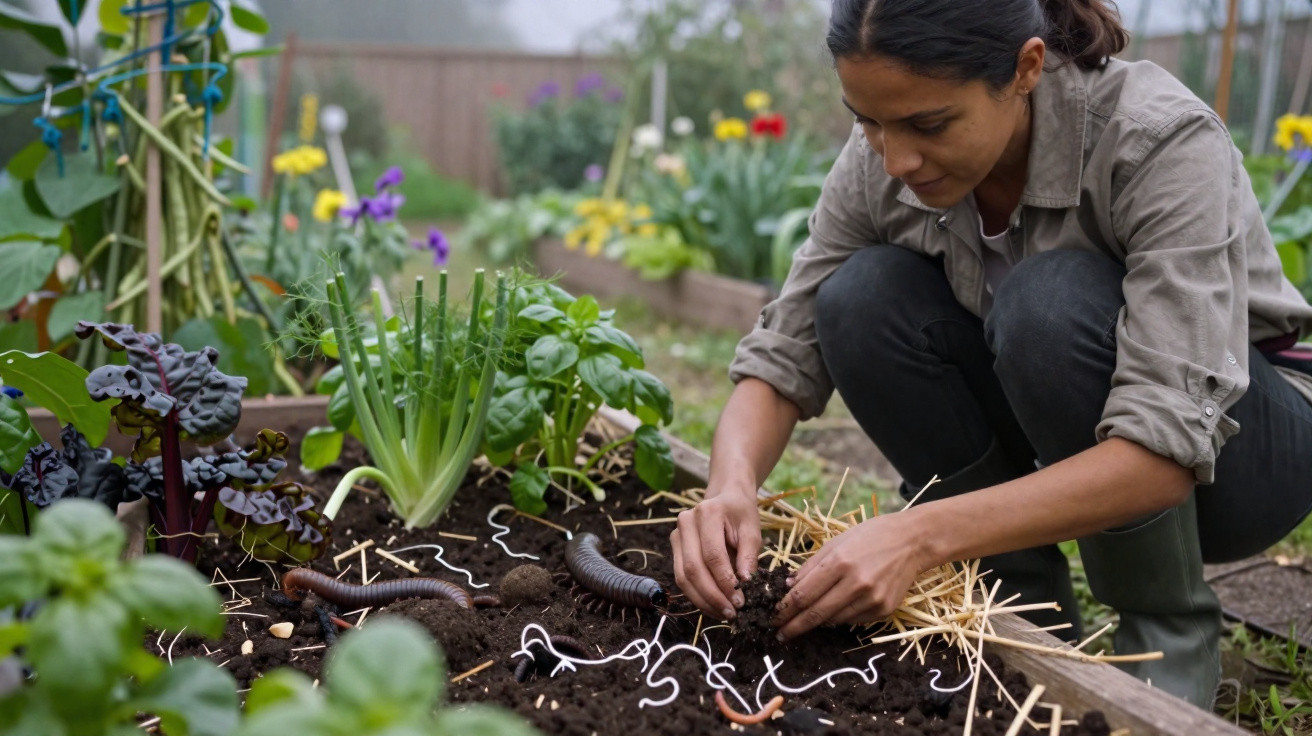
She squatted beside a fennel bed and drew aside the mulch as though opening a curtain onto a wet, industrious realm. Mycelium strands threaded through it; a centipede darted away; fragments of compost carried a faintly sweet scent. “Listen,” she said, as though the soil itself could speak. The garden held that subdued pre-dawn buzz. She squeezed a clump in her fingers, and it broke apart into fine, soft crumbs. “That’s diversity,” she smiled. “It’s not tidy. It’s alive.” After a moment, she bent closer, as if sharing something the earth alone was meant to hear. It seemed both a confession and a challenge. The ground thinks in plural.
The soil’s chorus and the lessons it offers the mind
When she said the ground “thinks,” I nearly laughed. But then I saw her distribute compost as though she were feeding a gathering rather than a single planting bed. Every handful welcomed bacteria, fungi, earthworms and springtails: different guests sharing one long table. She explained that a spoonful of healthy soil may contain billions of microbes, each performing its own role and influencing the rest. The bed was untidy, but it had its own order, much like a city during rush hour. Its coordination was tangible. So was its flexibility.
Her name is Marisol, and she approaches soil as a conversation. Years ago, she grew a single variety of lettuce in a neat grid. It shot up quickly, before aphids brought it down. Her beds now combine different textures and growing schedules: beans alongside basil, flowers slipped between chard, and layers of straw and leaf mould arranged like pastry. Pests still arrive, but they no longer dominate. “The predators have somewhere to live,” she said. She likes to point to one pattern: teams with diverse thinking styles solve problems faster, while soil containing more species recovers sooner from disruption. They are separate worlds, but the pattern is the same.
I came to understand that a diverse network below ground gives a garden resilience, whereas monoculture leaves it fragile. Minds operate similarly. If we rely on only one mode-speed, certainty and the same inputs-we either exhaust ourselves or overlook what matters. Combining unhurried reflection with rapid trials, logic with intuition, old notes with unfamiliar voices creates a brain ecosystem able to withstand a blow and grow again. This is not an overextended metaphor. It is simply the way complex systems endure. Monocultures create brittle systems. The soil already understands this; we are only beginning to catch on.
How gardeners create resilient soil - and how to develop resilient thinking
Marisol’s approach is straightforward enough for anyone to test. Begin with organic material-compost, shredded leaves or even coffee grounds mixed into the top 2.5 cm-then avoid tilling away the life within it. Rather than planting in rows, she groups companion plants in clusters to form microclimates and small, distinct functions. One flower attracts predators. One legume fixes nitrogen. One mulch layer moderates temperature and maintains consistent moisture. In her notebook, she rotates crops as a composer shifts between chords, encouraging roots to explore new paths each season. It appears gentle, but it is strategic.
There is an equivalent approach for the mind. Build a “compost layer” from inputs that do not all resemble one another: a book you would normally avoid, a discussion with someone beyond your usual circle, or a walk without a podcast. Vary the nature of your thinking work: deep concentration one day, untidy brainstorming the next, followed by slow editing. We have all reached the point where a familiar approach no longer works, yet we continue forcing it. That is the moment when another “species” of thought deserves room. Let’s be honest: nobody manages this every day. Aim for a rhythm rather than perfection.
When I asked her for one rule, Marisol laughed. She pressed her hand into the mulch, leaving its shape behind. “Feed the community, and the community feeds you.” She was referring to microbes. She was referring to us, too.
“If you want a smart garden,” she said, “invite more minds into the soil. If you want a smart mind, invite more soils into your day.”
- Biodiversity is a mental model: Combine inputs, timings and tools as a polyculture combines roots, flowers and groundcovers.
- Rotate tasks as you would crops: do not exhaust one area of attention; give another area time to recover.
- Mulch your week: build buffers through quiet hours, clear limits and a “no-screens” strip before bedtime.
- Plant “beneficials”: people who challenge you with kindness, and sources that move you beyond the familiar script.
It’s messy by design, which is exactly why it works.
The science beneath our feet and the stories in our minds
Healthy soil has no lone hero; it is a federation. Fungi exchange sugars for minerals with tree roots. Bacteria travel along those fungal highways. Minute predators hold populations in balance. During drought, mycelium distributes moisture, and when abundance comes back, the network stores it once more. Cognitive science tells a related tale. The brain is not a single voice but a parliament of patterns: rapid pattern matchers, slow reasoners, emotional alarms and spatial mappers, all negotiating as we live. Small experiments compound. Introduce only one “new species” into your day-drawing rather than typing, walking rather than scrolling-and you shift that parliament towards wiser choices.
A broader perspective for gardens and minds
Marisol’s garden offers no guarantee of certainty. What she offers is a field that can flex without breaking. Late frost has destroyed crops, and months later she has discovered tomato plants sprouting from the compost heap, where no plan had placed them. From this, she learned two practices: diversify the bed and diversify the story. Likewise, a fixed mental map fails the first time life refuses to fit it. A more varied map bends, poses a stronger question and discovers another route. The goal isn’t control; it’s conversation. Soil, team, family and self: the choreography is the same. Nourish the many so that the many can nourish you.
There is something encouraging about treating the ground as an ally rather than a battleground. It softens the tension and makes room for curiosity again. Marisol finishes her mornings by walking slowly around the garden, looking into shaded corners and recording what arrived overnight. She has faith in the unseen labour. Perhaps that is the invitation. Add a little compost to your week. Bring in a stranger’s voice. Rotate the light. The soil did not become fertile by making itself tidy; it made space for a crowd. Your mind may be ready for that sort of crowd as well.
| Key point | Detail | Why it matters to the reader |
|---|---|---|
| Soil diversity mirrors cognitive diversity | Billions of soil microbes and multiple thought modes both create resilience | Better decisions and gardens that recover from shocks |
| Polyculture beats monoculture | Mixed plantings reduce pests; mixed inputs reduce mental ruts | Fewer collapses, more steady growth in projects and plants |
| Design for conversation, not control | Compost, rotate, invite predators; read widely, rotate tasks, invite dissent | Systems that adapt instead of crack under pressure |
FAQ:
- How does soil biodiversity actually help plants? Different organisms provide different services-nutrient cycling, disease suppression and moisture retention-giving plants more consistent support and helping them recover faster after stress.
- What’s the mental equivalent of adding compost? Bring in rich, varied inputs: books from another discipline, conversations with people unlike you and unstructured time that allows ideas to decompose and recombine.
- Isn’t routine still valuable? Yes, like a dependable cover crop. Routine creates stability, while rotation prevents depletion. Retain your anchors, but change the species around them.
- Can I overdo diversity? The aim is not chaos. Seek complementary variety: elements with different roles that still work together towards your purpose.
- What’s one small step to try this week? Choose one task you always complete in the same manner and introduce a new “species”: alter the medium, setting or partner. Notice what develops.





Comments
No comments yet. Be the first to comment!
Leave a Comment