
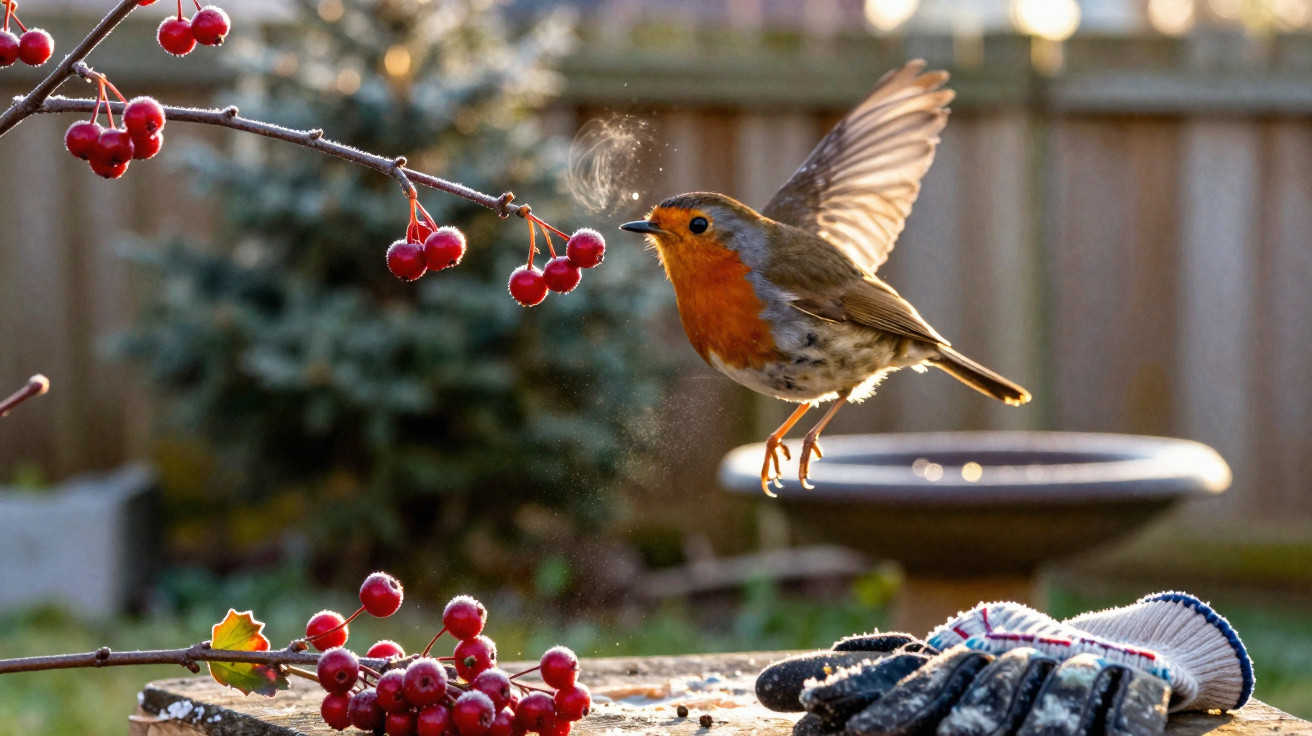
The lawn had remained white with frost for days, making each blade of grass look like a sliver of glass. Most birds had retreated to more sheltered spots, away from the harshest wind. But one brave flash of red breast continued to return to the same small part of the garden, hopping beneath bare branches as though it owned the place. The robin stopped, cocked its head and then shot towards a cluster of orange-red berries, glowing like fairy lights against the grey sky.
The shrub had seemed unremarkable in summer. By January, it felt like the garden’s beating heart.
Gardeners who notice these things insist it is no coincidence.
They say one type of winter fruit can make an occasional robin a dependable regular.
The winter fruit robins simply cannot resist
Spend enough time listening to winter birdwatchers and the same plant is mentioned repeatedly: pyracantha, also known as firethorn. This shrub carries bright orange or red berries when nearly everything else in the garden has finished for the year. To us, it may look ornamental. For a hungry robin on a frosty morning, it can be vital.
The berries hold firmly to the branches, even through severe frosts. While softer fruit has either spoiled or disappeared, pyracantha remains, offering what amounts to an all-you-can-eat winter buffet. This is where a robin’s attachment can begin.
On one suburban road in the Midlands, a retired teacher told me she could practically set the clock by the robin visiting her pyracantha hedge. “He’s there at 8am, 11am and late afternoon,” she said, gesturing at the bright berries. “He even sings from the satellite dish, like he’s guarding the place.”
Bird surveys carried out by local ringing groups support her observation: gardens containing berry-rich shrubs tend to keep robins returning for longer periods during the coldest weather. Rather than merely appearing briefly and moving on, the birds come back, patrol the area and stay nearby. Reliable food and secure cover create a routine.
Robins survive by making short journeys. Most do not travel great distances, instead organising their winter days around a mental route of trusted feeding places. Pyracantha suits this approach extremely well. Its berries are rich in energy, can be seen from afar, and grow on a shrub dense enough to provide cover. For a bird weighing about as much as a £1 coin, that combination is invaluable.
A feeder may draw a robin in for ten minutes, whereas a fruiting pyracantha can make your garden part of its routine for weeks. That is the understated value of a carefully chosen plant.
How to make pyracantha a robin magnet rather than simply an attractive shrub
Success depends on more than planting pyracantha: its position and the way you allow it to grow matter too. Robins prefer feeding close to somewhere they can quickly retreat if a sparrowhawk or local cat appears. Place pyracantha near a fence or wall, ideally with some tangled growth around it. Keep a few branches thick and untidy. A perfectly neat garden is not always a bird-friendly one.
Select berry colours that are noticeable in the light conditions in your garden. Orange and red fruits are usually easiest for robins to pick out against a dull winter backdrop. It is also worth putting at least one shrub somewhere visible from the kitchen window. Seeing the robin’s daily visits is a large part of the pleasure.
Many gardeners prune at exactly the wrong time for birds. Cutting the shrub back severely in late summer or early autumn can remove the berry clusters that robins rely on. It is much better to trim gently just after flowering and retain plenty of stems that will bear fruit.
Try not to be too eager to clear fallen leaves and debris from beneath the shrub either. Insects shelter in this untidy layer, providing protein for robins on days when fruit alone is not enough. Let’s be honest: nobody manages this every day, but a more relaxed, less immaculate approach once or twice a year can still make a difference.
One seasoned birdwatcher in Devon told me:
“The moment I stopped gardening for the neighbours and started gardening for the birds, the robins stopped being visitors and became residents.”
His pyracantha now spreads rather more than a designer garden might permit, and he would not alter it. Birds move through it like threads passing through fabric, slipping between the thorny stems and emerging again.
For an easy approach, many robin enthusiasts keep a short checklist pinned to the shed door:
- Plant at least one pyracantha in a visible, sheltered position.
- Trim lightly after flowering rather than immediately before winter.
- Keep some undergrowth and leaf litter beneath the shrub.
- Put a shallow water source nearby and refresh it whenever you remember.
- Look out at the same times each day – robins follow their own timetable.
Living with a winter robin that picks your garden time after time
Once a robin adopts your pyracantha as part of its winter territory, a subtle change takes place. You begin to know the individual bird through its mannerisms: the tilt of its head and the way it fluffs its feathers against the cold. On an otherwise bleak Tuesday, that small presence can brighten the whole day.
On a blustery morning, you may see it gripping a branch as the berries sway, unwilling to surrender its preferred feeding place. That quiet determination can be contagious. We have all had days when the garden seems like little more than background clutter, until a robin appears and brings everything sharply into view for a moment.
Planting a single berry-covered shrub will not transform your home into a wildlife reserve. Instead, it creates something more modest and personal: a shared pattern between you and a bird weighing less than your phone. Looking towards the shrub while the kettle boils or noticing when the berries begin to disappear makes winter feel less like a season to get through and more like one with a rhythm of its own.
After seeing a robin defend “its” pyracantha against other birds, you begin to understand that loyalty is not necessarily dramatic. It is repetition and habit: returning to the same berries each icy morning.
Many readers who give this a try change more than one small part of their garden. They begin planting other berry-bearing species, leaving seed heads through winter and tolerating a few nettles in a rear corner. The robin becomes a sort of barometer: when it stays around, they know they are getting something right.
In a world that often feels hurried and digital, a straightforward shrub bearing winter fruit creates another kind of notification: a bright red breast against orange berries. It is not urgent and it will not buzz on your phone, but it quietly asks you to pay attention. Once you have noticed it, it is difficult to stop looking.
| Key point | Detail | Why it matters to the reader |
|---|---|---|
| Pyracantha attracts robins in winter | Its berries persist for a long time, providing both energy and shelter | Understand why a single shrub can encourage one bird to keep returning |
| Positioning and pruning the shrub | Plant it close to a wall, prune it lightly and leave some ground-level mess | Turn an ordinary planting into a genuine robin hotspot |
| A garden designed for birds | Combine berries, insects, water and quiet areas | Create a lively garden that remains interesting to watch all winter |
FAQ:
- What is the best winter fruit to keep robins coming back? Most birdwatchers put pyracantha (firethorn) at the top of the list because its berries remain well into winter and the shrub provides thick cover.
- Will a bird feeder work as well as a pyracantha? Feeders may attract robins for short visits, but a berry-bearing shrub offers shelter as well as food, encouraging longer and more frequent returns.
- Which berry colour do robins prefer? There is no fixed rule, but orange and red berries appear to be easiest for robins to see against dull winter skies.
- Is pyracantha safe to grow near the house? Yes, although it has sharp thorns, so it is best kept away from narrow paths and areas where children play or pets pass through.
- How long before a new pyracantha attracts robins? Interest usually begins when the shrub is mature enough to produce a good crop of fruit, often in its second or third year, with loyalty developing as the bird learns your garden’s routine.





Comments
No comments yet. Be the first to comment!
Leave a Comment