
Many people instinctively reach for chemical moss killers. But if you want a thick, hard-wearing lawn, March is the time to start somewhere else entirely: with the soil beneath it. Three simple jobs can lay the foundations for green turf that copes without complaint with children, barbecues and rainy days.
Moss in the lawn: a warning sign, not the enemy
Moss in a lawn is not nature making a personal attack; it is fairly honest feedback: “Something is wrong with the soil here.” Two issues are especially common: waterlogging and compaction.
Moss usually indicates that the soil is too wet, too compacted or permanently too shady – fertiliser alone will not solve it.
Common signs of weakened ground in March include:
- Puddles remaining on the lawn for hours
- Soil that feels as hard as concrete underfoot
- Lots of moss but very few strong grass blades
- Yellowish, patchy lawn that is easily damaged by foot traffic
Over the years, rain, playing children, football, garden furniture and robotic mowers compact the soil ever more tightly. Even perfectly prepared ground loses its structure this way. That is exactly what this March treatment addresses.
Task 1: aerate the lawn thoroughly with a fork in March
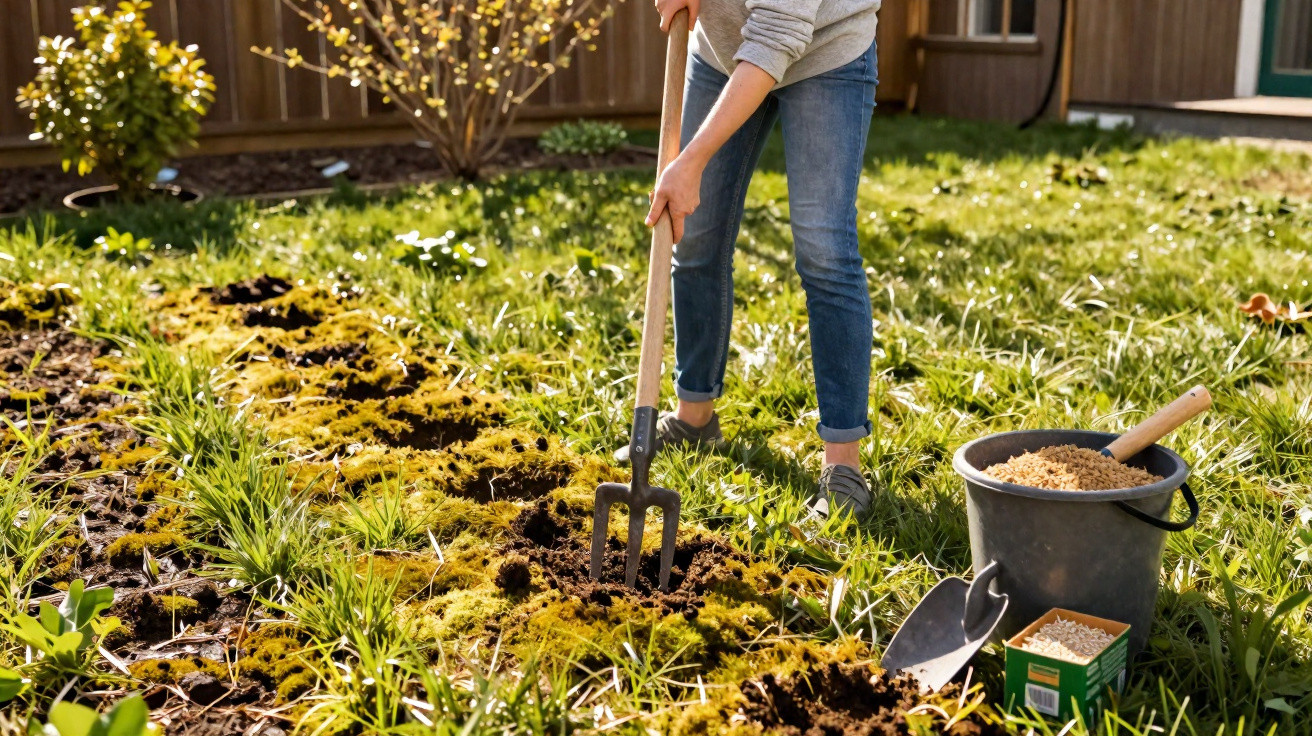
The most important job costs almost nothing apart from a little time: aerating the soil. For small to medium-sized lawns, a sturdy garden fork or lawn aerating fork is perfectly adequate.
The right way to do it
Choose an afternoon when the ground is dry but not bone-dry. It should not be muddy, yet it should still give slightly.
- Push the fork vertically into the soil to a depth of around 8–10 centimetres.
- Lever the handle gently backwards or sideways until the ground visibly lifts and cracks a little.
- Pull out the fork, move one step forward – about 15 centimetres – and repeat.
Work especially carefully in spots where puddles form after rain, or where the ground sounds dull and hard when you tap it with your heel. These are the problem areas where water collects and roots suffocate.
The numerous holes effectively form air channels in the soil. Excess water can drain away and oxygen reaches the roots – the foundation for vigorous growth.
Task 2: apply a thin soil layer and “feed” the holes
Move straight on to step two after aerating: spread a light layer of loose soil, sand and compost across the lawn. Professionals call this “topdressing”.
The ideal blend for a dense lawn
For a typical home garden, a straightforward mix is sufficient, such as:
- 1 part fine garden soil or shop-bought lawn soil
- 1 part coarse sand, such as play sand or river sand; do not use lime-containing building sand
- 1 part well-rotted, sieved compost or leaf mould
If you do not have compost available, soil and sand alone will also work. The crucial point is that the mixture remains loose and crumbly rather than becoming too heavy.
How the mixture works for you
Spread the material thinly over the aerated lawn using your hands or a shovel. Then brush it in with a stiff outdoor broom or a twig broom:
- Pull the broom back and forth over the surface.
- Take particular care to ensure that the holes are properly filled.
- Do not leave a thick layer sitting on the grass blades – just a light dusting.
The thin soil layer improves soil structure over the long term, promotes drainage and also provides nourishment for grass roots.
You will not see the result the following day; it develops over several weeks. Roots grow deeper, the ground absorbs rain more effectively, and the lawn becomes less sensitive to dry spells in summer.
Task 3: rake out moss, mow higher – and accept the “bald patches”
Only once the soil and holes have been treated is it time to tackle the moss. Rather than using chemicals, a robust steel rake or a specialist lawn rake is usually enough.
Rake out moss and thatch thoroughly
Work across the lawn section by section, pulling the rake firmly over the ground. The aim is to remove old dead material and mats of moss. Many people are surprised by how much plant debris comes out.
The benefits of vigorous raking include:
- More light reaches the soil surface.
- Rainwater drains away more readily.
- New grass germinates more easily in the exposed gaps.
Do not leave the raked-out material in a corner of the lawn. Put it on the compost heap or in the garden waste bin instead. If you have treated moss with lime or specialist products, check the packaging instructions before composting the material.
First cut of the year: keep it a little higher
After raking, the lawn can have its first cut of the season. Importantly, sharpen the mower blades before the first mow, or have them checked. Blunt blades tear grass rather than cutting it cleanly, which encourages disease.
For the first cut:
- Set the cutting height relatively high, at around 4–5 centimetres.
- Never remove more than one third of the blade length in a single cut.
- If the lawn is very weak, keep the cutting height a little higher for the second cut too.
After aerating, topdressing and raking, the lawn often looks rather battered – this is normal and generally lasts for only one to two weeks.
With every warmer week, the gaps close and the grass cover becomes visibly stronger. Overseeding only where bare soil is genuinely exposed will speed up the process.
Timing: March is the key period
These measures work best once the ground is no longer frozen but still nicely moist. In mild areas, you can begin as early as late February; in colder locations, mid to late March is more suitable.
When planning, bear in mind:
- The ground must not be frozen or completely waterlogged.
- Choose a dry day that is as frost-free as possible.
- Ideally, temperatures should remain consistently above 5 degrees.
If you set aside one afternoon, all three tasks can be completed in a single day: aerate, brush in the soil layer, rake out the moss and finally mow.
Why moss killers alone rarely work
Many products promise to remove lawn moss in no time. While they often kill it reliably, they do not alter the underlying causes. The soil remains compacted, wet and short of oxygen – the perfect environment for moss to return.
The approach described here goes deeper. It improves the ground beneath the lawn, strengthens grass roots and promotes the lawn’s natural ability to compete. In the long term, this type of lawn needs less chemical treatment, fewer emergency measures and is much more forgiving of maintenance mistakes.
Extra tips for a lawn that stays strong
To keep your lawn more resilient throughout the year, supplement the March treatment with a few simple habits:
- Use a specialist lawn fertiliser with a moderate nitrogen content in spring.
- Do not set the mowing height too low in summer, so the soil does not dry out severely.
- During prolonged dry periods, water less often but thoroughly, rather than sprinkling a little every day.
- Aerate compacted areas deliberately every year, such as beneath a swing, trampoline or rotary washing line.
A simple soil test from a garden centre can also be helpful for checking the pH level. If the soil is very acidic, lime can be used to counteract it. But the same principle applies here: improve the structure first, then fine-tune.
If time is limited, focus only on the three core tasks in March. Even one thorough aeration combined with a loose soil layer and firm raking can noticeably transform a lawn – from a patchy carpet of moss into dense, hard-wearing green turf.



Comments
No comments yet. Be the first to comment!
Leave a Comment