
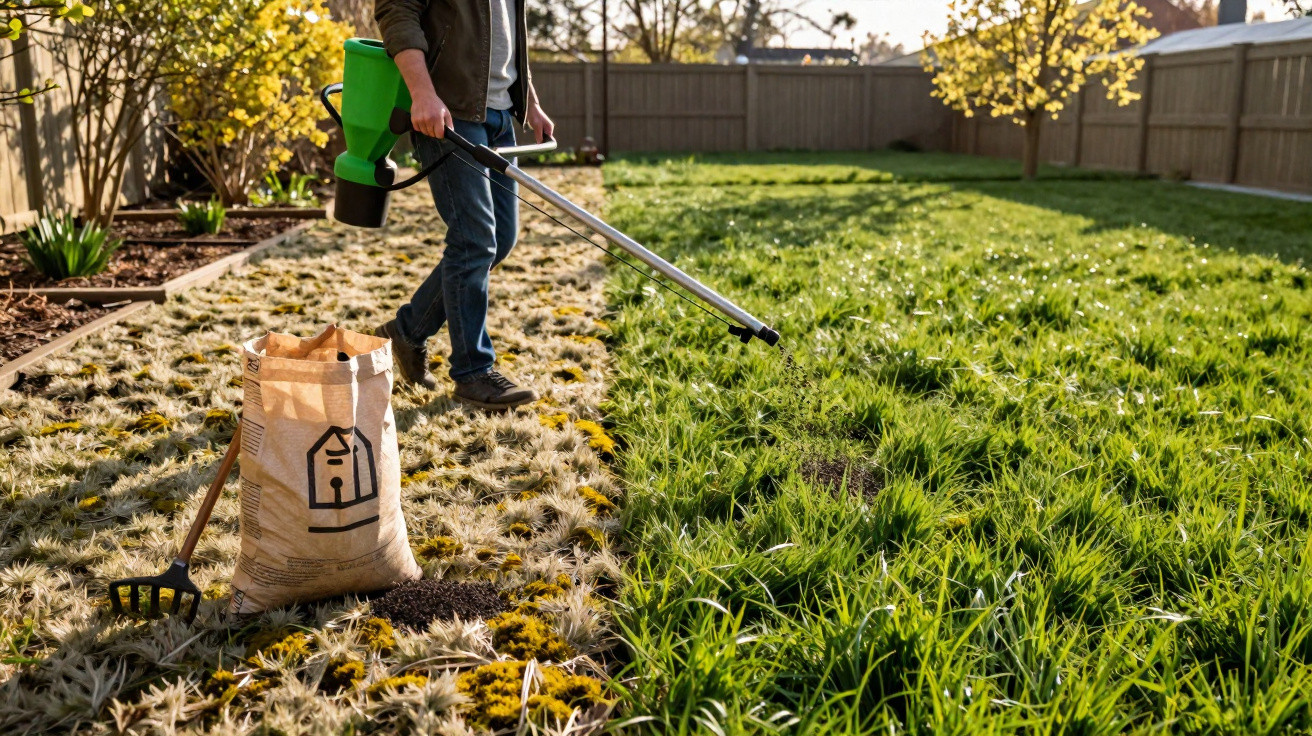
When the days begin to lengthen, many people immediately fetch the lawnmower or fertiliser from the shed. Professionals take a different approach: first, they use a mineral powder that displaces moss and quickly restores the lawn’s rich green colour. Getting the timing right is crucial – and March is the month for it.
Why lawns look so battered after winter
For several months, a lawn has to cope with a great deal: wet weather, limited light, frost and often heavy footfall or garden equipment that compacts the soil. The turf becomes weaker, the blades thin out and the roots are barely active.
Moisture and pressure compact the soil, making it harder for air and water to reach the roots. An old familiar problem then takes advantage of these conditions: moss. It thrives in damp, shady and compacted areas, spreading wherever the grass is struggling.
By late winter, moss can take over a lawn so extensively that hardly any dense grass coverage remains.
As temperatures gradually rise in March, the lawn comes out of dormancy. Its roots begin functioning again and the grass enters a new growth cycle – although it is still weakened. This transition is the ideal opportunity to intervene and give the lawn a proper fresh start.
The secret weapon used by many professionals: iron sulphate
Something that is often overlooked by amateur gardeners is almost standard practice for groundskeepers and lawn-care professionals: iron sulphate, a grey-green, water-soluble powdered compound. It has two effects, which is precisely why it works so well in March.
Moss killer and lawn booster in one
Firstly, iron sulphate reacts strongly with moss. Once applied, the moss turns dark brown or black within a few hours or days and dies. It then loses its grip on the soil and can be removed easily later.
Secondly, its iron content provides an important component for chlorophyll production. Chlorophyll is the pigment that gives grass blades their deep green colour and enables photosynthesis. With this additional iron, the lawn looks noticeably greener and visually denser.
A dull, pale lawn can shine deep green again with iron sulphate as early as March – long before summer arrives.
There is another advantage: compared with many specialist fertilisers, iron sulphate is relatively inexpensive and goes a long way. This is why many local authorities and sports facilities use it to improve large grassed areas.
How to apply iron sulphate correctly in March
Both timing and application technique determine whether the result is impressive or disappointing. The best window is from early to mid-March, once daytime temperatures are mild and no severe frost is forecast.
The most important conditions
- Daytime temperatures should ideally be above 8–10 degrees.
- The soil should be slightly damp, but not waterlogged.
- There should be no frost in the ground.
- No heavy rain should be forecast within the following 24 hours.
In practice, the powder is almost always dissolved in water and applied as a liquid. This distributes the active ingredient far more evenly and prevents splashing or sharply defined patches.
Recommended dosage and application
Many manufacturers give guideline rates of 20 to 30 grams of iron sulphate per litre of water. The solution can be applied using a pressure sprayer, a watering can with a rose attachment or a dedicated liquid-fertiliser trolley.
A typical process is as follows:
- Mow the lawn one to two days beforehand, without cutting it too short – around 4 cm.
- Weigh the iron sulphate and dissolve it completely in warm water.
- Spread the liquid evenly across the affected area.
- Do not walk on the area after application until it has dried.
Anyone who follows the manufacturer’s instructions exactly and applies the product evenly significantly reduces the risk of lawn scorch.
Common mistakes and how to avoid them
Iron sulphate is effective, but it is not harmless. Application errors can cause damage to both the lawn and nearby surfaces.
| Mistake | Consequence | Better approach |
|---|---|---|
| Dosage too high | Scorched turf and brown patches | Use scales and follow the manufacturer’s instructions |
| Spraying onto dry soil | Uneven application and patchiness | Lightly moisten the soil or wait for a damp period |
| Rain immediately after application | The active ingredient is diluted or washed away | Check the forecast and allow for 24 hours without rain |
| Contact with stone surfaces | Rust stains on patios and paths | Cover edges and rinse off splashes thoroughly straight away |
Protect yourself as well: gloves, long sleeves and sturdy footwear or wellington boots help prevent skin irritation. Rinse any splashes on the skin immediately with plenty of water.
What happens in the lawn after treatment
The real process continues out of sight after application. Over the first few days, the moss dies and darkens markedly. The lawn itself will often show stronger colour after just one week.
After roughly two weeks, the next task is due: the dead moss layer needs to be removed. Otherwise, it remains on the surface like thatch and once again restricts aeration.
The right lawn-care plan after iron sulphate
- After 10–14 days: remove moss with a scarifier or sturdy rake.
- Overseed exposed bare patches with suitable lawn seed.
- Lightly rake it in and apply a thin layer of lawn topsoil if necessary.
- An organic spring fertiliser supports continued growth.
Only the combination of moss removal, overseeding and appropriate fertilising ensures that the cleared areas are occupied by grass rather than moss in the long term.
How to keep moss out of the lawn long term
Iron sulphate resolves the immediate issue, but it does not automatically tackle the underlying causes. Anyone wanting permanently less moss in their lawn needs to address several factors.
Key measures to prevent moss returning
- Soil aeration: Regular scarifying or aerating loosens compacted soil.
- Check the pH level: Highly acidic soils encourage moss. Depending on the starting value, garden lime can help balance it.
- Adjust the mowing height: Grass cut too short becomes weak. Four to five centimetres is ideal for many lawns.
- Reduce shade: Prune overhanging branches to allow more light onto the area where possible.
- Water correctly: Water less frequently but thoroughly, rather than applying small amounts constantly.
A common misconception is that a strong dose of nutrients alone will solve every problem. While over-fertilising may produce vigorous growth in the short term, it makes the lawn more vulnerable to disease over time and then requires even more maintenance to manage.
Who benefits most from using iron sulphate
Owners of older gardens with shady corners and clay soil, in particular, benefit significantly from targeted application in March. In these areas, moss is often so firmly established that mechanical measures alone are barely sufficient.
Those with a heavily used family lawn should schedule treatment for a time when children and pets can avoid walking over the area as much as possible. Once the lawn has dried, and after substantial rain or watering, there is generally no issue with using the lawn, provided no visible residue remains.
One further point: iron sulphate is primarily suitable for lawn care, not for flower beds or vegetable plots. In those areas, it disrupts soil life more than it helps. Better-balanced iron products are available for ornamental and edible plants.
Anyone who uses this powder purposefully in March, keeps the dosage under control and cares for the lawn properly afterwards will begin the season with a clear advantage. The difference from an untreated lawn can usually be seen from several metres away – and that is exactly what matters to many garden owners.





Comments
No comments yet. Be the first to comment!
Leave a Comment