
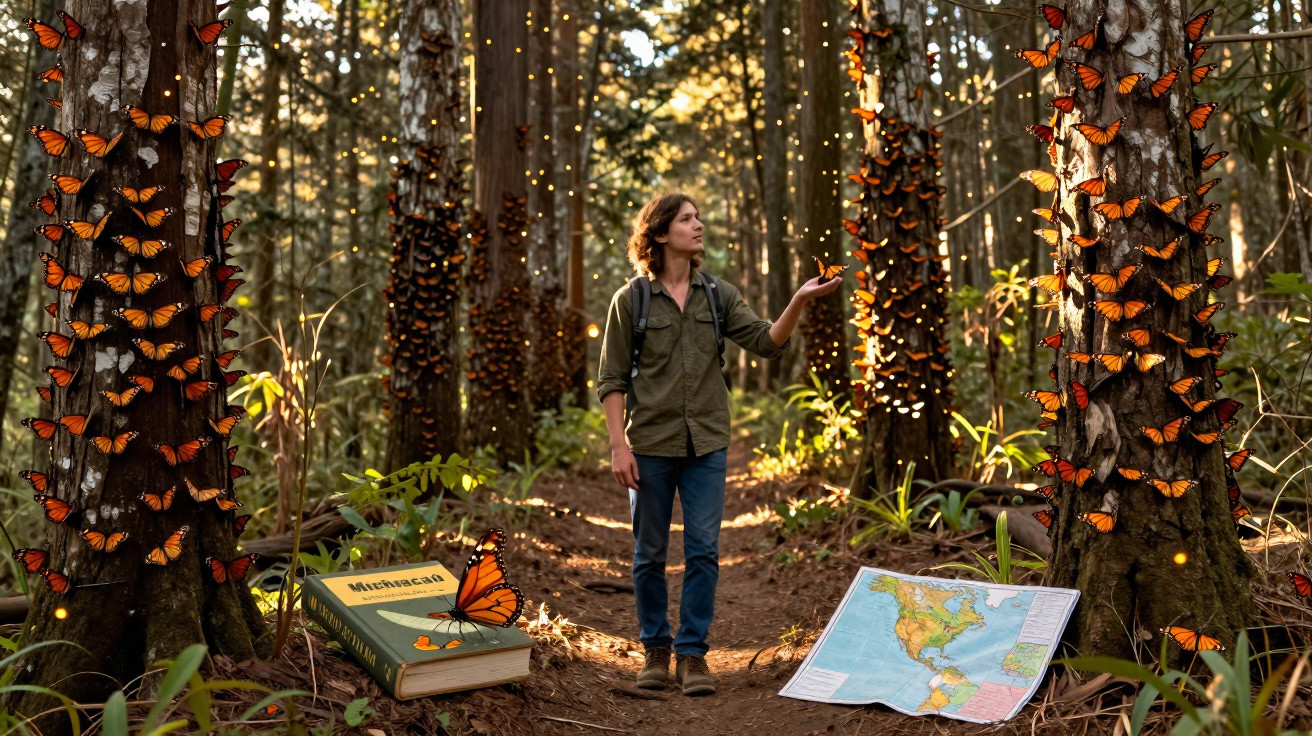
At dawn in the mountains of Michoacán, silence is never completely still. Millions of orange-and-black wings quiver among the oyamel firs, the tall high-altitude trees where monarch butterflies spend the winter huddled together against the cold. A shaft of sunlight cuts through the branches and, all at once, part of the forest takes flight. Mexico has worked to safeguard this one-of-a-kind refuge since the 1980s. Yet, forty-five years after the first protection measures, biologists remain preoccupied by one question: how does an insect, sometimes born more than 4,023 kilometres away, return to this same small cluster of mountains without ever having been there? The journey seems impossible. And it begins again every year.
In the forests of Michoacán, a spectacle both vast and vulnerable
For visitors arriving at the Monarch Butterfly Biosphere Reserve, the first impression is almost physical. Tree trunks appear to be covered in living bark, when in fact they hold clusters of sleeping butterflies; as the temperature rises slightly, the branches loosen and the sky becomes ember-coloured. We all know the feeling of a landscape making us pause, without quite knowing what to say. Here, that landscape relies on an animal weighing less than a gram, yet its arrival supports entire villages, guides, forest rangers and a far-reaching network of local conservation.
Mexican conservation efforts began to take shape in the early 1980s, before protected areas were formally established in 1986 and the current biosphere reserve was created in 2000. The sanctuary now extends across more than 56,000 hectares in the states of Michoacán and Mexico, although the areas where monarchs actually gather are tiny. During the winter of 2023-2024, their occupied area was estimated at about 0.9 hectare, according to monitoring by WWF-Mexico and Conanp. That figure may sound abstract. In practical terms, it means that a continental phenomenon can sometimes fit into the equivalent of just a few football pitches.
Forest protection has curbed some illegal logging, with clear results in areas watched over by local communities. But the issue does not end at the fir forest edge: throughout their North American route, monarchs also rely on milkweeds, the plants eaten by their caterpillars. A butterfly does not recognise borders drawn on a map. Pesticides, droughts, storms and the loss of grasslands all take their toll, so protecting the final Mexican refuge is not always enough to save the journey.
The 4,023-kilometre mystery: memory without a map
Helping monarchs can start with something almost ordinary: allowing native plants to grow. In a garden, on a suitable balcony or along the edge of a field, indigenous milkweeds provide food for caterpillars, while nectar-rich flowers sustain adult butterflies on their route. It is best to choose local species from a reputable nursery rather than a packet of seeds with no clear origin. Let us be honest: nobody turns their outdoor space into a perfect refuge every day. Even a few square metres left less closely mown can make a difference.
A common mistake is to think every butterfly spotted must be “saved” by bringing it indoors, or by planting any milkweed available. The impulse is well intentioned and understandable: a damaged wing makes people want to act straight away. However, poorly managed home rearing can encourage disease, while certain non-native milkweeds may disrupt migration cycles in warmer areas. The most useful action is often the least dramatic: avoid insecticides, create a wider variety of flowering plants and leave a little living untidiness in the landscape.
At the centre of the puzzle is a special generation known as the “Methuselah generation”, born at the end of summer. It lives for several months, far longer than summer generations, then travels south to Mexico from Canada and the northern United States over a distance that can reach 4,023 kilometres. It has never seen the oyamel firs or followed its parents, which died long before.
“Monarchs do not simply migrate south: they target a precise place, in mountains they have never known.”
- The sun acts as a guide through an internal compass located in their antennae.
- A biological clock adjusts for the sun’s changing position throughout the day.
- Earth’s magnetic field may play a part when skies are overcast, although its precise role remains debated.
- Scents, winds and terrain also appear to offer clues that are still poorly understood.
A migration extending far beyond Mexico’s borders
Researchers have shown that monarchs combine a sun compass with a circadian clock, but this finding does not close the case. A compass provides direction; it does not explain how they target the same wooded valleys, at such a precise altitude, after weeks in flight and thousands of kilometres of turbulence. The insects must also know when to leave, when to conserve their energy and where to find nectar. The slightest shift in weather can disrupt this delicate timetable. Ultimately, the mystery is not that they travel south. It is that they seem able to recognise a destination.
Ultra-light tracking tags and citizen observation networks now make it possible to follow part of this odyssey. Researchers record appearance dates and sightings at schools, gardens and fields, then compare the information with weather maps. Each signal reveals one fragment, but rarely the whole picture. Monarchs do not fly in straight lines, nor do they all use the same corridor: they climb, descend and sometimes wait for a favourable wind. A storm in Texas or a drought in the Midwest can redraw the route of millions of individuals without anyone being able to predict it fully.
What Mexico has protected for almost forty-five years is therefore not a postcard scene, but the final chapter of a story spanning three countries. When a Michoacán resident watches over a plot of oyamel firs, that work connects with that of a farmer reducing herbicide use in Ontario or a family letting its garden flower in Minnesota. Biologists are still seeking the exact formula linking sunlight, genes, magnetism and landscapes. There is something unsettling about that uncertainty, but something valuable too: it reminds us that a familiar creature can hold a secret greater than our technologies.
| Key point | Detail | Added value for the reader |
|---|---|---|
| A decisive Mexican refuge | Monarchs overwinter in oyamel fir forests in Michoacán and the State of Mexico. | Understand why a small forest area has a continental role. |
| 4,023 km of questions | The migratory generation reaches Mexico without learning the route from earlier generations. | Appreciate what science already knows, and what it is still trying to understand. |
| Actions within reach | Local milkweeds, native flowers and reduced pesticide use strengthen migration stopovers. | Move from wonder to practical action, however modest. |



Comments
No comments yet. Be the first to comment!
Leave a Comment