
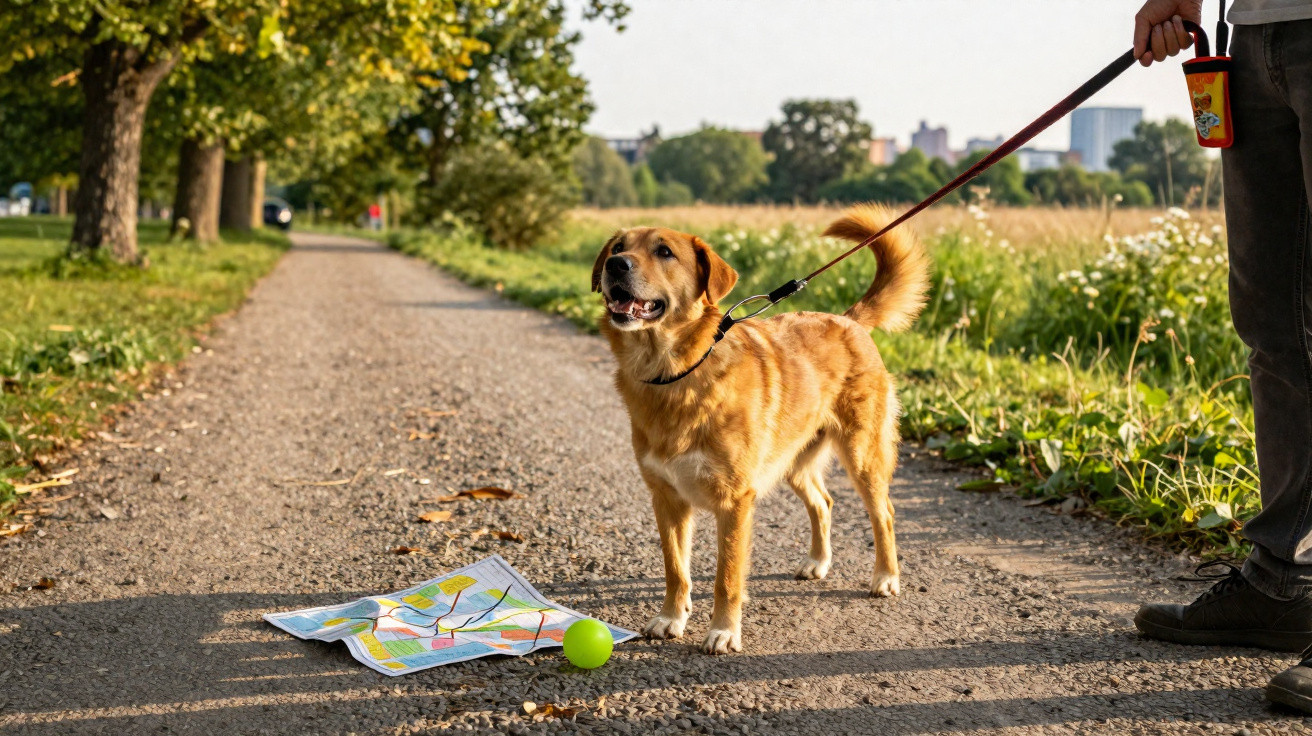
At 7.30 am, the same gate opens, the same lead rattles, and the dog heads almost automatically towards the usual pavement. They sniff the post by the bakery, pause outside the small green, then gently pull towards the hedge where another dog passed the day before. We all know the point at which a walk becomes such a well-established routine that we could complete it with our eyes shut. It is convenient when time is short, and reassuring too. Yet research into environmental enrichment and canine behaviour encourages us to view this habit differently: dogs do not simply walk; they explore, choose and investigate. Their mood may depend on these unseen details. A walk is about more than toileting.
The same route can reassure a dog… before eventually dulling their curiosity
A dog that knows their neighbourhood is not necessarily unhappy - far from it. Familiar landmarks, recognised scents and predictable encounters can soothe animals that are anxious, elderly or sensitive to noise. On a route they understand, they will often move along with quiet confidence, nose to the ground and tail relaxed. The issue arises when that circuit becomes an unchanging obligation, with no possible detour or opportunity to explore. Over time, some dogs appear to simply “do the route” rather than experience the walk. They pull less, sniff quickly and pay little attention to what is around them. This is not laziness: it can sometimes indicate that stimulation has become too limited.
Researchers studying animal welfare often refer to environmental enrichment. Although it sounds technical, the idea is straightforward: give an animal opportunities to discover, search, solve small problems and display natural behaviours. In shelters, adding unfamiliar scents, food-based toys or areas to explore is linked to calmer, more active behaviour in many dogs. At home, a walk can serve the same purpose. A brief diversion down a shrub-lined street, a path after rain or a visit to a park at a different time can alter the world’s scent-based “reading”. To a dog, every smell tells a story.
The reason becomes almost obvious when you take time to watch. Dogs live in a sensory world of which we perceive only a small part, and their sense of smell gathers social, food-related and territorial information throughout the route. Returning to the same place lets them follow certain trails, but a complete lack of novelty reduces their chances to choose and investigate. The ability to influence their environment is recognised as an aspect of animal welfare. A successful walk does not have to be long: it is often rich. The aim, then, is not to turn every outing into a sporting expedition, but to bring a little surprise back into this daily ritual.
Varying your dog’s walks without unsettling a dog who likes routine
The easiest approach is to retain part of the familiar route, then change ten minutes of the outing. You might turn left instead of right, cross a small public garden, follow a quiet street you have never used or change the time you pass through. Above all, let the dog stop where it is safe: sniffing is not wasted time, it is the main activity of their walk. Some trainers call this a “choice walk”: for a few minutes, the person follows the direction chosen by the dog, within sensible safety limits. This small reversal can make a significant difference to an animal who is always directed.
Nor should novelty be forced at all costs. A fearful dog may be unsettled by a noisy main road, crowds, scooters or an overly busy park. In that case, the change can be tiny: a new scent placed in the garden, a quieter path, a very early-morning outing or a few treats hidden in the grass. Let us be honest: nobody really does this every day. The point is not to make owners feel guilty when they get home late or are balancing children, work and the weather. Just one different walk each week can be enough to rekindle a dog’s interest.
Watch their body rather than looking for a universal rule. A curious dog sniffs thoroughly, moves freely and takes time to look around; an overwhelmed dog, by contrast, may freeze, pant or want to go home. The right walk is one that respects their pace.
“Novelty should not be an ordeal: it becomes beneficial when the dog can explore it at their own pace and retain some room for choice.”
- Plan a short detour within a familiar route.
- Allow proper sniffing breaks, without pulling on the lead.
- Alternate calm environments: grass, woodland, a quiet street and an empty park.
- Return to the usual route if the dog shows signs of anxiety.
A dog’s mood can sometimes be read at the end of their nose
Varying walks does not mean abandoning the habits that make your companion feel secure. The same street corner can remain their favourite landmark, where they find other dogs’ traces and the familiar scent of a garden. What matters is avoiding an outing that feels like a timed task squeezed between two obligations. A dog does not need spectacular scenery to be interested: a grass verge they have never inspected, a puddle, a pile of leaves or a distant encounter may be enough. It is a question worth asking when you pick up the lead: today, am I really giving them time to be a dog?
| Key point | Detail | Benefit for the reader |
|---|---|---|
| Routine is not always negative | A familiar route can reassure an older, anxious or easily startled dog. Stable landmarks can sometimes reduce tension and make the outing smoother. | You avoid confusing variety with overstimulation: the aim is to tailor the walk to your dog’s actual temperament. |
| Sniffing supports exploration | Scents are a major source of information for dogs. Pauses, diversions and different surfaces enrich this natural activity. | You can make a short walk more rewarding without covering kilometres or buying any accessories. |
| Choice matters as much as distance | Allowing a dog to choose a route or linger for a few moments, in a safe setting, increases their sense of control. | You learn to notice their signals and turn a daily obligation into a genuinely shared moment. |
Also read: Why your dog rolls on their back in the grass before going home: the reason dates back to their ancestors


Comments
No comments yet. Be the first to comment!
Leave a Comment