
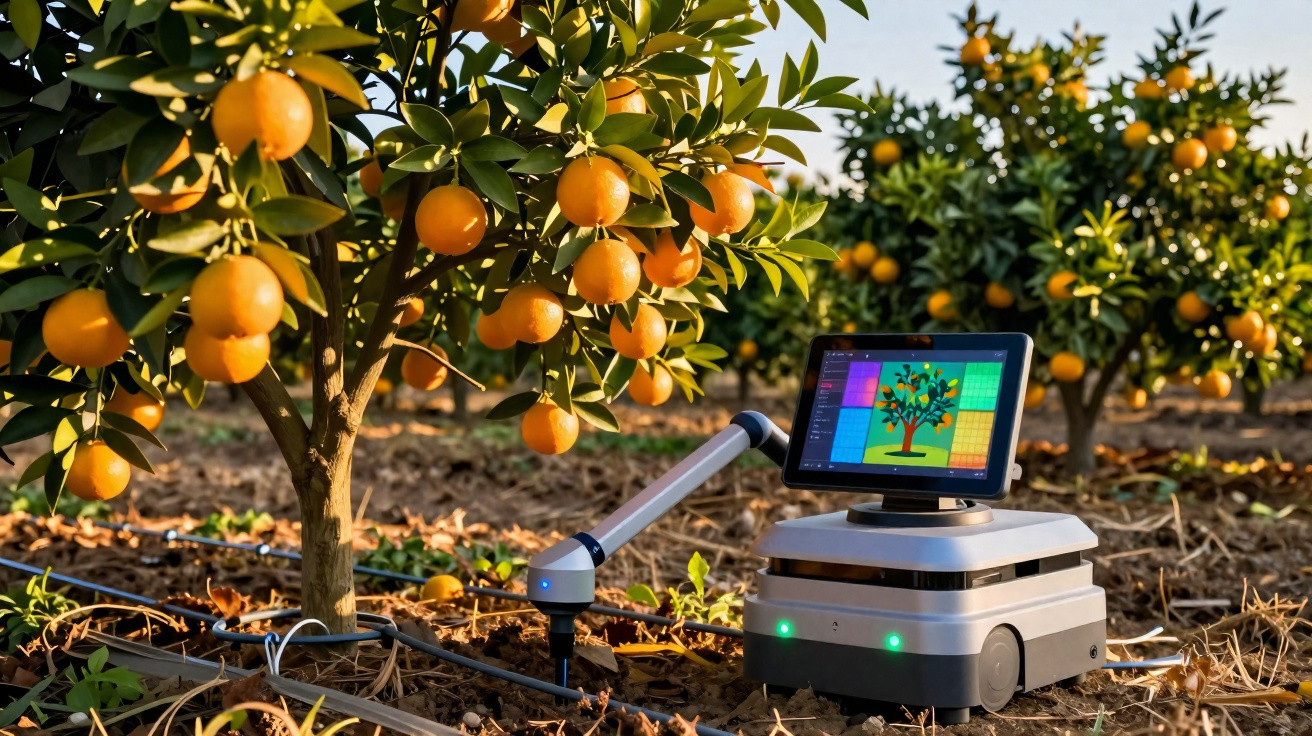
A compact robot designed for irrigation has demonstrated that two citrus trees growing side by side may require markedly different quantities of water.
This result changes irrigation from a field-wide estimate into a decision made for individual trees, particularly where drought and rising costs place the greatest pressure on growers.
Water maps for each tree
In two citrus orchards in Riverside, California, the robot mapped water conditions in ways that stationary sensors could not reveal.
Using data gathered during these runs, Elia Scudiero of the University of California, Riverside (UCR) connected the measurements with real soil moisture levels.
His team found that identical sprinkler applications could still provide neighbouring root systems with very different amounts of water, as soil patches responded differently.
This disparity shows why a small number of underground probes may fail to capture the true conditions, even where orchards receive the same irrigation.
Soil does not always know
Along a single row, one tree may grow in finer-textured soil while its neighbour sits above sandier material. Fine particles retain water more firmly, whereas larger grains drain more rapidly and leave less moisture available for roots.
Since micro-sprinklers moisten only selected areas of soil, these textural variations can produce wet pockets next to areas that dry out rapidly.
Trees react to this uneven distribution, making broad, uniform irrigation more wasteful than it may first appear.
Irrigation robot reads moisture
Rather than installing additional sensors, the irrigation robot measured electrical conductivity - the ease with which electricity travels through soil - as it moved through the orchard.
Wet soil generally transmits this signal more effectively, although salt, clay and temperature can also raise or lower the readings.
To convert this combined signal into estimates of water content, the researchers matched the robot’s scans with direct measurements from probes already installed underground.
This approach replaced estimation with a sufficiently detailed map to identify trees receiving too little water as well as those being overwatered.
Fewer checks needed
The method remained highly accurate when the model relied on only four to six sampling locations per field.
Using 12 calibration points, the strongest models from the main study produced an average error of 0.039 in volumetric water content.
This measurement indicates how much of the soil’s volume is occupied by water, and the improvement in accuracy levelled off after six sampling points.
That trade-off is important, since every additional probe brings costs for equipment, labour and maintenance before any water savings can be realised.
When roots suffocate
Insufficient water places trees under stress, but excessive irrigation can cause quieter, more persistent harm.
When soil pores become filled with water, roots cannot access enough oxygen, and the tissues responsible for taking up water and nutrients begin to fail.
Persistently wet soil also creates an opportunity for root diseases, an issue orchard managers have observed for many years.
By keeping moisture within this limited range, the robot’s maps can support plant health as well as help reduce water bills.
Water beyond roots
Overwatering wastes more than water: flowing water can carry dissolved fertiliser beneath the root zone, the area of soil that roots can reach.
After nutrients move below that level, crops cannot use them and the remaining nitrogen may enter groundwater.
“If water becomes limited, farmers have two choices. They can retire orchards, or they can find ways to produce the same crops using less water,” said Scudiero.
A map that reduces unnecessary irrigation can therefore protect both farm spending and the water below the farm.
A longer build
The development process took years, as the partnership between engineers and agricultural scientists started in 2019.
Before the robot began operating between orchard rows, Scudiero had spent around 15 years investigating how soil signals could expose hidden variations across fields.
Earlier models established that the sensor could travel safely close to trees, paving the way for moisture mapping across entire fields.
This extended process is significant because dependable agricultural tools generally emerge through years of incremental design improvements rather than a single fortunate breakthrough.
Closer to autonomy
During these orchard trials, the irrigation robot was still driven using a hand controller, despite hardware that can already support more automated movement.
In related field experiments, researchers have shown that the same platform can travel through orchard aisles and inspect numerous trees on a single battery charge.
Before growers can rely on it every day, commercial deployment will require more robust hardware, reliability in all weather and testing in crop systems beyond university orchards.
Private firms could develop the system into a practical farm tool, but only once repeated trials show that it can withstand real growing seasons.
Irrigation robot limitations
A key constraint remains below ground, because the mobile sensor measures soil at greater depths than the handheld moisture readings used for calibration.
This difference can weaken the connection between moisture near the surface and deeper water conditions, particularly where roots extract water unevenly.
The findings also came from two California citrus orchards, meaning that performance could differ across other soil types, crops and weather conditions.
These constraints do not remove the significance of the advance, but they indicate where future agricultural trials must focus most strongly.
What this changes
Orchard irrigation changes when water is considered a local condition around every tree rather than an average for the entire field.
If larger-scale farm trials confirm the findings, growers may be able to use fewer monitoring points, waste less water and reduce pollution simultaneously.

Comments
No comments yet. Be the first to comment!
Leave a Comment