
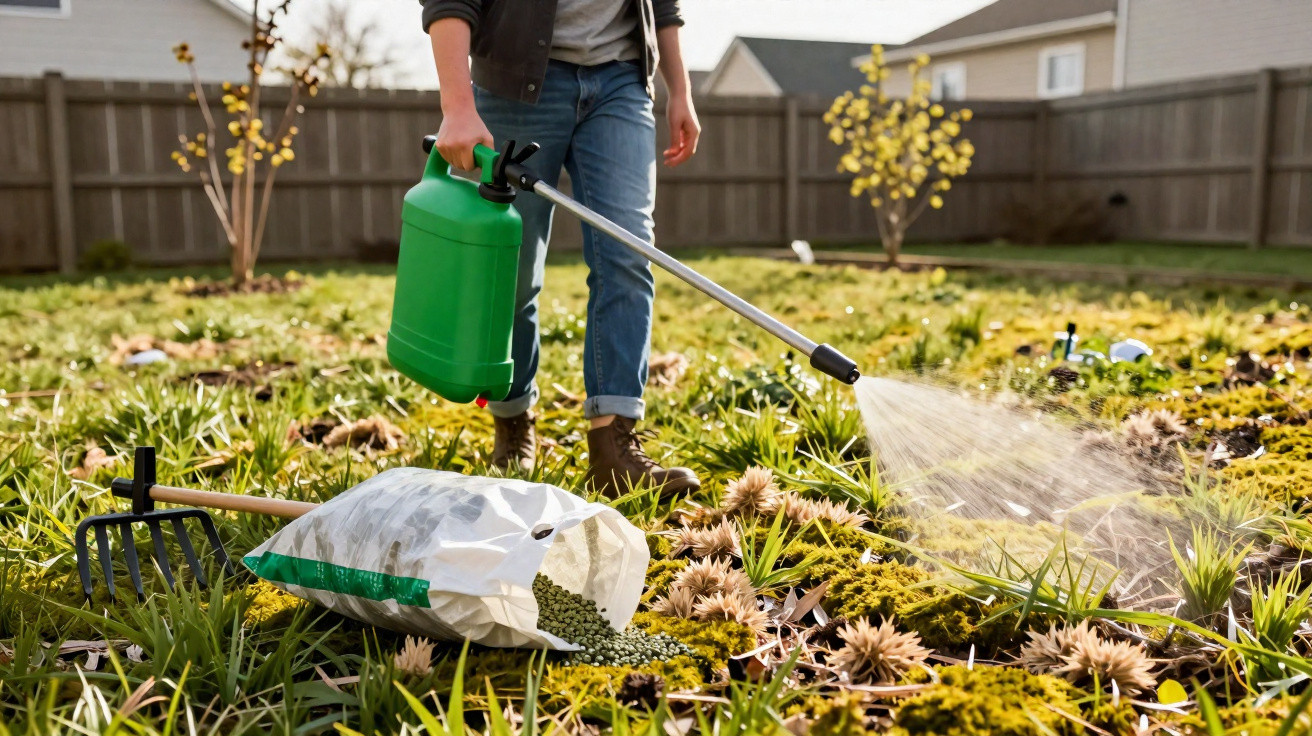
With one simple, frequently overlooked powder, amateur gardeners can make a remarkable difference in March.
By the end of winter, many gardens look more like brown meadows than lush green carpets, with yellowing blades, bare patches and thick cushions of moss. This is precisely the time to take focused action – not by applying the first heavy dose of fertiliser, but by using a traditional gardening aid that professionals have relied on for years.
Why lawns look so battered after winter
From November to February, lawns have little chance to thrive. The sun stays low, soil remains wet for long periods and repeated frosts add further stress. Grass slows its growth while its roots operate at minimum capacity. At the same time, rain and foot traffic compact the ground ever more tightly.
In this dense, poorly aerated soil, moisture gathers immediately below the surface. These are exactly the conditions moss enjoys. It pushes between grass blades, colonises gaps and deprives the lawn of light and air.
“As the days grow longer, mosses and lichens ruthlessly overtake a weakened lawn – unless action is taken.”
March brings a turning point: temperatures gradually rise, roots become active again and grass starts to grow. Taking the right steps now gives the lawn a genuine head start for the entire season.
The professional-grade powder: iron sulphate
Many local authorities and gardening businesses use a trusted product in late winter: iron(II) sulphate, usually referred to simply as iron sulphate. This grey-green to brownish powder has a dual benefit – it tackles moss while helping the lawn develop a deep green colour.
A fast-acting moss killer
Iron sulphate reacts quickly on moss-covered areas. When the solution reaches the cushions, they first turn dark green, then brown to black. Moss cells are damaged and the moss dries out.
“Depending on the weather, a dense layer of moss can turn within a few days into a crumbly black covering that is easy to remove.”
The crucial point is that, although the moss dies, it initially still occupies space. Without follow-up work after treatment, there may be less moss, but not automatically more grass. It is the combination of treatment and subsequent care that makes the difference.
An extra boost for leaf colour
Alongside its effect on moss, iron sulphate supplies iron to the soil – a trace element that can stimulate chlorophyll production. Chlorophyll is the green pigment in leaves that enables plants to turn light into energy.
When iron is lacking, grass can appear pale and almost yellowish. A targeted application of iron in March can help the lawn recover much faster. Many gardeners report that their lawn looks fresher and denser after only a few days, even though the grass itself has not yet grown significantly.
- Moss is weakened and dies off
- Leaf colour becomes more intense
- The lawn gets an earlier start to the season
- The cost per square metre remains moderate
How amateur gardeners should apply iron sulphate in March
The best window is from early to mid-March, depending on the region. Nights may still be cool, but prolonged frost should have passed. The soil should feel slightly damp rather than waterlogged.
Apply it as a liquid, not as dust, for even results
In practice, liquid application has proved effective. Dissolve the powder in water, then distribute the solution using a watering can with a rose or a pressure sprayer. This allows the quantity to be controlled far more accurately than scattering the powder.
| Step | What to do |
|---|---|
| 1 | Check the forecast: no heavy rain front should be expected for 24 hours |
| 2 | Mow the lawn one or two days beforehand, without cutting it too short |
| 3 | Measure iron sulphate according to the manufacturer’s instructions, often 20–30 g per litre of water |
| 4 | Apply the solution to slightly damp soil, covering the area evenly |
| 5 | Avoid contact with paving, wood and metal; rinse off splashes immediately |
Protective clothing is not an unnecessary extra: gloves and rubber boots prevent skin irritation and unsightly staining. Anyone using a knapsack or pressure sprayer should also wear simple protective goggles.
“Iron sulphate does not only affect moss; it can also permanently stain patios, paving slabs and pool edges – so spray with great precision.”
Essential steps after treatment
Once applied, the area needs to be left alone. Nobody should walk across the lawn for at least one day. Heavy rain shortly after spraying partly washes away the active ingredient and noticeably reduces its effect.
After around ten to fourteen days, it is time for the next stage. The moss will now be black, dry and brittle. This is when the clearing-up work begins.
Scarifying, overseeding and nutrients: the formula for a dense lawn
Use a scarifier or hand rake to pull the dead layer of moss thoroughly out of the turf. It may seem drastic, but it restores air and light at the soil surface. Bare areas will now become clearly visible – and these are exactly where overseeding is worthwhile.
Work high-quality lawn seed, suited to its intended use (family lawn, ornamental lawn or shade lawn), lightly into the opened areas. A modest feed of organic or organic-mineral fertiliser supports new growth.
- Remove dead moss
- Work overseed into gaps
- Apply a light treatment of organic fertiliser
- Keep the area evenly moist during the first few weeks
Combining all of these measures can transform a patchy, mossy area into a noticeably denser, more even lawn within a few weeks.
The limits and risks of this method
Iron sulphate is not a miracle cure that resolves every problem permanently. If moss is mainly caused by lasting shade, a leaking gutter outlet or severe waterlogging, it will return despite treatment. Only structural changes will help in that case: improved drainage, crown thinning on trees or different soil preparation.
Excessive doses can harm the grass itself. This shows up as scorched brown patches. It is therefore worth checking the packet and carefully weighing the amount, rather than adding a little extra to the bucket “by eye”.
Practical advice for different garden types
Small urban garden
For an area of only a few dozen square metres, a watering can with a rose is generally sufficient. The amount can be controlled easily, and the work can be done comfortably strip by strip. Cover the edges beside paved paths with cardboard to prevent stains.
Large rural area
For several hundred square metres, a knapsack sprayer or an attachment system for lawn tractors is worthwhile. Here, the greater challenge is ensuring consistent overlap between spraying or walking passes. Marking out the area with string or stakes helps ensure no sections are missed.
Why treating the lawn in March matters so much
Those who wait until April or May often regret losing valuable weeks. By then, the moss is already well established and grass is competing for light and nutrients. Treatment in March takes advantage of the point at which the grass is only just waking up and can gain a slight lead.
In dry springs, an early-treated and well-overseeded lawn has another advantage: its root system thickens more quickly, the soil is shaded and does not dry out as deeply. This makes the area more resilient in summer, so it does not have to recover at record speed after every warm weekend.
Using March not only for spring bulbs but also specifically for lawn care lays the foundation for a season with far less frustration over brown patches and carpets of moss. A bag of iron sulphate, one free afternoon and some patience afterwards are often enough to turn a tired winter meadow back into a presentable garden lawn.




Comments
No comments yet. Be the first to comment!
Leave a Comment