
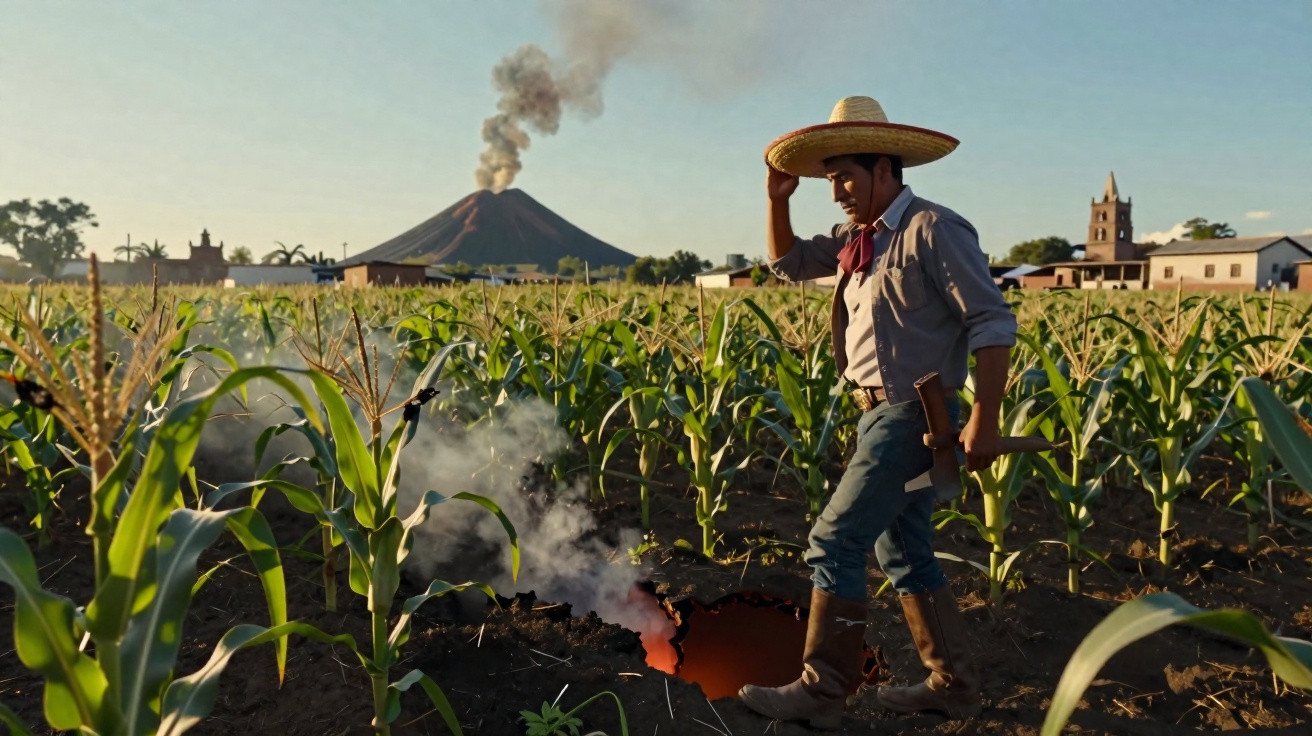
On the morning of 20 February 1943, farmer Dionisio Pulido came across something impossible to overlook in his maize field in the Mexican state of Michoacán. The ground had begun to split apart, emit smoke and make noises from below. Within a few hours, what had been a crack in the field would become the beginning of the Parícutin volcano.
What did the farmer notice among the crops?
Pulido was working near the small community of Parícutin when he spotted unusual changes in the land. An existing hollow in the area started widening, with smoke and gases rising from the ground. Tremors, loud blasts and the ejection of hot rocks soon followed, making clear that something far larger was taking place beneath his feet.
Rather than appearing at the summit of an old mountain, the eruption was effectively beginning from scratch in front of witnesses. The farmer left the site and alerted other people in the area. Later that same day, ash and volcanic fragments began gathering around the opening, creating the first metres of a new cone.
How did the Parícutin volcano grow so quickly?
Parícutin is a cinder cone, created as fragments of lava are thrown into the air and fall around the eruptive vent. During its first days, this material built up at a remarkable pace. The previously almost flat farmland developed a visible rise, which continued to grow as explosions and ash columns took over the landscape.
A few figures show how rapidly the volcano’s emergence reshaped the region. Its fastest growth came at the start of the eruption, although fresh layers of material continued changing the cone for years.
- Parícutin’s visible birth began on 20 February 1943.
- The cone rose by dozens of metres in its first hours and continued expanding rapidly over the following days.
- By the end of its activity, the mountain stood around 400 metres above the original ground level.
- The eruptive phase remained active until 1952, roughly nine years after it emerged.
What happened to nearby communities?
This geological spectacle also had severe consequences for the people living nearby. Ash blanketed crops, disrupted rural livelihoods and made certain areas increasingly difficult to inhabit. As eruptions and lava flows progressed, residents had to leave threatened settlements and rebuild their lives elsewhere.
Parícutin and San Juan Parangaricutiro were among the places affected. Lava moved over buildings and buried much of the former landscape. To this day, the ruins of San Juan church remain surrounded by solidified volcanic rock, forming one of the best-known images of the changes caused by the eruption.
Why did Parícutin fascinate so many scientists?
Volcanoes are generally studied after they have already existed for hundreds, thousands or even millions of years. Parícutin presented an exceptional situation. Geologists reached the area shortly after the activity began and were able to follow the cone’s development, the explosions, the ash deposits and the movement of lava as it unfolded.
This close observation made Parícutin an important natural laboratory. Photographs, measurements and records collected over the years helped researchers gain a better understanding of how a volcanic cone can be born and develop. Science has rarely had the chance to document such an extensive part of a volcano’s life from its earliest moments.
Watch the video shared by the YouTube channel Originz TV showing the world’s youngest volcano.
What remained after nine years of eruption?
When activity ended in 1952, Dionisio Pulido’s maize field had become part of a completely different landscape. In place of cultivated land stood hardened lava, ash and a mountain that had not existed nine years earlier. Parícutin remains a rare reminder of how quickly underground processes can alter the planet’s surface.
Its story also shows that enormous changes can begin with seemingly small signs, such as a crack in the ground. To learn about Parícutin is to see Earth as a planet still being formed. This story is worth examining closely now, because it reveals, in an almost unbelievable way, what may be happening silently beneath our feet.




Comments
No comments yet. Be the first to comment!
Leave a Comment