
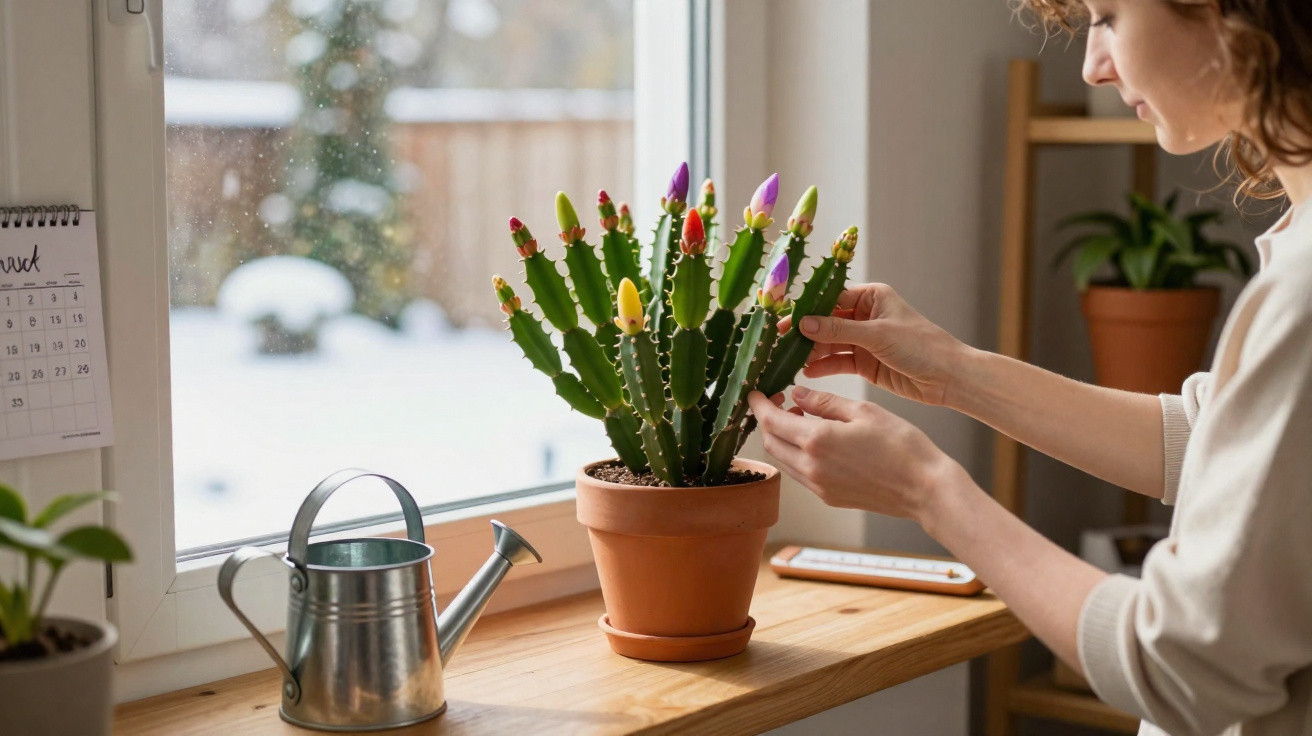
Often, the issue is not a “black thumb” but a single winter-care mistake.
Many plant enthusiasts know the situation: at the garden centre, an Easter cactus is covered in star-shaped flowers; at home, it delights for one season – then nothing happens the following year. Its shoots remain lush and green, and the plant looks healthy, yet no buds appear. Once you understand how this unusual cactus works, it quickly becomes clear that spring itself is not the decisive period, but rather the months leading up to it.
Why the Easter cactus differs from other cacti
The Easter cactus, usually sold under the botanical name Rhipsalidopsis, originates in the humid forests of South America. In its natural habitat, it grows high up in trees as an epiphyte, rather than in hot desert sand. This has a major effect on the care it needs.
- Not a desert plant: It cannot cope with intense midday sun in the way a desert cactus can.
- Airy rather than dense: Its roots need a loose, free-draining growing medium.
- Even moisture: It prefers soil that is lightly moist, but never soaking wet.
Indoors, it thrives in a bright room away from direct midday sunshine, such as on an east- or west-facing windowsill. There, it grows neatly and spends the year building up the energy needed for its spring display.
Mistaking it for a Christmas cactus
It is common to buy a Christmas cactus instead of an Easter cactus, or the other way round. They look similar, but their flowering periods differ.
| Feature | Easter cactus | Christmas cactus |
|---|---|---|
| Flowering period | Spring, usually March to May | Winter, usually November to January |
| Shoot segments | More rounded, with softer outlines | Clearly toothed or pointed |
| Typical time of purchase | February to April | October to December |
Anyone who misjudges the flowering period often shifts the resting phase unintentionally, then later wonders why flowers fail to appear.
The crucial factor: the Easter cactus needs a proper winter rest
The key message for anyone whose plant stays green but refuses to flower is this: an Easter cactus will only produce buds reliably if it receives a cool break in winter. A permanently warm place on a windowsill above a radiator is its greatest enemy.
No frost, but noticeably cooler conditions: giving your Easter cactus fresh temperatures from November to January lays the foundation for an explosion of flowers in spring.
The ideal winter schedule
To achieve flowers around Easter, experienced houseplant growers follow a clear timetable:
- Late autumn to early winter (late October to November): Gradually reduce temperatures, water less and stop feeding.
- Winter rest (November to January, around 8–12 weeks): Provide a cool setting of around 10–15°C, considerably less light and almost no water.
- Waking phase (February): Move it gradually to a warmer, brighter spot and water carefully a little more often, without overdoing it.
It is during this cool period that the plant decides whether or not to develop buds. If it remains warm throughout, it may continue growing and look healthy, but the hoped-for flowers will not arrive.
The role of light, temperature and darkness
Temperature is not the only factor that triggers flowering; light is important too. In its native environment, the plant experiences long nights and cooler periods before it begins growing in spring.
How much light does the Easter cactus need in winter?
During its resting phase, around eight hours of indirect daylight each day is sufficient. Even more important are long, uninterrupted nights.
- Daytime light: Choose a bright but non-sunny position, such as a north-facing window or a place slightly further into the room.
- Night-time darkness: Provide at least twelve hours of genuine darkness, with no lamps, television or continuous lighting.
Constant artificial light in a living room that stays on until late at night disrupts the Easter cactus’s internal calendar. It then “believes” that the dark period has not yet arrived and postpones bud formation.
Watering: the most common mistake happens in the pot
Many owners spoil their Easter cactus with water during winter because they fear it might dry out. In fact, this slows flowering and damages the roots.
Watering correctly throughout the year
- Spring and summer: Water every one to two weeks once the top layer of compost has dried out. Avoid waterlogging at all costs.
- Autumn: Lengthen the intervals between watering, reduce the amount given and prepare the plant for its rest.
- Winter rest: Give only a small amount of water every three to four weeks, just enough to prevent the segments from becoming limp.
Checking the pot after watering and emptying excess water from the saucer protects the roots from rot. A loose blend of good-quality compost and one third coarse material, such as perlite, lava rock or coarse sand, helps water drain away.
Common mistakes that ruin flowering
The same problems crop up time and again in homes and conservatories. Once you recognise them, they are easy to avoid.
These pitfalls deprive the Easter cactus of its buds
- Winter positions that are too warm: Constant temperatures of 20°C or more, for example directly above a radiator.
- Lamplight until late at night: An open-plan kitchen and living area with continual artificial lighting.
- Moving it too often: Changing its position, especially once buds are already visible.
- Draughts and temperature shocks: An open winter window immediately beside the plant.
- Permanently wet compost: Dense, wet soil that barely dries out.
Anyone who tries to “protect” their Easter cactus in winter by keeping it warm, bright and moist means well – but deprives the plant of precisely the signals it needs to flower.
How to rescue a green but flowerless plant
If an Easter cactus has gone for years without flowering, it is worth giving it a fresh start over several months.
A practical recovery plan
In autumn, repot the plant into fresh, airy growing medium and a slightly smaller pot that is not too tight. Then place it somewhere cool and bright, such as a stairwell window or an unheated guest room. The rules there are simple: little water, no fertiliser and long dark periods.
When the first buds appear in late winter, the pot can move to a slightly warmer room, though not a hot one. Calm conditions are now essential: do not turn it or carry it back and forth between the window and a table. Even a brief cold shock or draught can cause buds to drop before opening.
Why humidity and position affect the number of flowers
While it is flowering, the Easter cactus reacts sensitively to dry air from central heating. Its shoot segments may shrivel, while buds can dry up or fall off before developing.
A simple solution can help: place the pot on a saucer filled with damp clay granules or gravel, while ensuring that the root ball does not sit in water. This allows a steady amount of moisture to rise without leaving the compost waterlogged.
A slightly sheltered position, away from a radiator and the draught from patio doors, also supports a generous display of flowers. Turning the plant no more than once a week while it is flowering prevents it from leaning too strongly towards the light without causing stress.
What the “resting phase” really means botanically
Behind the scenes, the Easter cactus responds to day length, temperature and water availability. Specialists describe it as a photoperiodic plant: it uses the balance between hours of light and darkness as a signal to form buds. Cooler temperatures and reduced watering reinforce this signal. In nature, this prevents the plant from flowering on unsuitable days.
Anyone who recreates this approach in the living room will often find that a plant that has been “stubborn” for years suddenly becomes a flowering machine. The green cactus was never “difficult” – it simply lacked the right winter.



Comments
No comments yet. Be the first to comment!
Leave a Comment