
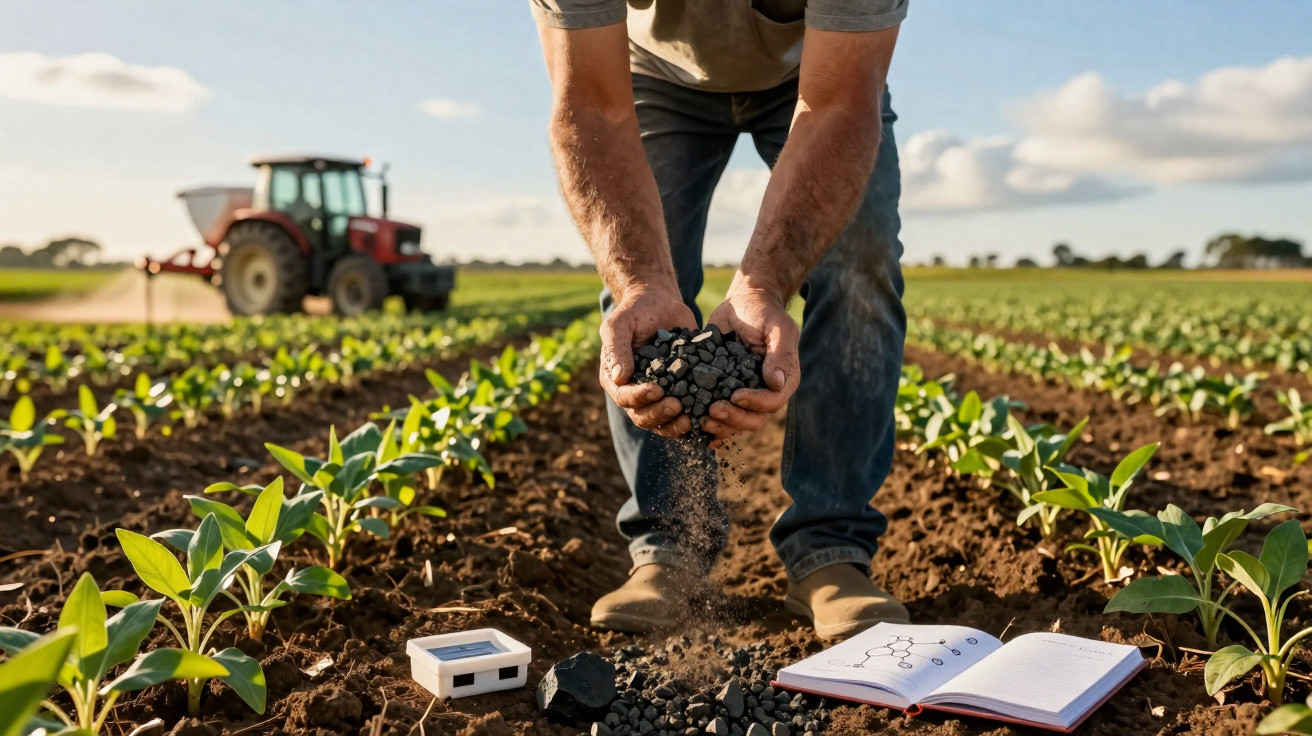
Spreading crushed rock across agricultural fields could draw substantial quantities of carbon dioxide out of the atmosphere, while potentially improving crop growth at the same time.
However, a new assessment indicates that the approach can only become a significant climate solution through widespread deployment, particularly in hot, wet areas where the chemical process is quickest and agricultural gains may be greatest.
Scientists at Cornell University modelled the rate at which enhanced rock weathering could be adopted worldwide. Their findings show that global adoption – including who adopts it, when they do so and where it is used – will decide whether the method can make a substantial contribution to limiting warming.
How farms capture carbon with rock
Enhanced rock weathering is, in essence, geology sped up. Finely ground silicate rock is applied to farmland soils, where it is allowed to react naturally with carbon dioxide.
As these reactions take place, CO2 is converted into stable mineral forms that can remain stored for thousands of years.
The method is also appealing because it could offer farmers practical advantages. Rock dust may supply nutrients including calcium, magnesium and iron, lower soil acidity, and possibly reduce the need for synthetic fertilisers.
This dual benefit – removing carbon while improving soils – is the reason the concept is now receiving serious attention.
Climate impact relies on scale
Rather than presuming that every region would take up the method at the same rate, the study examined a range of different rollout scenarios.
With strong uptake, the researchers calculate that enhanced rock weathering could remove as much as roughly a gigaton of carbon annually by 2100 – broadly similar to the annual emissions of a large industrial economy.
Yet their analysis found that reaching anything close to this scale requires extensive adoption across the Global South.
Farms in many of these countries are located in warm, wet climates that can accelerate rock weathering. As a result, the same effort may remove more carbon there than in cooler, drier regions.
“If this were to be scaled, the Global South would eventually contribute more,” said study senior author Chuan Liao, an assistant professor at Cornell. “Tech transfer and global carbon markets could accelerate adoption in these regions while also making adoption more equitable.”
“Previous research assumed a uniform adoption across regions. Our major contribution in this study is to model these trajectories in a more realistic way.”
How agricultural technologies spread
Instead of representing adoption as a steady worldwide trend, the researchers incorporated phased uptake, regional lags and social “tipping points”, at which a practice may rapidly gain popularity once the right circumstances emerge.
For this work, they used historical adoption patterns for other agricultural technologies, including fertiliser and irrigation, in countries around the world.
This method generated forecasts featuring both early and late adopters, alongside more rapid expansion in certain regions than in others.
Higher-income nations are generally expected to take the lead initially. The projections nevertheless suggest that Global South countries – including India and Brazil – will surpass them at about 2050.
Crushed rock for carbon removal
Based on the speed and extent of deployment, the team estimates that carbon removal could reach around 0.35 to 0.76 gigatons by 2050, rising to approximately 0.7 to 1.1 gigatons by 2100.
These ranges account for uncertainty in real-world conditions. They depend on the expansion of mining and grinding capacity, as well as on whether carbon markets provide rewards for using the technique.
The outcome also rests on whether farmers consider its benefits sufficient to justify adoption, and whether policies and logistics are developed in the locations where weathering is most effective.
Carbon markets are paying attention
Although enhanced rock weathering remains at an early stage, it is beginning to attract interest from the private sector. The article notes that Microsoft and Stripe have invested millions in carbon-removal portfolios that include the method.
Part of its attraction lies in the permanence of the storage – with carbon locked into minerals rather than held temporarily – as well as in the prospect of direct benefits for farmers.
If it boosts soil health and yields while creating carbon credits, scaling it may prove easier than for methods that seem entirely theoretical or disconnected from everyday life.
“We need to sharpen scientific predictions of enhanced rock weathering,” said co-author Benjamin Houlton, the Dean of the Cornell University College of Agriculture and Life Sciences. “It has amazing potential to drive carbon profits directly into farmers’ pocketbooks,”
Fairness and climate calculations
A key conclusion of the research is that broader access in the Global South is not solely an issue of fairness. It is also essential for performance: if uptake remains focused in wealthier regions, the technique is unlikely to achieve its full potential for carbon removal.
“It means carbon credits could be directed to those countries, to small-farm owners, which could help raise their income and support crop yields,” Liao said.
Enhanced rock weathering on farms could therefore develop into an important climate tool for removing carbon during this century.
Its success, however, will depend on governments, investors and industry leaders moving beyond the earliest adopters, expanding the practice in the regions where it is most effective, and combining it with finance and technology transfer that do not exclude small farmers.




Comments
No comments yet. Be the first to comment!
Leave a Comment