
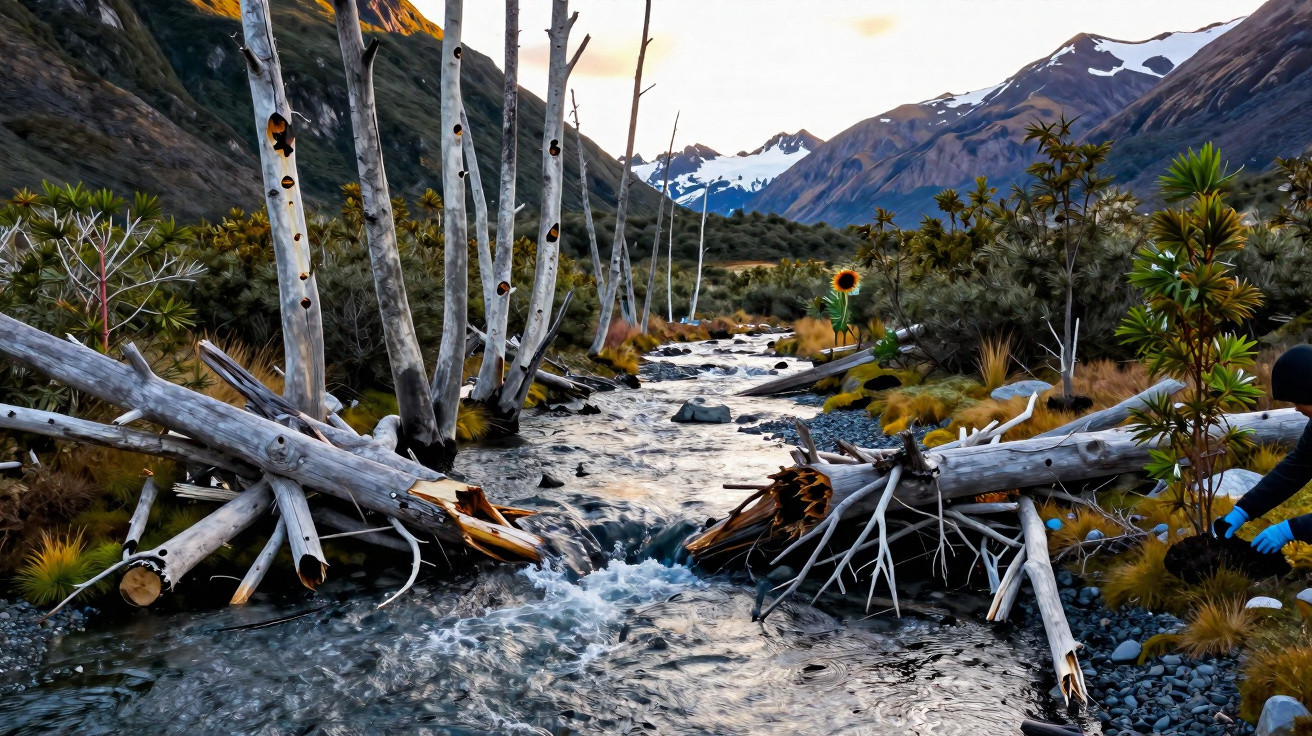
In 1946, Argentine authorities released 20 Canadian beavers on the main island of Tierra del Fuego to establish a wild population for the fur industry. The venture never succeeded, yet the animals found water, timber and no natural predators, spreading across one of Patagonia’s most vulnerable forest regions.
Why were beavers brought to Tierra del Fuego?
The animals were introduced at a time when the effects of non-native species received little consideration in economic decision-making. The aim was to use beaver fur and establish a new productive industry in a sparsely populated region.
The arrival of beavers in Patagonia brought together several factors that enabled their unforeseen spread:
- An abundance of rivers, streams and wetlands;
- Trees available both as food and for building dams;
- No key predators of the kind found in North America;
- An ability to adapt to Tierra del Fuego’s cold climate;
- No population control during the first decades.
How did only 20 animals become an invasion?
With few barriers to reproduction, beavers began colonising rivers and streams on both the Argentine and Chilean sides of the archipelago. Official estimates suggest their population has exceeded 100,000 individuals, while roughly 95% of Tierra del Fuego’s drainage basins show evidence of occupation.
A satellite-image survey recorded more than 206,000 dams across the archipelago, with about half located in Argentina and half in Chile. They are most concentrated in forested areas, where trunks, branches and leaves are more readily available.
Why do beaver dams cause such extensive forest damage?
Beavers also alter waterways and fell trees in their native range. The issue is that southern forests did not evolve alongside this type of disturbance. When the animals build dams, they block or redirect water flow, flood the ground and leave tree roots permanently waterlogged.
Native species including lenga, guindo and ñire cannot withstand prolonged flooding. Nor do they have the same capacity for regrowth seen in some North American trees after they are cut down. Recorded consequences include:
- Trees dying because their roots receive too much water;
- Tree trunks being felled for dam construction;
- Forests being turned into open, flooded ground;
- Changes to river routes and flow speeds;
- Non-native plants entering the clearings created;
- Loss of habitats used by native wildlife.
Surveys indicate that approximately 30,000 to 31,500 hectares have been affected in the Argentine part of the island alone. In some places, recovery may take decades, while trees such as lenga can require around 200 years to restore the forest’s original structure.
Do the impacts extend beyond Patagonia’s trees?
The invasion also affects peatlands, water quality, forestry, livestock farming and aquatic habitats. Dams trap sediment, alter nutrient availability and can damage roads, drainage channels and areas used by local communities.
Its wider effects include:
- Changes to water sources and watercourses;
- Reduced carbon-storage capacity in peatlands;
- Damage to forestry and agricultural production areas;
- Shifts in fish populations and other aquatic organisms;
- High costs for monitoring, control and restoration.
One official estimate put annual losses at more than US$66 million in Argentine Tierra del Fuego. There are also concerns that the species could spread onto the mainland and reach new areas of the Patagonian Andes.
Can areas occupied by Tierra del Fuego beavers be restored?
Argentina and Chile are carrying out joint measures to limit further expansion, remove populations from priority locations and restore damaged environments. Pilot projects have established beaver-free zones to monitor how watercourses, soils and vegetation respond once the beavers’ continual pressure has been removed.
Some sites have shown signs of recovery, but the process is slow and does not always restore the forest’s original composition. The case of the Tierra del Fuego beavers has become an example of the lasting consequences that can arise when a species is introduced for economic reasons without understanding its effects on the ecosystem.




Comments
No comments yet. Be the first to comment!
Leave a Comment