
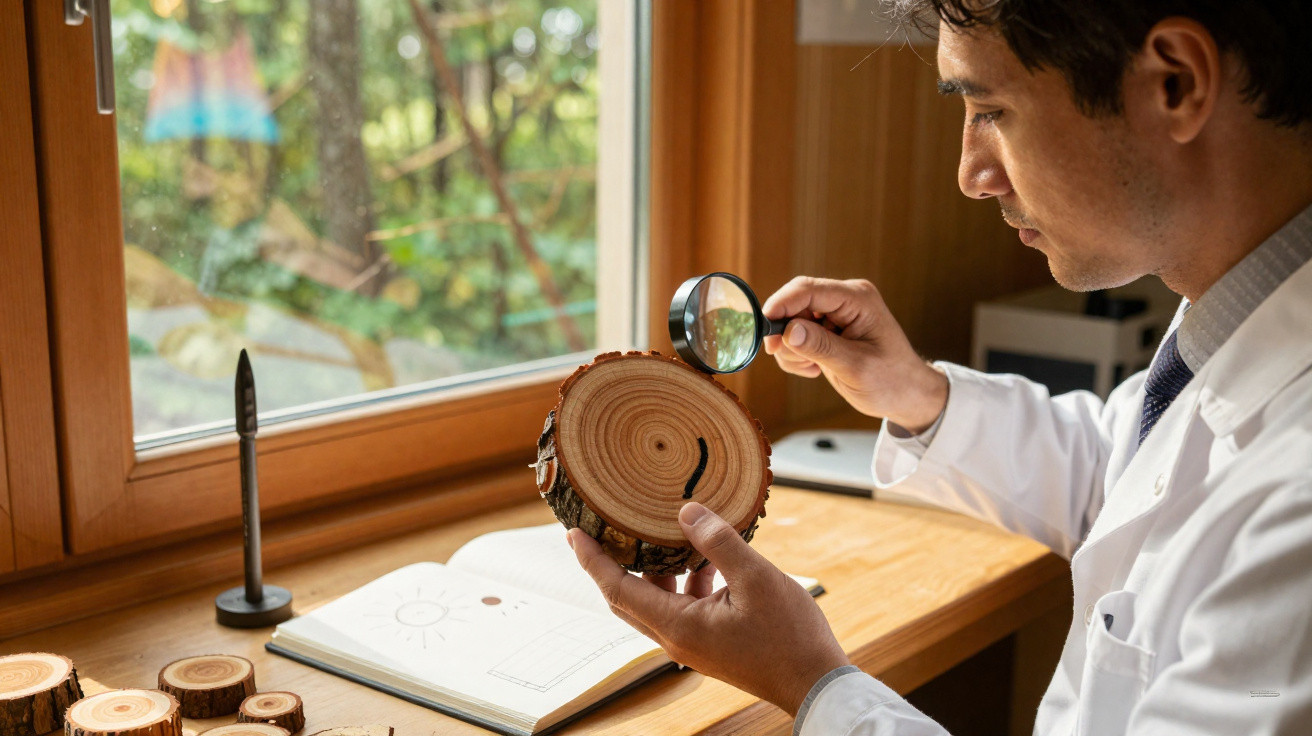
When the Sun erupts, it can send streams of high-energy particles towards Earth, causing solar storms capable of disrupting satellites, electricity grids and communications systems.
Although these events can now be monitored, the most severe storms occurred well before modern instruments were available.
To uncover them, scientists use an unexpected archive: tree rings. New research led by a Northern Arizona University team finds that trees do more than preserve records of solar storms – in some cases, they also blur them.
The ways trees grow, retain carbon and produce wood can spread these signals over several years, meaning plant biology is essential to reconstructing the history of Earth’s space weather.
Solar storms leave carbon clues
High-energy particles released during solar storms hit Earth’s atmosphere, producing a rare radioactive carbon isotope known as carbon-14.
During photosynthesis, plants take carbon dioxide from the atmosphere, while growing trees seal carbon into their wood. Since every tree ring corresponds to a year, rings provide a natural chronology.
Abrupt increases in carbon-14 within rings can identify rare solar storms called Miyake events. Tree rings from numerous continents contain evidence of these events.
Certain storms in the past were much more powerful than anything recorded in the modern era. Understanding how trees retain carbon can help researchers assess the potential intensity of future solar storms.
Trees record carbon slowly
Although tree rings serve as natural archives, wood does not form immediately after carbon reaches a tree’s leaves. Instead, carbon takes a complicated route through the tree.
Photosynthesis produces sugars, some of which trees retain as nonstructural carbohydrates. These reserves may be stored for months, years or even decades before being incorporated into new wood.
“Although tree rings are one of our best tools for reading Earth’s history, they’re not perfect instruments,” said study co-author Amy Hessl, from the Department of Geology and Geography at West Virginia University.
“This paper shows how tree biology shapes the stories they tell.”
As stored carbon combines with newly absorbed carbon, radiocarbon peaks caused by solar storms can be distributed over multiple rings. This blending makes precise dating more difficult.
Growing seasons shift solar storm signals
Different tree species take up carbon at different points in the year. The timing of leaf growth, leaf fall and photosynthesis differs between climates and species.
Deciduous trees photosynthesise only while they have leaves. Evergreen trees retain needles throughout the year, but temperature and limited light still impose seasonal patterns.
Local climate also influences carbon uptake. Woodlands in warmer areas generally take in carbon for longer than forests in colder locations.
Differences in growing-season duration alter when trees capture atmospheric carbon. Depending on when a tree grows, a solar storm signal may emerge earlier or later.
Wood formation adds another delay
Wood production, known as xylogenesis, starts only once specific temperature and moisture conditions are met. While some trees stop producing wood early in summer, others continue into autumn.
Earlywood develops first, followed by latewood. The carbon used to create earlywood frequently comes from stored reserves instead of recent photosynthesis.
These differences in timing help explain why solar storm signals may occur in several rings. A storm late in one year can produce its strongest signals during growing periods in subsequent seasons.
Carbon storage shapes records
Trees hold nonstructural carbohydrates in the form of sugars and starches, storing them in roots, stems and branches.
The amount of storage available varies between species. Deciduous trees commonly maintain larger carbon reserves than evergreen trees, and some of this stored carbon may remain unused for many years.
Studies indicate that carbon held in storage can later support respiration, root development, leaf growth and wood formation.
The mixture of older and newer carbon softens sharp radiocarbon signals. This effect is more apparent during extreme events such as Miyake events.
“Understanding how trees acquire carbon from the atmosphere, store it for future use and then use it to grow new wood is critical,” said Mariah Carbone, associate research professor at Northern Arizona University.
“The biology determines how faithfully the atmospheric signal is preserved.”
Geography reshapes storm records
Tree anatomy can also influence carbon signals. Ring-porous species typically depend more heavily on stored carbon for early growth than diffuse-porous species.
Latitude matters as well. Owing to Earth’s magnetic field, regions at higher latitudes experience greater carbon-14 production during solar storms.
The effects of geography combine with growth schedules and carbon-storage behaviour to shape tree-ring records.
This variation accounts for the slight differences in timing that scientists find when comparing regions or tree species. Recognising these patterns supports more precise reconstructions of solar storm history.
Benefits beyond space weather
Better knowledge of the carbon pathways in trees has uses beyond space-weather research. Accurate carbon timelines are central to radiocarbon dating.
A clearer understanding of carbon storage can improve the dating of archaeological sites and historical artefacts.
Study co-author Andrew Richardson is an ecologist at Northern Arizona University.
“It’s amazing that one way to improve our understanding of solar storms and solar physics is to better understand tree growth processes, which in turn is critical for improving how we use radiocarbon for carbon dating,” said Richardson.
Preparing Earth for extreme storms
The research, described in New Phytologist, is part of a wider National Science Foundation initiative.
Scientists are seeking to establish how extreme earlier solar storms were and what comparable events could mean for modern technology. Satellites, astronauts and power systems are still exposed to the risks posed by such storms.
Trees remain quiet witnesses to solar storm activity. By understanding how wood preserves carbon, scientists can interpret this history with more clarity and confidence.


Comments
No comments yet. Be the first to comment!
Leave a Comment