
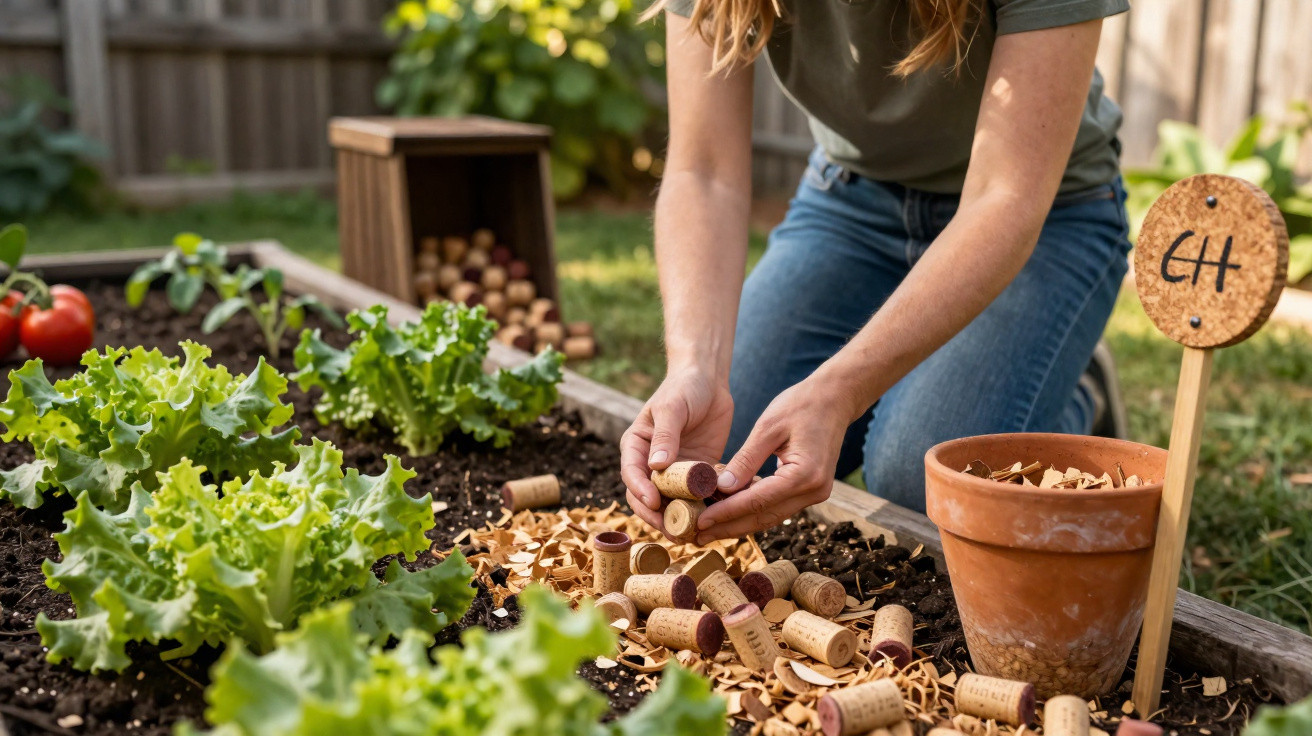
Small cork stoppers can in fact serve as a remarkably ingenious garden tool.
Anyone tending a vegetable garden will know the issue: water never stays where it is needed, roots suffer in hot weather, and slugs mercilessly strip young lettuces. Although we buy costly specialist products, the answer is often already sitting in the kitchen. Natural cork from wine bottles can perform a whole range of jobs in a garden bed – free, sustainable and surprisingly straightforward.
Why natural cork is so valuable in the vegetable garden
Cork comes from the bark of the cork oak, a tree found mainly in Mediterranean areas. Harvesting it does not require the tree to be cut down, as the bark grows back. This makes the material relatively gentle on the environment.
For gardeners, cork offers several qualities that are especially useful in a garden bed:
- Moisture management: Cork repels water while remaining slightly permeable to air.
- Heat protection: It acts as a thin insulating layer around plant roots.
- Slow decomposition: It breaks down only gradually, improving soil structure as it does so.
- Antifungal properties: Its natural compounds can inhibit some unwanted fungi.
These benefits are particularly important in a vegetable garden containing delicate young plants and thirsty crops such as tomatoes or courgettes. Loose, well-aerated soil stays healthy for longer and does not dry out as quickly.
When prepared properly, an ordinary bottle cork becomes free mulch, drainage material and slug protection all in one.
Which corks are suitable – and which are not
Before reaching for the box of saved wine corks, it is worth inspecting them closely. Not every stopper belongs in the soil.
The best option: untreated natural corks
Traditional natural corks made from a single piece are ideal. They usually have a matt, warm beige surface with irregular grain. A small winery stamp is perfectly acceptable.
These types work well for:
- mulch layers around vegetables
- drainage in pots and containers
- adding to compost
- slug barriers and plant labels
Better avoided: plastic and heavily treated corks
Many modern bottles use plastic stoppers or highly compressed corks bonded with synthetic resin. They can often be recognised by:
- a very smooth, glossy surface
- an unnaturally uniform colour
- a distinctly plastic feel when bent
Such stoppers belong neither in the soil nor on the compost heap. It is also best to discard corks with very heavy varnishing, as they may contain substances that have no place in a vegetable bed.
Preparing corks: clean, dry and break them up
Before putting the first cork into the garden, a little preparation is needed. It takes only a few minutes but prevents mould and unpleasant smells.
Cleaning and storing corks
Simply rinse bottle corks that have spent a long time in wine or other drinks under clean water. Usually, nothing more is required. Then leave them to dry thoroughly, ideally for one or two days in an airy place. Any residual damp can easily lead to mould, especially if a large number of corks are stored together.
Suitable storage options include:
- an open fabric bag
- a cardboard box in a dry cellar
- a bucket with air holes
Breaking them up using simple tools
For most uses, cutting or crushing the corks is worthwhile. Common household tools are enough:
- Knife: Use a sturdy kitchen knife to cut slices, cubes or strips.
- Hammer or rubber mallet: Wrap the cork in an old cloth and strike it until coarse pieces form.
- Old blender: Anyone with a spare appliance can process cork into a finer granulate.
Larger pieces are well suited to drainage or winter protection. Finer cork mulch is better spread over bed surfaces or in narrow rows between lettuces.
Cork mulch: saving water in the vegetable garden
One of the most useful applications for cork is directly on the soil surface. A mulch layer around tomatoes, peppers, courgettes or strawberries creates a small protective cushion.
Many home gardeners use it as follows:
- Lightly loosen the soil around the plants and remove weeds.
- Spread 2–4 centimetres of chopped cork over the soil.
- Mix it with other materials, such as straw, leaves or wood chips.
This mixed mulch keeps moisture in the soil noticeably longer, so the surface does not dry out as rapidly. Particularly during heatwaves, this can save an extra watering session or two.
Cork mulch reduces evaporation, suppresses many weeds and creates a pleasant microclimate around the roots.
Because cork is extremely light, many gardeners combine it with heavier materials. This helps the layer remain in place even in wind or heavy rain.
Drainage in pots and raised beds: cork instead of clay
Pots and planters are common on balconies and terraces. Waterlogging is a familiar problem there – and a frequent cause of rotting roots. Traditionally, broken terracotta or expanded clay pellets are placed in the bottom of pots. Cork provides a lighter alternative.
To use it in a container:
- Cover the base of the pot with coarsely chopped or halved corks.
- Lay fleece or a piece of hessian over them so that soil does not fall through.
- Only then fill the container with growing medium.
The cork pieces create an airy layer. Excess water can drain away more quickly, while the pot does not become unnecessarily heavy – useful for balcony railings and large planters that may need moving from time to time.
A rough barrier against slugs
Anyone who has found a row of lettuces eaten bare in the morning knows how frustrating slugs can be. Cork alone is not a replacement for a sturdy fence, but it can form an initial obstacle around especially vulnerable young plants.
For this purpose, rub cork down as finely as possible or process it in a blender until it forms small, sharp-edged crumbs. Scatter these in a 5–10 centimetre-wide ring around the plant.
The rough texture makes the route unattractive, especially for sensitive slugs without shells.
Rain will gradually work the layer into the soil, so top it up regularly. Combined with other methods – such as early hand-picking, beer traps around the perimeter or purpose-made slug fences – it can reduce damage significantly.
Cork in compost and as a small garden tool
Alongside mulching and drainage, bottle corks have several other, often overlooked uses in the garden.
Cork in the compost heap
Finely cut cork leftovers are a good addition to a compost bin. They are among the more carbon-rich components and help loosen the material. Anyone adding plenty of grass clippings and kitchen waste can improve air circulation this way.
Here too, only natural cork should be used, preferably in small pieces. Whole corks take a very long time to decompose. Combined with leaves, straw and chipped branches, they produce structure-rich humus over the course of several months.
Labels and protective caps
Old corks can quickly be turned into practical garden aids:
- Plant labels: Write on a cork with a felt-tip pen, push it onto a wooden skewer and place it in the bed.
- Protection for support canes: Corks pushed onto the tops of tomato or bean canes prevent accidental injuries.
This is particularly helpful when gardening with children, as these caps greatly reduce the chance of bruises and scratches from pointed bamboo canes.
How much cork is useful – and what are its limits?
Useful as natural cork may be, it is not a complete replacement for every other material. Even a fairly neutral substance can alter soil conditions when used in very large quantities. It is therefore better to use it sparingly and rely on mixtures.
For an average-sized vegetable plot, it is enough to increase the amount of cork gradually. Those who drink wine regularly, or ask friends and neighbours to save corks, will have a decent supply after a few months. This makes it easy to observe how the soil responds: if it remains loose, smells fresh and supports sturdy plant growth, the amount is right.
One further point: cork may inhibit fungi, but it does not replace careful crop rotation or good garden hygiene. Diseased plant material should still not be placed among the tomatoes simply because there is now a layer of cork there.
Practical tips for getting started with cork in the garden
Anyone wishing to try the system does not need to transform the whole garden at once. A gradual approach works well:
- start with two or three pots, using cork as drainage
- add cork mulch to one tomato plant or a small section of bed, then observe its water retention
- create a thin cork ring around a row of lettuce or kohlrabi as slug protection
This quickly gives a sense of where the material makes the greatest difference in an individual garden. In dry regions, its water-saving effect matters most. In wetter areas, drainage and its loosening effect in compost tend to be more important.
Those who enjoy using it can gradually combine cork with other sustainable materials: chipped twigs, grass clippings in thin layers and chopped straw. This mix of different structures and decomposition speeds creates a lively, crumbly soil over the long term – and that is ultimately what produces the best harvest.

Comments
No comments yet. Be the first to comment!
Leave a Comment